War headlines have a particular talent for making long-term investment theses feel suddenly fragile. In early 2026, as regional tensions rattled sentiment across Gulf markets, a predictable wave of doubt washed over investors holding — or considering — Dubai South airport corridor property. The question was not trivial: should a community positioned literally beside Al Maktoum International Airport feel more exposed when geopolitical risk flares, or less?
The answer, grounded in data and historical patterns, is less. The very infrastructure that defines the Dubai South investment corridor — a Dh128 billion airport expansion, a Dh2 billion contracted community, and a mandate written into the Dubai 2040 Urban Master Plan — is precisely what insulates long-horizon buyers from the short-cycle fear that headlines manufacture. This article builds the case.
The Dubai South Airport Corridor: Scale That Outlasts Any Single News Cycle
Before assessing geopolitical risk, it is worth anchoring the infrastructure numbers. The expansion of Al Maktoum International Airport carries a price tag of Dh128 billion — approximately USD 34.8 billion — approved directly by His Highness Sheikh Mohammed bin Rashid Al Maktoum. When completed, the airport will handle up to 260 million passengers annually across five parallel runways and 400 aircraft gates, making it the largest airport in the world by capacity. Phase one alone targets 150 million passengers per year by the early 2030s — already exceeding the current total throughput of Dubai International Airport, which handled 95.2 million passengers in 2025.
| Metric | Data Point |
|---|---|
| Airport Expansion Budget | Dh128 billion (USD $34.8 billion) |
| Ultimate Passenger Capacity | 260 million per year |
| Phase 1 Target Capacity | 150 million per year (early 2030s) |
| Number of Runways (full build) | 5 parallel runways |
| Aircraft Gates | 400 gates |
| DXB Passengers (2025 actual) | 95.2 million |
| DXB 2026 Forecast | 99.5 million (Dubai Airports confirmed) |
| DXB Status | Operating at the physical capacity edge |
| Etihad Rail Connection | Planned multimodal link to DWC |
| Metro Extension | Dubai Metro Blue Line to Al Maktoum (planned) |
These are not aspirational figures from a developer brochure — they are approved government infrastructure commitments. Dubai International Airport is already operating, in its CEO Paul Griffiths’ own words, at the edge of physical capacity. The structural pressure driving passengers, cargo, and economic activity toward Dubai South is not speculative. It is physically unavoidable.
For buyers evaluating Dubai South off-plan properties and long-term appreciation drivers, this infrastructure backstop is the foundation the entire corridor thesis rests on — regardless of what any particular month’s news cycle looks like.
What War Headlines Actually Do to Dubai Property — The Historical Record
The Dubai real estate market has been stress-tested by geopolitical shocks more times than most investors realise. Each event followed a consistent sequence: an immediate sentiment pause, a brief window of motivated sellers offering below-market pricing, and then a stronger recovery driven by capital that moved into Dubai precisely because of regional instability elsewhere.
| Event | Initial Market Reaction | 12-24 Month Outcome |
|---|---|---|
| 9/11 attacks (2001) | Transaction slowdown, uncertainty | Capital flight to Gulf safe havens accelerated |
| Iraq War escalation (2003) | Short pause in investor activity | The Dubai boom years began shortly after |
| Global Financial Crisis (2008–09) | ~50% price correction from peak | Full recovery by 2013; all-time highs by 2025 |
| Russia-Ukraine war (2022) | Expected Russian buyer exit | Russian HNW capital flooded into Dubai luxury |
| Iran regional tensions (2026) | 48–72 hr transaction slowdown | Structural demand fundamentals unchanged |
The 2026 regional tensions are the most recent entry in this pattern. According to ANAROCK research, Dubai recorded AED 917 billion in total real estate transactions in 2025 — the highest in the emirate’s history. The Dubai Land Department reported that January 2026 alone delivered a 43.9 percent year-on-year surge in residential transactions to AED 55.18 billion. That is the market baseline from which geopolitical noise briefly caused buyers to pause — not a fragile market teetering on the edge.
High-net-worth capital inflows in 2025 rose 46 percent year-on-year, with USD 63 billion arriving from conflict-affected jurisdictions including Iran, Israel, Lebanon, Russia, and Ukraine. When regional neighbours face instability, Dubai has historically captured — not lost — mobile capital. The Dubai property safe-haven thesis for geopolitical buyers is not marketing language. It is a repeating empirical pattern.
Why the Airport Corridor Is Structurally Different from Tourism-Dependent Zones
It is worth making a careful distinction. Tourism-heavy districts — beachfront hotels, short-term rental apartments in visitor-intensive areas — are genuinely exposed to sustained geopolitical tension. A prolonged conflict that reduces Middle East visitor numbers by 23 to 38 million travellers, as some industry estimates suggest is possible, would hurt hospitality-adjacent property first.
The Dubai South airport corridor has a fundamentally different demand composition. Its primary occupants are not tourists. They are:
- Logistics and freight professionals serving Jebel Ali Free Zone, Dubai South Free Zone, and the cargo gateway
- Aviation sector employees — the airport build-out itself will require hundreds of thousands of workers and ultimately permanent staff
- Families drawn by Expo City proximity, the GEMS Founders School campus, and wellness-oriented master-planned living
- Regional professionals who value the corridor’s direct road access to Sheikh Mohammed bin Zayed Road, Emirates Road, and Abu Dhabi beyond
None of these demand segments evaporates during geopolitical noise. The Jebel Ali Free Zone — one of the world’s largest — does not stop operating because of regional tension. The airport construction workforce does not disappear. Long-term lease demand from families choosing HAYAT by Dubai South for its school proximity and community amenities is not driven by quarterly news.
This is precisely the structural argument behind the Dubai South price growth forecast of 35 to 45 percent by 2030. It is a corridor-led thesis rooted in infrastructure delivery, not sentiment cycles.
HAYAT by Dubai South: Contracted Execution as Geopolitical Hedge
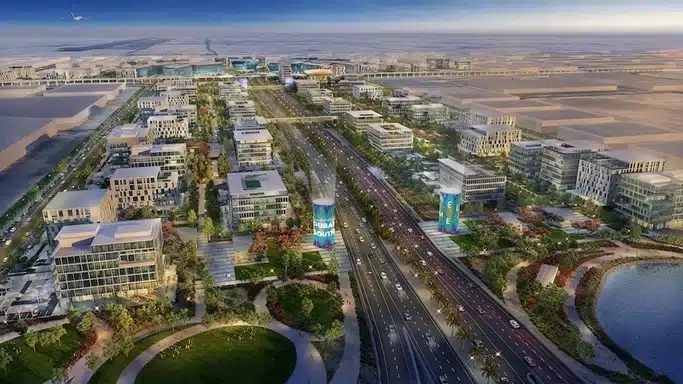
Within this broader corridor story, HAYAT by Dubai South carries a specific additional insulation that many observers have underweighted: a Dh2 billion signed construction contract awarded to Mohammed Abdulmohsin Al Kharafi and Sons LLC, with Q2 2026 construction confirmed and initial phases targeting 2028 delivery.
In a market environment where geopolitical uncertainty causes buyers to ask hard questions about whether announced projects will actually get built, HAYAT has already answered the most important one. A master developer does not issue a two-billion-dirham contract as a confidence signal — they issue it because engineering approvals are complete, escrow structures are in place, and contractor mobilisation has been funded.
For buyers who understand how to protect themselves when assessing off-plan delivery risk, the contract represents the clearest available evidence of execution intent. It materially separates HAYAT from the broader landscape of projects that remain at the concept stage during a period when buyer scrutiny of developer credibility is at an all-time high.
| Investment Risk Factor | Generic Off-Plan Project | HAYAT — Dubai South Corridor |
|---|---|---|
| Infrastructure anchor | Often speculative or planned | Dh128B airport expansion in execution |
| Construction contract | May not yet exist at launch | Dh2B contract signed March 2026 |
| Construction start | Unconfirmed or developer estimate | Q2 2026 confirmed |
| Demand composition | Varies widely | Multi-segment: logistics, aviation, families |
| Geopolitical exposure | Dependent on project type & location | Airport corridor insulated from tourism shocks |
| Dubai 2040 alignment | May or may not be designated zone | Explicitly identified priority growth corridor |
| Entry price vs Downtown | Variable | ~60–70% below prime central Dubai pricing |
The Counterintuitive Argument: Geopolitical Fear Creates the Entry Window
For the investor with a three-to-five-year time horizon, the logic inverts further. Geopolitical uncertainty does not just fail to undermine the Dubai South airport corridor property 2026 thesis — it actively creates a favourable entry environment. When sentiment pauses and buyer competition eases, the pricing advantage available to a decisive buyer is larger than during periods of peak confidence.
The historical record is unambiguous. Buyers who entered Dubai during the 2020 COVID shock, the 2022 Russian capital flight period, and the 2015 oil price correction all outperformed those who waited for clarity. The off-plan prelaunch pricing advantage that early HAYAT buyers accessed in 2025 is now compounding on the back of contracted construction, and the geopolitical pause has simply meant fewer competing buyers at the table while the asset’s fundamental case strengthens.
Experienced buyers who understand how Dubai real estate infrastructure mega-projects drive off-plan hotspot pricing recognise that the window between contract award and 30 percent construction completion is historically the highest-return entry period — and that window is exactly where HAYAT sits right now.
What Long-Term Buyers Should Focus on Instead of Headlines
The appropriate framework for evaluating a Dubai South airport corridor investment in 2026 is not the daily news feed. It is a checklist of structural questions that determine whether the underlying thesis is intact:
| Evaluation Question | HAYAT Status |
|---|---|
| Is the airport expansion still funded and committed? | Yes — Dh128B approved; construction underway |
| Is the construction contract in place? | Yes — Dh2B contract signed, Q2 2026 start |
| Does Dubai 2040 still designate this as a priority zone? | Yes — confirmed by Dubai South CEO Nabil Al Kindi |
| Is the D33 Economic Agenda still operational? | Yes — no policy reversal |
| Are rental yields in Dubai South still above average? | Yes — approx. 7.6% gross, above city-wide average |
| Is entry pricing still competitive vs established districts? | Yes — AED 800–1,200 per sq ft vs AED 3,000+ Downtown |
| Is the RERA escrow framework protecting buyer funds? | Yes — mandated by law for all off-plan sales |
| Has the demand composition (logistics, aviation, families) changed? | No — all segments intact |
Every one of these structural markers remains green. Short of a scenario in which the UAE government abandons the airport expansion, rewrites the 2040 Master Plan, and dissolves its free zone framework simultaneously — none of which has occurred or shown any sign of occurring — the airport corridor property thesis is intact. Regional noise does not move any of these indicators.
Buyers who want to understand their full financing and payment plan options in light of current market dynamics should review the guide to mortgage versus cash financing for Dubai off-plan properties — a particularly relevant analysis during periods when motivated sellers and competitive developer incentives are both in play.
The Corridor Thesis Is Intact, The Entry Window Is Open.
War headlines will keep arriving. The Dh128 billion airport will keep being built. The Dubai South airport corridor property 2026 investment case — anchored by contracted construction, government infrastructure commitment, and a demand base that does not depend on regional tourism — will keep compounding. The only question is whether you act during the fear or after it has cleared and the entry window has closed.
Fill out the enquiry form on prelaunch.ae today to receive personalised guidance on available units at HAYAT by Dubai South, current payment plan structures, and how to position your portfolio for the corridor opportunity before construction reaches the 30 percent milestone.
Contact Us:
Phone: (+971) 52 341 7272
Email: [email protected]
Frequently Asked Questions
Q: Does proximity to an airport increase or decrease geopolitical risk for property buyers?
For properties near Al Maktoum International Airport specifically, proximity increases long-term demand visibility. The airport is the anchor of a Dh128 billion government infrastructure commitment, creating tenant and buyer demand from aviation, logistics, and business sectors that are not dependent on short-term tourism sentiment.
Q: How has Dubai property historically performed during regional conflict?
Dubai’s real estate market has followed a consistent pattern across every major regional shock since 2001: an initial transaction slowdown of 48 to 72 hours to several weeks, followed by recovery and — in several cases, such as 2022 — accelerated capital inflows from conflict-affected jurisdictions into Dubai as a regional safe haven.
Q: What makes the Dubai South airport corridor specifically resilient?
The corridor’s demand is composed primarily of logistics professionals, aviation sector workers, free zone employees, and families choosing the area for schools and lifestyle amenities. These groups are structurally different from tourism-dependent demand and are not materially affected by short-term geopolitical headline risk.
Q: Is HAYAT by Dubai South still a good investment in 2026, given current tensions?
The structural case — a Dh2 billion signed contract, Q2 2026 construction confirmed, Dh128 billion airport expansion underway, and explicit Dubai 2040 Master Plan designation — is unchanged by regional tensions. If anything, the sentiment pause creates a more favourable entry environment for buyers with a multi-year horizon.
Q: What is the current rental yield at Dubai South?
Dubai South residential properties are currently delivering gross rental yields of approximately 7.6 percent, which is above the city-wide average and reflects strong underlying rental demand from the corridor’s diverse occupant base.
Q: When will Al Maktoum International Airport be fully operational?
Phase one targets capacity for 150 million passengers per year by the early 2030s. The ultimate capacity of 260 million passengers is projected for full completion not before 2035–2050 in phased stages. Emirates airline is expected to fully transfer all operations from Dubai International Airport once phase one is complete.