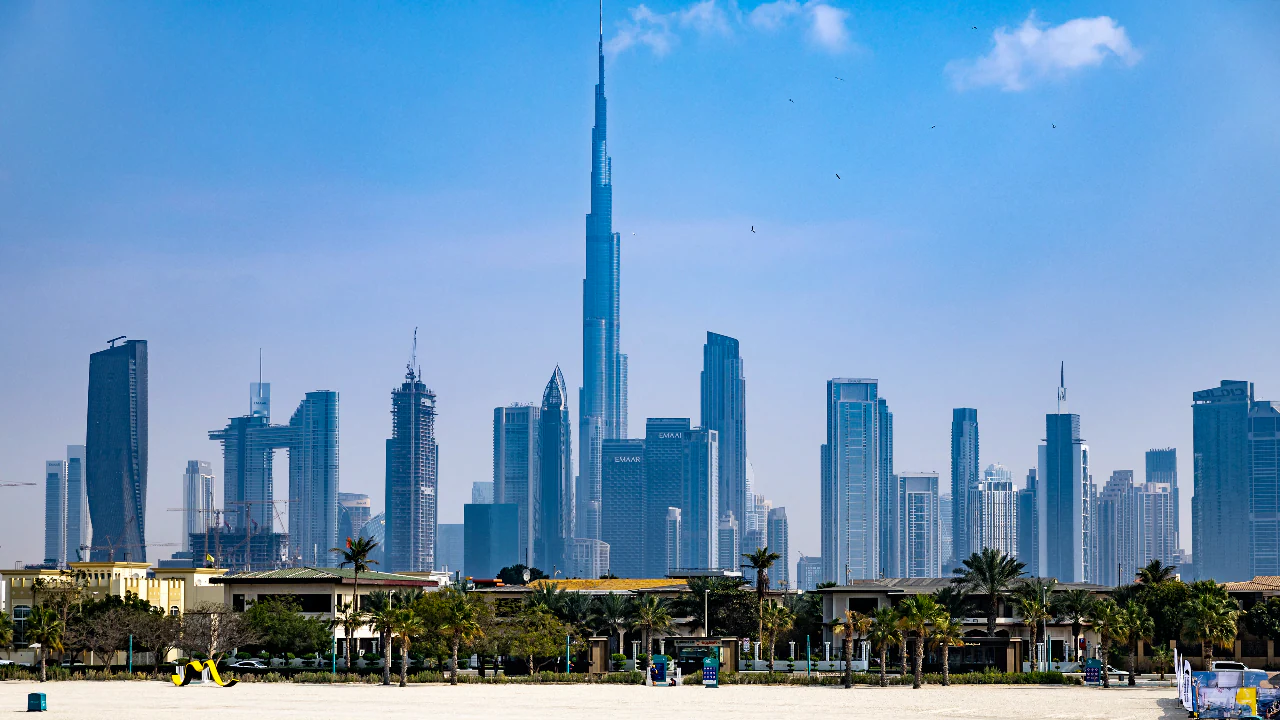
Some cities build for the moment. Dubai builds for the century. When DMCC announced in early 2026 that the next phase of its Uptown Dubai master plan would centre on a 600-metre-plus supertall tower — one of only a handful in the world — it sent a signal that no economic dashboard can replicate. It told the world: we are not flinching. We are planning decades ahead, and we expect you to do the same.
At a time when the US-Israel-Iran conflict has rattled Gulf markets and tested investor nerves, that kind of long-range institutional confidence is more than architectural ambition. It is a masterclass in how a city communicates its future.
What Is the Uptown Dubai 600-Metre Tower?
In March 2026, Ahmed Bin Sulayem, Executive Chairman and CEO of DMCC, officially announced the next evolution of the Uptown Dubai district: a mixed-use supertall tower exceeding 600 metres in height, placing it in one of the rarest categories of structures ever built. The tower will form Phase 3 of the Uptown master plan, following the completed 340-metre Uptown Tower (Phase 1) and ongoing residential and office developments in Phase 2.
To put the scale in context, here is how Uptown’s new tower compares with global benchmarks:
| Tower | City | Height | Type |
|---|---|---|---|
| Burj Khalifa | Dubai | 828 m | Mixed-use |
| Merdeka 118 | Kuala Lumpur | 679 m | Mixed-use |
| Uptown Dubai (planned) | Dubai | 600+ m | Mixed-use |
| Burj Azizi (planned) | Dubai | 725 m | Mixed-use |
| Existing Uptown Tower | Dubai | 340 m | Mixed-use |
The proposed tower will feature Grade A commercial offices, ultra-luxury residential units, and a high-end boutique hotel — a configuration that mirrors the district’s existing LEED Gold-certified Uptown Tower, which today houses 24,000-plus DMCC-registered companies and the acclaimed SO/ Uptown Dubai hotel. The Plaza, a 21,000 sqm open-air entertainment space capable of hosting 5,000 guests, has already been opened, and One Uptown Place and Two Uptown Place, totalling 70,000 sqm of premium office space, are under construction. The 600-metre tower is the crown jewel that ties it all together.
For investors considering Dubai off-plan property investment, this masterplan is precisely the kind of anchor infrastructure that drives sustained capital appreciation around it.
Mega-Vision Planning: Why It Matters More Than Market Noise
There is a fundamental difference between a developer building a single tower and a sovereign institution building a district across three decades. The former is a transaction. The latter is a statement of civilisational intent.
The Uptown Dubai master plan began in 2017. Phase 1, the 340-metre Uptown Tower, completed in 2023 after six years of construction. Phase 2 — Mercer House (34 and 41 storeys, ~600 units), One Uptown Place, and Two Uptown Place — is underway with a 2027 completion target. Phase 3, anchored by the 600-metre supertall, has now been announced. The planning horizon: well into the 2030s.
This phased, multi-decade commitment from DMCC — backed by Abu Dhabi’s sovereign institutional strength — is a confidence signal that the market cannot manufacture artificially. No developer announces a 600-metre tower in a city they believe will peak in five years. Mega-vision planning is the original long-term investment thesis.
The same logic applies to Dubai’s broader infrastructure agenda. The Al Maktoum International Airport expansion — projected to eventually handle 400+ gates across five parallel runways at a cost of hundreds of billions of dirhams — is designed for a 2050 completion. The Dubai Urban Master Plan 2040 targets a population of 7.8 million residents. The D33 Economic Agenda aims to double the size of Dubai’s economy before 2033 and grow real estate transaction volumes to AED 1 trillion annually.
When institutional planners think in these timeframes, long-term property investors in Dubai are simply following the city’s own logic.
The Numbers Behind Dubai’s Long-Term Investment Case
Dubai’s real estate market fundamentals in 2026 remain structurally compelling, even accounting for short-term geopolitical disruption. The data tells a layered story:
| Metric | Figure | Source |
|---|---|---|
| 2025 total real estate transactions | AED 917 billion (~$250 bn) | Dubai Land Department |
| 2025 transaction volume | 270,000+ deals (record) | DLD / Anarock |
| Jan 2026 residential transactions | AED 55.18 billion (+43.9% YoY) | Dubai Land Department |
| Feb 2026 residential transactions | AED 45.39 billion (+9.59% YoY) | DLD |
| Average gross rental yield 2026 | 6.7% – 9% annually | Knight Frank / Global Property Guide |
| UAE GDP growth 2026 (projected) | 5.0% (highest in GCC) | International Monetary Fund |
| Dubai population (2025) | Surpassed 4 million residents | Dubai Statistics Center |
| Cash buyers share of transactions | ~86% (Q1–Q3 2025) | Knight Frank |
Compare those yields — 6.7% to 9% annually — against London (2–3%), New York (2–4%), or Hong Kong (2–3%), and the structural advantage of Dubai property investment becomes self-evident. Add zero personal income tax, zero capital gains tax, and a 10-year UAE Golden Visa available to investors purchasing AED 2 million or more in real estate, and the case for staying — not just visiting — becomes compelling.
For a deeper dive into pre-launch opportunities that let investors lock in today’s prices before appreciation, see our guide to off-plan Dubai property trends in 2025 and beyond.
The War Factor: When Headlines Test Conviction
No honest assessment of Dubai’s investment environment in early 2026 can ignore the elephant in the room: the US-Israel-Iran conflict, which escalated dramatically in late February 2026 when coordinated strikes on Iranian nuclear and military infrastructure prompted retaliatory drone and missile attacks across Gulf states, including the UAE.
The facts, as they currently stand, are these:
- The DFM Real Estate Index (DFMREI) fell approximately 21% from its February 27 peak of 16,910 points to 13,353 by March 9, 2026 — though it is critical to note this measures developer equities, not direct property transaction prices.
- Drone debris impacted areas near Dubai International Airport, the Burj Al Arab, and Palm Jumeirah. The Dubai stock exchange was closed for two sessions.
- Between late February and late March 2026, total property sales dipped, with some reports indicating approximately 8,059 deals in that window — below typical early-year momentum — and average property prices off around 4–5%.
- Fitch Ratings had already forecast a potential price correction of up to 15% in 2025–2026 due to supply increases — the conflict may accelerate near-term softening in some segments.
And yet. Critically: demand has not disappeared — it has reorganised.
High-net-worth individuals from conflict-adjacent countries are actively securing Dubai property as a contingency asset. Off-plan sales from regional buyers remained active through February 2026. Israeli investors who entered post-2020 Abraham Accords — attracted by Dubai prices roughly half of Tel Aviv equivalents while delivering superior yields — remain present in the market. South Asian buyers from India and Pakistan continue to drive significant volumes. In January 2026, ultra-luxury properties above AED 10 million recorded 990 transactions alone.
History is instructive. Dubai’s property market absorbed the 2008 global financial crisis. It recovered from the Arab Spring. It turned COVID-19 — a global catastrophe — into the most extraordinary real estate boom in its history, with prices rising 60% between 2022 and early 2025. Investors who looked past the fear in 2020 are counting those returns today.
The UAE’s response to the conflict has also been measured: Abu Dhabi maintained active diplomatic channels with both Israel and Iran, and the UAE’s air defense systems intercepted over 95% of incoming threats, with no major real estate assets or construction sites suffering direct damage. The port of Jebel Ali — which generates 60% of the emirate’s revenue — was operating at full capacity within four days of initial strikes.
That is not luck. That is infrastructure resilience built across decades — the same kind of institutional durability that a 600-metre tower in Uptown Dubai represents.
For context on how Dubai’s real estate market has historically navigated oversupply and global uncertainty, our analysis provides a thorough breakdown of the structural demand drivers.
Why Staying Long-Term Is the Strategy — Not the Hedge
The short-term investor watching the news today sees volatility. The long-term investor watching Uptown Dubai’s master plan sees a district in Phase 2 of 3, with its defining architectural statement — a 600-metre megatall — yet to break ground. These are not the same investment.
Consider the case for long-term residency in Dubai alongside property ownership. The UAE Golden Visa program ties a 10-year renewable residency directly to a AED 2 million property investment. In 2026, eligibility has been extended to off-plan investors from approved developers the moment their purchase reaches the threshold — meaning buyers of pre-launch Dubai property can begin their residency journey before handover.
This changes the calculus entirely. A long-term Dubai resident is not speculating on a market. They are building a life — and a life that a 600-metre tower, a 21,000 sqm plaza, 70,000 sqm of Grade A offices, and a sovereign-backed master plan will serve for generations.
For those evaluating the pre-launch booking and EOI process in Dubai, securing entry before the broader market absorbs this infrastructure story is precisely the early-mover advantage that consistently generates the strongest returns in Dubai’s property cycles.
The D33 Agenda targets AED 1 trillion in annual real estate transactions by 2033 — roughly 10% growth per year from today’s AED 917 billion record. A city that builds 600-metre towers is a city that intends to meet that target.
Uptown Dubai vs Other Major Investment Corridors in 2026
| Investment Location | Avg. Gross Yield | Capital Gains Tax | Long-Term Visa | Key Risk |
|---|---|---|---|---|
| Dubai (Uptown / DMCC) | 6.7–9% | 0% | Yes (Golden Visa) | Supply pipeline (manageable) |
| London, UK | 2–3% | Up to 28% | Complex | High entry cost, Brexit friction |
| New York, USA | 2–4% | Up to 30% | Complex | Property taxes, regulation |
| Hong Kong | 2–3% | 15% stamp duty | Limited | Political risk |
| Dubai South / Expo City | 6–8% | 0% | Yes (Golden Visa) | Emerging area maturation time |
As global investors shift capital away from high-tax, low-yield European and North American markets, Dubai real estate for long-term investors occupies a unique position: high yield, zero tax, sovereign-backed mega-infrastructure, and a residency pathway that turns investment into lifestyle.
Our guide to upcoming Dubai projects and handover timelines from 2025 to 2028 covers the specific developments entering the market and how to time entry for maximum capital appreciation.
The Off-Plan Advantage in a Mega-Vision Market
When a district announces a 600-metre anchor tower, surrounding property values do not wait for the tower to be built. They price in the vision. Investors who secure off-plan properties near Uptown Dubai — in JLT, Dubai Marina, and the emerging DMCC business corridor — today are buying before that re-rating is fully absorbed.
The off-plan market in Dubai continues to dominate: off-plan transactions accounted for 71.27% of activity in January 2026. Developers have responded with flexible payment structures — 60/40, 80/20, and post-handover plans — that allow buyers to enter with 10–20% upfront. The result is a leverage-efficient route to Dubai’s compounding capital growth story.
In the luxury segment, the supply-demand dynamic is particularly favourable: analysts at ValuStrat project luxury villas and townhouses — less than 20% of Dubai’s housing stock — will outperform the wider market significantly, with prices forecast to rise 17.7% in 2026 even amid broader supply increases.
For investors seeking to understand the full landscape of the hottest off-plan projects and pre-launch opportunities in Dubai, our curated research cuts through the noise to identify where the genuine value lies.
Also relevant for investors seeking entry points with strong long-term growth potential: Dubai South’s projected 35–45% growth corridor, backed by Al Maktoum Airport’s expansion, represents a complementary thesis to Uptown’s commercial dominance.
Frequently Asked Questions
Q: How tall will the new Uptown Dubai tower be?
DMCC has confirmed the tower will exceed 600 metres, placing it among a very select few structures worldwide at this height category (classified as megatall). Precise final height and timeline are yet to be officially released.
Q: Is Dubai safe to invest in real estate during the US-Israel-Iran conflict in 2026?
Short-term sentiment has been impacted, with transaction volumes dipping and developer equities falling ~21% from their peak. However, physical property prices have declined only 4–5%, cash buyers dominate at ~86% of transactions, and long-term fundamentals — yields of 6.7–9%, zero taxes, Golden Visa, and sovereign-backed mega-infrastructure — remain intact. Every major crisis since 2008 has been followed by a stronger Dubai market for patient investors.
Q: What is the UAE Golden Visa, and how does real estate qualify?
The UAE Golden Visa is a 10-year renewable residency visa available to investors who purchase AED 2 million or more in real estate. In 2026, eligibility extends to off-plan buyers from approved developers, allowing residency applications to begin before handover.
Q: What are the typical rental yields in Dubai vs. other global cities?
Dubai consistently delivers gross rental yields of 6.7% to 9% annually — two to four times the yields available in comparable prime property in London, New York, or Hong Kong — with zero personal income tax and zero capital gains tax on returns.
Q: What is the Uptown Dubai master plan, and what phases are complete?
Phase 1 delivered the 340-metre Uptown Tower (completed 2023), The Plaza (21,000 sqm, opened February 2026), and the SO/ Uptown Dubai Hotel. Phase 2 includes Mercer House (~600 residential units, targeted 2027) and One and Two Uptown Place (~70,000 sqm offices). Phase 3 is the announced 600-metre supertall tower.
Q: How do I invest in off-plan property in Dubai before launch?
The Expression of Interest (EOI) process allows buyers to register serious intent with a refundable deposit — typically AED 10,000 to 5% of unit value — securing priority access and preferred unit selection before public launch. Our team at Prelaunch.ae manages this process end-to-end.
Ready to Position for the Long Term?
The 600-metre Uptown Dubai tower is not just a building. It is the most vivid declaration of where this city is headed — and it is going there with or without hesitant investors. The question is whether you will be on board.
Whether you are looking for a Dubai off-plan investment, exploring the UAE Golden Visa through property, or seeking a long-term base in one of the world’s most dynamic cities, Prelaunch.ae gives you exclusive early access to the opportunities that matter.
Fill out the form on our website at prelaunch.ae, and our expert team will reach out with curated opportunities tailored to your goals.
Contact us directly: (+971) 52 341 7272 | [email protected]
Do not let short-term headlines overwrite a decade-long master plan. Dubai is thinking in centuries. Are you thinking in years?