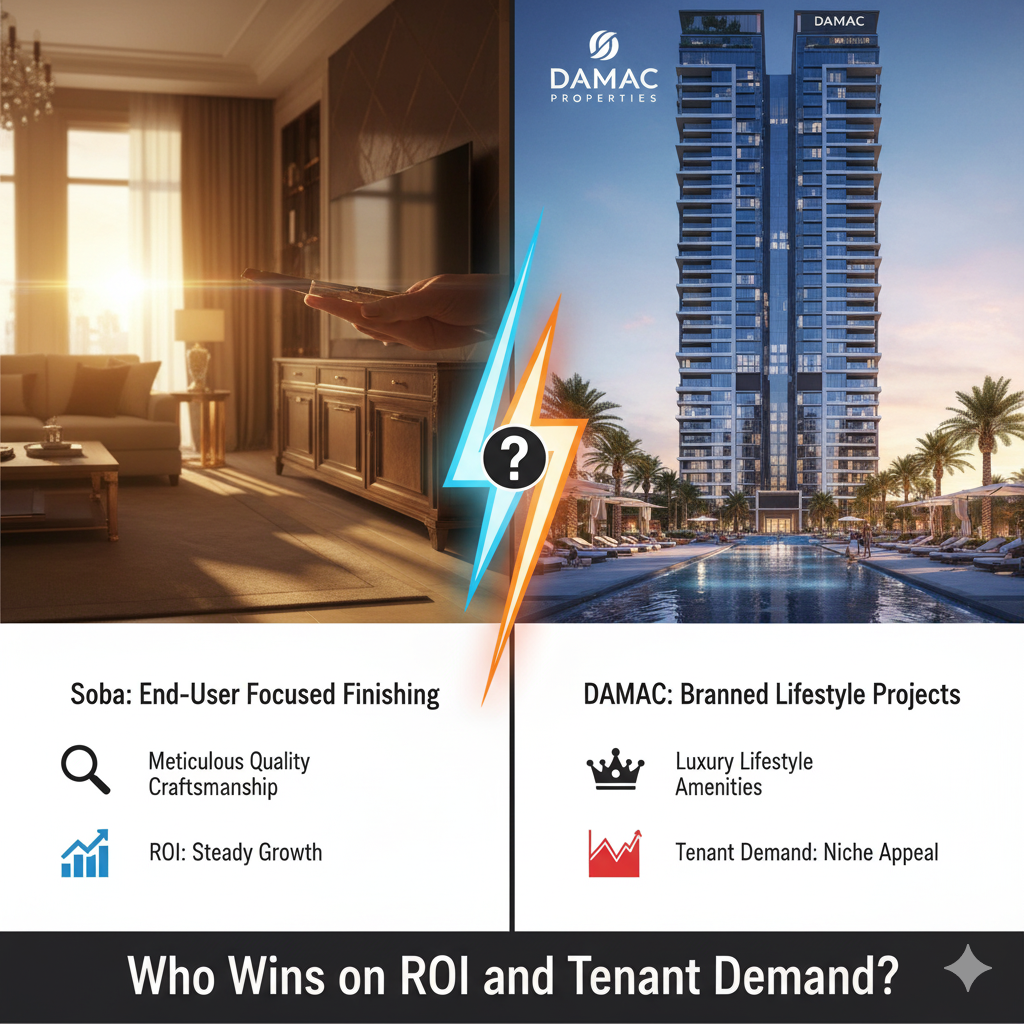
In the upper mid to premium segment of Dubai real estate, two developers are constantly on investor shortlists: Sobha Realty and DAMAC Properties. Both are powerful brands, but they play very different games:
- Sobha focuses on end-user quality, in-house construction, and gated master communities such as Sobha Hartland.
- DAMAC is synonymous with branded lifestyle projects, golf communities and high-visibility towers like DAMAC Hills, DAMAC Lagoons, and Aykon City.
For investors asking which brand delivers better ROI, rental yields, and tenant demand, a side-by-side look at the data is essential. Below is a neutral, fact-based breakdown of Sobha vs DAMAC for 2025.
1. Developer overview: positioning and scale
| Factor | Sobha Realty | DAMAC Properties |
| Core identity | End-user focused finishing, craftsmanship, master communities | Branded lifestyle developer, strong marketing, themed projects |
| Flagship Dubai communities | Sobha Hartland, Sobha Hartland II, Sobha Reserve | DAMAC Hills, DAMAC Hills 2, DAMAC Lagoons, Aykon City |
| 2024 sales (Dubai & UAE) | ~AED 23B, ~50% YoY growth | Large private backlog; strong sales across villas, townhouses, towers |
| Product positioning | Gated, green, premium to luxury | Mid-market to luxury with strong emphasis on amenities & branding |
| Typical buyer | End-users and HNW investors seeking build quality & serenity | Yield-driven investors, lifestyle buyers, branded-residence seekers |
Sobha Realty has publicly reported record-breaking 2024 sales of around AED 23 billion, with ~50% year-on-year growth, underscoring strong demand for its premium communities and new island projects.
DAMAC is privately held, but independent market reports show robust transaction volumes and rental demand in DAMAC Hills and Aykon City, confirming its status as one of Dubai’s most active lifestyle developers.
2. Community-level numbers: Sobha Hartland vs DAMAC Hills & Aykon City
To understand Sobha vs DAMAC ROI, it is useful to compare their core investment communities.
2.1 Price and yield snapshot
| Community | Developer | Avg price/sq ft (approx) | Typical gross yield (approx) | Tenant profile |
| Sobha Hartland (apartments) | Sobha | ~AED 1,900–2,000 | ~6–6.6% | Families, professionals, quality-focused end-users |
| DAMAC Hills (apartments) | DAMAC | ~AED 1,200–1,250 | ~6.5–7.5% (up to 8% studios) | Families, golfers, yield-focused tenants |
| Aykon City (Business Bay) | DAMAC | ~AED 1,950–2,050 | ~6–7.5% | Young professionals, executives, STR-friendly |
Key data points behind this table include:
- Sobha Hartland: December 2024 stats show an average asking sales price of about AED 2.3M for completed 2BR units, at roughly AED 1,980 per sq ft, with an average annual rent around AED 114,000 and an average gross yield of about 6.61%.
- DAMAC Hills: 2024 resale and forecast data indicate average apartment prices around AED 1,227 per sq ft, with forecast 2025 yields of 7–8% for studios, 6.5–7.5% for 1BR, and 6–7% for 2BR units.
- Aykon City (Business Bay): 1BR units have recent median prices around AED 1.4–1.5M at roughly AED 2,000 per sq ft, while rental indices show 1BR annual rents near AED 100,000–105,000, implying mid- to high-6% yields.
Against an average UAE gross rental yield of about 5.45%, and city averages of 6–7% for apartments, all three submarkets are competitive – with DAMAC Hills and Aykon City slightly ahead on headline yield, and Sobha Hartland stronger on perceived quality.
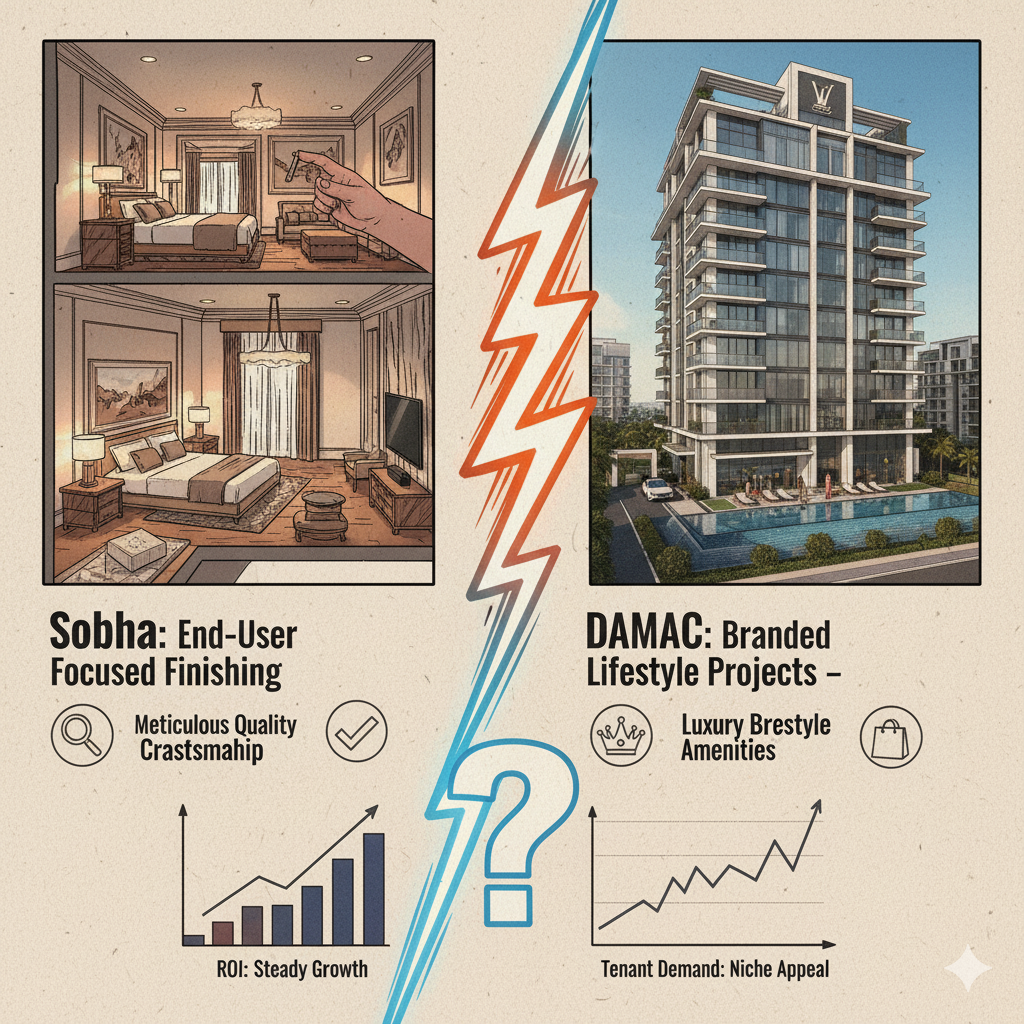
3. End-user focused finishing vs branded lifestyle
Sobha: quality-first, end-user orientation
Sobha’s brand promise is built around:
- Backward-integrated construction (in-house joinery, MEP, etc.).
- High-quality finishes in kitchens, wardrobes, bathrooms, and lobby/common areas.
- Gated, green master-planned layouts with strong landscaping and community feel.
In practice, Sobha Hartland appeals to tenants and buyers who put a premium on:
- Quiet surroundings close to, but not inside, Downtown and Business Bay.
- A “European-style” finish and consistent specification across towers.
- Long-term living rather than short-term stays.
For end-user families, this creates lower tenant churn and a higher likelihood of multi-year leases, which supports long-term cash flow stability.
DAMAC: branded lifestyle and amenity-heavy communities
DAMAC’s edge lies in:
- Branded lifestyle projects (e.g., Cavalli, Fendi), golf-course communities and lagoon concepts.
- Highly amenitised projects with resort-style pools, clubhouses, retail, and themed landscaping.
- Strong marketing, often targeting investors globally with clear ROI narratives.
In DAMAC Hills and Aykon City, this leads to:
- Strong appeal among young professionals, golfers, and lifestyle-focused tenants.
- Good short-term and long-term rental demand, particularly for well-furnished, view-heavy units.
- A perception of “holiday-living” that can translate into above-average yields in certain unit types.
4. ROI analysis: who comes out ahead?
Gross yield vs. net comfort
On paper, DAMAC often leads on headline gross yields in its core apartment products:
- DAMAC Hills studios and 1BR units can hit 7–8% gross yields when purchased at sensible price points.
- Aykon City yields in the 6–7.5% range are common when units are well-priced and efficiently furnished.
Sobha Hartland typically delivers 5.8–6.6% gross yields, slightly lower on average but underpinned by:
- Higher perceived build quality.
- Strong, stable end-user and executive tenant base.
- Lower risk of “race to the bottom” on rents, as the community attracts a specific quality-focused profile.
For investors focused purely on maximum yield, DAMAC Hills and Aykon City usually have the edge. For investors who prioritise tenant quality, reduced maintenance disputes, and long-term hold comfort, Sobha Hartland is often preferred.
Capital appreciation potential
Looking ahead:
- Dubai-wide, analysts expect 5–7% annual price growth in the medium term, driven by population growth, Golden Visa demand, and constrained prime supply.
- Premium master communities and branded lifestyle projects should both benefit, but in different ways:
- Sobha’s value case leans on quality, scarcity of similar gated stock near Downtown, and its rising brand equity.
- DAMAC’s case leans on ongoing activation of golf, lagoon, and branded projects, plus strong mid-market demand for high-amenity living.
In a downturn scenario, Emaar and Sobha-type quality communities often hold better, while yield-focused branded stock can experience more volatility. However, well-bought units in DAMAC Hills and Aykon City can offer strong upside from lower entry prices.
5. Tenant demand: who attracts and keeps better tenants?
Both developers benefit from Dubai’s robust fundamentals: rapid population growth, high inbound migration, and strong demand for both apartments and villas in 2024–2025.
- Sobha Hartland tenants:
- Senior professionals and families working in Business Bay, DIFC, and Downtown.
- Tenants who care about layout, finishing, and community quietness.
- More inclined to sign multi-year leases and treat the property as a “home”.
- DAMAC Hills tenants:
- Families and professionals attracted by golf, greenery, and value vs. other villa/apartment communities.
- Good mix of long-term residents and some flexible shorter stays, especially in furnished units.
- Aykon City tenants:
- Young professionals, executives, and tourists want Business Bay / Canal proximity.
- Strong short-stay and mid-stay demand for Dubai Canal view apartments.
In terms of tenant demand depth, DAMAC wins on the diversity of its communities and the sheer number of units across multiple price brackets. In terms of tenant quality and stability, Sobha often has the edge, particularly in Hartland’s mid- to upper-tier stock.
Conclusion: Sobha vs DAMAC – which wins for you?
In the Sobha vs DAMAC debate, the “winner” depends on your definition of long-term value:
- Choose Sobha if you prioritise:
- End-user focused finishing and construction quality.
- Gated, green master communities like Sobha Hartland.
- Stable, higher-quality tenants and a more “home-first” profile.
- Choose DAMAC if you prioritise:
- Branded lifestyle projects with strong marketing and amenity sets.
- Higher headline yields in communities like DAMAC Hills and Aykon City.
- Flexibility between long-term and short-term rentals and a wider range of ticket sizes.
A balanced portfolio for 2025–2030 could reasonably include both:
- One Sobha Hartland unit is a quality-led, end-user-friendly hold.
- One DAMAC Hills or Aykon City unit is a yield and lifestyle-driven asset.
To understand which mix fits your budget, risk profile, and goals:
- Visit prelaunch.ae and fill up the form so our team can send you a customised shortlist of Sobha and DAMAC options with updated prices, payment plans, and projected ROI.
- Or contact us directly at:
Phone: (+971) 52 341 7272
Email: [email protected]
Our advisors can walk you through real, current listings in Sobha Hartland, DAMAC Hills, DAMAC Lagoons, and Aykon City, including rental comps, service charges, and exit strategies, so you can choose the right developer for your long-term Dubai real estate investment.
Frequently Asked Questions (FAQs)
1. Is Sobha or DAMAC better for pure rental yield?
In many cases, DAMAC Hills and Aykon City show slightly higher headline yields (especially studios and 1BRs), so DAMAC often wins on pure gross yield. However, Sobha Hartland can still deliver competitive yields around 6–6.5% while offering stronger perceived quality and more stable tenants.
2. Which developer is better for end-users planning to live in the property?
If you value finishing, quiet gated communities and greenery, Sobha Hartland is often preferred by end-users. If you want a more “active” lifestyle with golf, lagoons or central city living, DAMAC Hills or Aykon City under DAMAC may be more suitable.
3. Are DAMAC branded projects good for short-term rentals?
Yes. Communities like DAMAC Hills (holiday-style living) and Aykon City (Business Bay / Canal location) work well for both short-stay and long-stay strategies, provided building regulations and permits allow holiday homes and the unit is furnished appropriately.
4. Does Sobha’s higher build quality really matter for ROI?
Over time, solid construction and better finishes can mean fewer maintenance issues, higher tenant satisfaction, and more resilient resale prices. For investors with a 7–10+ year horizon, this can contribute meaningfully to long-term value, even if initial yields are marginally lower than some DAMAC segments.
5. How should a first-time investor decide between Sobha and DAMAC?
Start with your priority:
- If your focus is stable, high-quality tenants and long-term hold, prioritise Sobha Hartland apartments for sale.
- If your focus is higher headline yields and lifestyle branding, look at DAMAC Hills and Aykon City apartments for investment.
Then narrow down based on budget, financing, and whether you plan to use the property personally or purely as a rental asset.