By the time drone debris landed near Dubai International Airport in late February 2026, triggering the most serious test of Dubai’s safe-haven reputation in living memory, the city’s off-plan property market was already carrying a question that serious investors had been sitting with for months: in a market where 65% of all transactions are off-plan, how do you tell the difference between a launch that will deliver and one that is merely well-marketed?
The US-Israeli strikes on Iran on 28 February 2026, followed by Iranian retaliatory missile and drone attacks that struck civilian infrastructure across the Gulf — including intercepted strikes near Dubai airport, the Burj Al Arab, and Palm Jumeirah — compressed that question into urgency. The Dubai Financial Market is temporarily closed. The real estate index shed more than 15% in a single week. Transaction volumes between late February and 22 March dipped significantly from typical early-year momentum, with approximately 8,059 sales recorded over that window. Average prices softened 4–5% in sentiment-sensitive segments.
And yet: Dubai recorded 3,570 property sales worth AED 11.93 billion in just the first week of March 2026 alone. High-net-worth buyers continued registering transactions above AED 100 million during the conflict period. Demand did not collapse. It reorganised. The buyers who kept moving were those who had a framework for evaluating launches that went beyond brand reputation and render quality. They were looking at something much more specific: construction completion rates. And one company had just handed them a masterclass.
Dubai Investments PJSC: The Company and What It Just Disclosed
Dubai Investments PJSC (DFM: DIC) is a publicly listed, diversified investment group managing a portfolio across real estate, manufacturing, and financial investments. Its real estate subsidiary, Dubai Investments Real Estate Company (DIRC), established in 2006, has built a track record across residential, commercial, and industrial assets in Dubai, Abu Dhabi, and Sharjah. As of March 2026, the Group reports total assets of AED 23.28 billion and equity attributable to shareholders of AED 14.90 billion — a financial base that matters enormously for delivery credibility.
In March 2026, Dubai Investments published a construction progress update across its active development pipeline that was remarkable not for what it announced, but for its specificity. Rather than the vague ‘construction progressing well’ language that characterises most developer communications, DIRC disclosed exact percentage completion figures — project by project — at a moment when the broader market was operating under significant geopolitical stress. That decision was not accidental. It was a statement of institutional confidence directed squarely at buyers who know how to read the signal.
The Completion Rate Dashboard: What DIRC Disclosed in March 2026
| Project | Location | Completion % | Target Handover | Status Note |
| Violet Tower | Jumeirah Village Circle (JVC) | 57.61% | Q4 2026 | On track — construction progressing steadily |
| Asayel Avenue | Mirdif Hills Master Community | 28.47% | Q2 2027 | Construction commenced Q2 2025, progressing to plan |
| Al Vista | Meydan | 100% enabling works | Q1 2028 | Enabling phase complete, main construction advancing |
| Danah Bay Apartments | Al Marjan Island, RAK | Advanced stage | H2 2026 onwards | Handover activities already underway |
These are not marketing claims. They are RERA-aligned, publicly disclosed progress figures released by a listed company under continuous disclosure obligations. Under Dubai’s Law No. 8 of 2007 and the RERA 2025 framework, developers must submit progress reports via the official digital portal, with escrow fund releases tied to independently verified construction milestones. What Dubai Investments disclosed goes beyond regulatory minimum — it is the kind of granular transparency that separates institutional-grade developers from those who communicate in adjectives.
For investors in Violet Tower, the 57.61% completion figure in March 2026 — targeting a Q4 2026 handover — means that for every AED paid on a milestone linked to a construction phase up to 57%, the corresponding work is provably done. That is not a promise. It is an audit trail.
Why the Iran-US-Israel Conflict Made Completion Rates the Primary Trust Signal
Before the late February 2026 escalation, Dubai’s off-plan market was navigating a subtler uncertainty: a mature bull market, early signs of price moderation in premium segments, and a supply pipeline of 120,000 planned handovers in 2026 — of which analysts estimated the actual delivery rate would be closer to 60,000–70,000 units, based on 2025’s pattern of shortfall against announced targets. In that environment, delivery credibility was already becoming the differentiating factor between developer tiers.
The conflict — which killed Iran’s Supreme Leader Ali Khamenei in US-Israeli coordinated strikes and prompted retaliatory attacks on Gulf infrastructure — dramatically accelerated that shift. Buyers who had been willing to evaluate off-plan launches primarily on yield projections and location narratives suddenly needed a more stress-tested filter. In a market where sentiment can move faster than fundamentals, the question became: if conditions worsen further, which developers have the financial depth, the institutional structure, and the proven execution discipline to keep building?
The answer pointed unmistakably toward publicly listed developers with audited financials, active construction sites, and government-verified progress data — precisely the profile that Dubai Investments’ March 2026 disclosures represent. The broader investor behaviour shift was confirmed in reporting by The National, where Springfield Properties CEO Farooq Syed noted that while short-term sentiment fluctuated, interest from buyers remained active — but those buyers were applying far more scrutiny to developer track records before committing.
Dubai has navigated this pattern before. After every geopolitical stress event — the Arab Spring, COVID-19, the Russia-Ukraine war — the buyers who paused and then re-entered were rewarded. Investors who bought during the mid-2020 dip saw property values increase by more than 60% within two years. The conflict of 2026 is, by structural analogy, another entry window — provided the buyer is positioned in launches with verifiable delivery infrastructure rather than sentiment-dependent prestige plays. The Dubai real estate market’s response to geopolitical stress follows this consistent pattern.
Building the Completion Rate Trust Framework for Off-Plan Buyers
The completion rate is not a single number. It is an input into a multi-variable framework that buyers can use to evaluate any new launch — whether by Dubai Investments or any other developer. The five variables that matter are as follows.
| Trust Variable | What to Check | Why It Matters | Where to Verify |
| 1. Published Completion % | Specific % figure, not vague language | Shows how much work is already done and de-risks your capital timeline | DIRC press releases, DLD REST app |
| 2. Escrow Account Status | Active RERA-registered escrow, approved bank | Funds released only on milestone verification — protects against misuse | DLD website, Dubai REST app |
| 3. Developer Financial Strength | Listed company, audited profit, total assets, equity base | Financially strong developers can continue building through market downturns | DFM / ADX filings, annual reports |
| 4. Handover Track Record | Previous projects delivered on time vs. delayed | Past delivery behaviour predicts future execution better than any promise | RERA project tracker, DLD records |
| 5. Milestone-Linked Payments | SPAs that tie your instalments to construction stages, not calendar dates | Means your money only moves when work is proven — aligns your risk with progress | Your Sale and Purchase Agreement |
Dubai Investments PJSC scores strongly across all five variables. Its 31% profit growth in 2025 — net profit rising to AED 1.55 billion from AED 1.21 billion — confirms that the Group has the financial resilience to complete its pipeline regardless of short-term market sentiment. Its DFM listing means quarterly disclosures are mandatory and audited. Its rental income of AED 1.19 billion in 2025 — representing 25.7% of total income — signals an income-generating asset base that does not depend on rapid off-plan sales to sustain operations. It is not a developer that needs to sell to survive. That distinction matters in a stressful environment.
RERA’s 2025 framework has tightened this system further. Developers are now required to tie escrow fund releases to AI-backed construction audits by the DLD, submit detailed progress reports, and maintain digital compliance logs accessible to buyers via the Dubai REST mobile app. This means that for the first time, a buyer in Violet Tower or Asayel Avenue can check their project’s real construction status from their phone — and compare it against what the developer is claiming. In any market, but especially in a stressed one, that transparency is foundational. The 2026 handover race and which developers deliver on time is an essential reference for applying this framework to any launch.
Applying the Framework: Project-by-Project Analysis
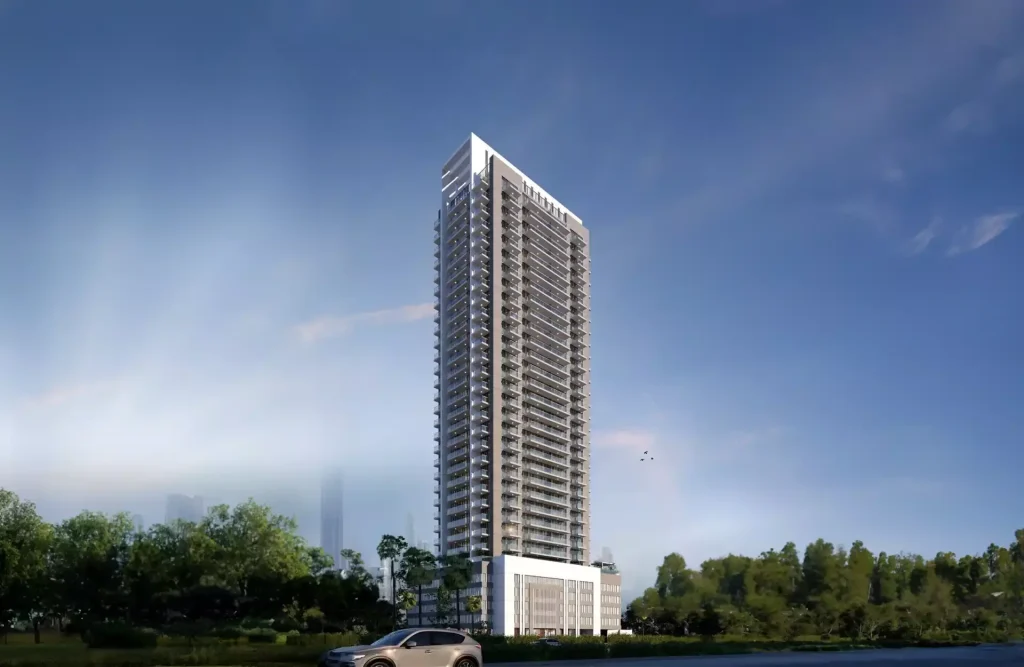
Violet Tower, JVC — 57.61% Complete, Q4 2026 Handover
With more than half of construction physically complete and a Q4 2026 handover target, Violet Tower represents the shortest remaining risk window of any active DIRC project. For buyers who have already committed, the 57.61% figure is reassuring confirmation. For investors considering JVC — one of Dubai’s highest-yielding residential districts, with average gross yields of 7–8% — it represents a near-complete asset at a pre-handover entry point. JVC has been among the most searched communities by both renters and buyers for three consecutive years.
Asayel Avenue, Mirdif Hills — 28.47% Complete, Q2 2027 Handover
As part of the larger Mirdif Hills master development — a mixed-use community integrating retail, medical, educational, and residential components — Asayel Avenue has a longer runway but a deeper community anchor. Construction commenced in Q2 2025 and has reached 28.47% in under a year, a healthy pace for a mid-scale residential project. The Q2 2027 target aligns with the community’s broader activation timeline. For investors who want a community-integrated off-plan entry point with a publicly listed developer and verifiable build progress, this is a structurally sound position.
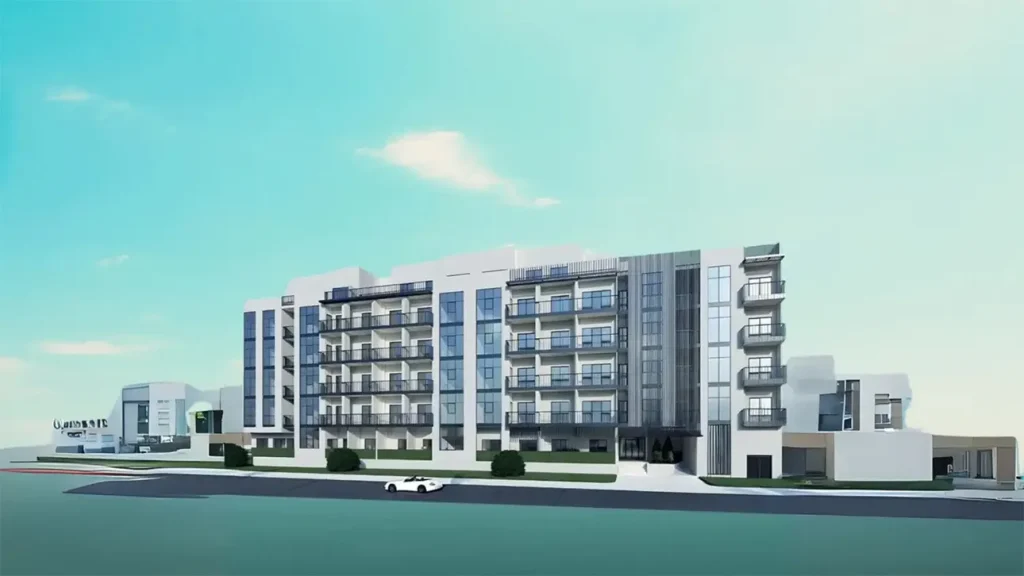
Al Vista, Meydan — 100% Enabling Works, Q1 2028 Handover
Meydan has emerged as one of Dubai’s most strategically important residential corridors — centrally located, well-connected to Downtown and Business Bay, and benefiting from the broader Mohammed Bin Rashid City master plan. Al Vista’s enabling phase — foundation preparation, ground levelling, infrastructure connections — is 100% complete, and main construction is now advancing to plan. A Q1 2028 handover means buyers have the longest capital deployment horizon of the three active projects, but also the benefit of a developer committed to a long-term pipeline in a high-value location.

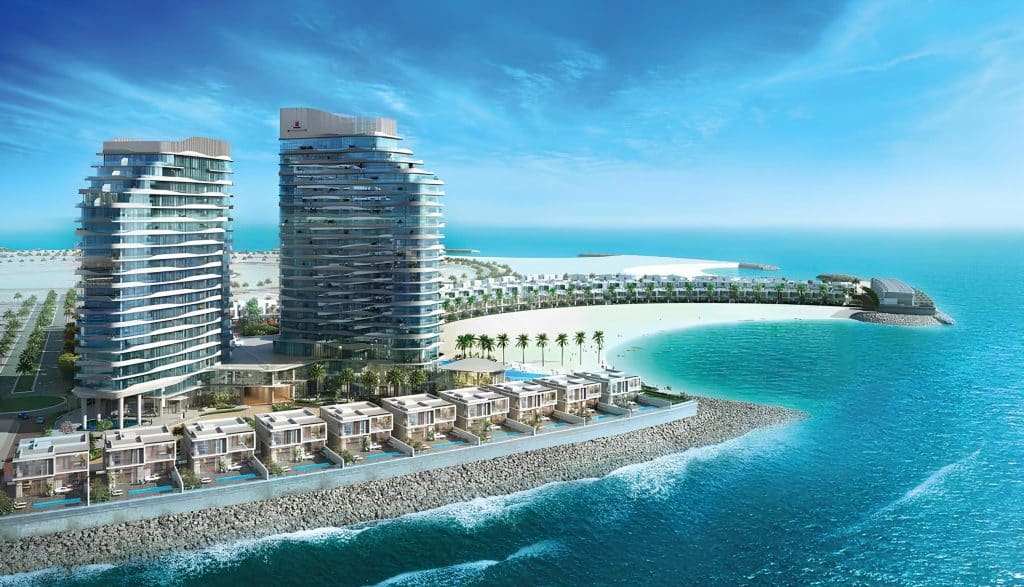
Danah Bay, Al Marjan Island, RAK
Danah Bay sits in one of the UAE’s most active investment corridors — Al Marjan Island in Ras Al Khaimah, which was anchored by the Wynn Resorts casino licence announcement and has seen some of the highest price-per-square-foot growth in the region since 2023. Handover activities are already underway for completed components, making Danah Bay the most advanced project in DIRC’s current pipeline. Buyers taking delivery in H2 2026 are entering a community that is operationally live, in a district that still has significant capital appreciation ahead as the hospitality and tourism infrastructure activates. For an overview of why RAK’s supply squeeze is creating an investor opportunity, the RAK Property Playbook 2026 is directly relevant.
What Dubai Investments Financials Add to the Confidence Framework
| Financial Metric | 2024 | 2025 | Year-on-Year Change |
| Profit Before Tax | AED 1.30 billion | AED 1.70 billion | +31% |
| Net Profit (after tax) | AED 1.21 billion | AED 1.55 billion | +28% |
| Total Income | AED 4.66 billion | AED 4.63 billion | Stable |
| Rental Income | N/A disclosed | AED 1.19 billion | 25.7% of income |
| Total Assets | AED 22.10 billion | AED 23.28 billion | +5.3% |
| Shareholder Equity | AED 14.11 billion | AED 14.90 billion | +5.6% |
| EPS | AED 0.28 | AED 0.36 | +28.6% |
| Proposed Cash Dividend | N/A | 25% (AED 0.25/share) | Pending approval |
A developer proposing a 25% cash dividend at a moment of regional geopolitical stress is making a public statement of financial confidence that few operators can afford to make. It means the Group is generating sufficient cash beyond its construction obligations to return capital to shareholders. That is the operational surplus signal that off-plan buyers should seek from any developer they are considering in a stressed market environment.
The Group’s Vice Chairman and CEO, Khalid Bin Kalba,n described the results as reflecting the resilience of the diversified portfolio, noting that the combination of real estate, manufacturing, and financial services creates revenue stability that a pure-play property developer cannot match. When one segment faces headwinds, others compensate. For buyers in DIRC projects, this means the entity funding their building’s construction has a diversified revenue base — the build does not depend on a single revenue stream ,maintaining perfect conditions through delivery.
The Geopolitical Stress Test: What History Tells Off-Plan Buyers
Every major geopolitical stress event in the past two decades has produced the same investor behaviour cycle in Dubai: initial shock, a wait-and-see pause, followed by a re-entry that rewards patience. The Russia-Ukraine war in 2022 brought a flood of Eastern European capital seeking safe-haven asset protection. COVID-19 in 2020 produced a rebound so powerful that it drove prices and volumes to multi-year records. The Arab Spring of 2011, which destabilised multiple regional governments, sent capital flowing into Dubai’s relative political stability.
The Iran-US-Israel conflict of 2026 has elements that make Dubai’s position more complex than any prior event — physical strikes on UAE infrastructure are something Dubai has not experienced before. But the underlying structural case is intact: the UAE dirham is pegged to the US dollar (eliminating currency risk), personal income tax is zero, rental yields of 6–9% are available on delivered assets, RERA escrow laws protect buyer funds from developer misuse, and the government has repeatedly stated its commitment to stability and openness. The strategic influx of global capital into Dubai real estate was already being analysed before the conflict began — and the structural reasons for that capital movement have not changed.
What has changed is the buyer selection criteria within the market. In a stress cycle, the premium that sophisticated buyers place on developer credibility, financial strength, and verified construction progress increases dramatically. Dubai Investments’ March 2026 disclosures — released in the middle of the conflict period, not before or after — are the clearest possible signal that the Group understands this dynamic and is deliberately positioning itself as the institutional answer to it.
The Completion Rate Is Your New Due Diligence Baseline
When markets are calm, buyers have the luxury of evaluating launches on lifestyle, design, and location story. When markets are stressed — as they demonstrably are in March 2026 — the completion rate becomes the primary due diligence signal for any rational off-plan buyer. Not because the other factors stop mattering, but because completion rate tells you something none of the other metrics can: is there actual concrete in the ground?
Dubai Investments’ disclosures — 57.61% on Violet Tower, 28.47% on Asayel Avenue, 100% enabling works on Al Vista — are not numbers for a press release. They are a confidence framework made visible. At AED 23.28 billion in assets, AED 1.55 billion in net profit, and a 25% proposed cash dividend in the same quarter that regional missiles struck Gulf infrastructure, this is a developer communicating one thing with unusual clarity: the build goes on. Buyers in their projects should feel that certainty. Buyers evaluating their next launch should use it as the benchmark.
The PropTech transformation reshaping Dubai real estate data access is making completion-rate verification more accessible than ever — the Dubai REST app, blockchain-backed title deeds, and AI-powered DLD audits mean that the asymmetry between developer knowledge and buyer knowledge is narrowing fast. In 2026, the buyers who will capture the best risk-adjusted returns are those who learn to read the completion rate with the same fluency they already bring to reading a payment plan.
Start Your Off-Plan Due Diligence Today
The geopolitical stress of early 2026 has handed disciplined investors something genuinely useful: a buyer’s market for credibility. Developers who cannot show verified progress, audited financials, and active construction sites are being filtered out by a more cautious buyer cohort. Developers like Dubai Investments, who can and do show all three, are standing apart.
Fill in the enquiry form at prelaunch.ae to access expert guidance on the strongest off-plan launches in Dubai — filtered by completion rate, developer financial health, and RERA escrow status. Our team responds within two hours.
Phone / WhatsApp: (+971) 52 341 7272
Email: [email protected]
In every market cycle, the investors who build lasting wealth are those who choose frameworks over feelings. The completion rate is your framework. Explore our full off-plan property investment guide for Dubai and make your next move with the data behind it.
Frequently Asked Questions
What are construction completion rates, and why do they matter in off-plan property?
A construction completion rate is the verified percentage of physical construction work completed on a project at a specific point in time. In Dubai, these figures are independently verified by RERA-approved engineers and linked to escrow fund releases. They matter because they give off-plan buyers an objective, auditable measure of how much work has genuinely been done — replacing vague developer communications with verifiable progress data that can be cross-checked via the DLD REST app.
What is Dubai Investments’ current completion rate for Violet Tower?
As of March 2026, construction at Violet Tower in Jumeirah Village Circle has reached 57.61% completion, with the project on track for handover in Q4 2026. This figure was publicly disclosed by Dubai Investments Real Estate Company (DIRC) and represents independently verified construction progress.
How has the Iran-US-Israel conflict affected Dubai’s off-plan market in 2026?
The conflict — which escalated dramatically on 28 February 2026 following US-Israeli strikes on Iran and Iranian retaliatory attacks on Gulf infrastructure — caused a temporary softening of Dubai real estate sentiment. The real estate stock index shed more than 15% in a single week, transaction volumes dipped in late February and early March, and prices in premium segments softened 4–5%. However, total sales recorded in the first week of March alone reached AED 11.93 billion across 3,570 transactions, confirming that demand reorganised rather than disappeared. Most analysts expect recovery once the conflict de-escalates, consistent with Dubai’s behaviour after prior geopolitical events.
How does RERA protect off-plan buyers in Dubai?
RERA protects off-plan buyers through a mandatory escrow account system introduced under Law No. 8 of 2007. All buyer payments must be deposited into a RERA-approved, developer-specific escrow account managed by an approved bank. Developers can only withdraw funds after independently verified construction milestones are confirmed. The 2025 RERA framework further tightened this system by linking escrow releases to AI-backed DLD construction audits and requiring real-time progress disclosures via the official digital portal.
Is Dubai Investments a reliable developer for off-plan investment?
Dubai Investments PJSC is a publicly listed company on the Dubai Financial Market (DFM), subject to continuous disclosure obligations and quarterly audited reporting. It reported a 31% increase in profit before tax to AED 1.70 billion for 2025, holds total assets of AED 23.28 billion, and maintains shareholder equity of AED 14.90 billion. Its diversified revenue base — spanning real estate, manufacturing, and financial services — provides financial resilience that is not available to pure-play property developers. Its 2026 project disclosures, specifying exact construction completion percentages, exceed standard regulatory requirements and reflect institutional-grade transparency.
Which Dubai Investments projects are currently available for off-plan buyers?
Dubai Investments Real Estate Company’s active development pipeline in early 2026 includes Violet Tower in JVC (57.61% complete, Q4 2026 handover), Asayel Avenue in Mirdif Hills (28.47% complete, Q2 2027 handover), Al Vista in Meydan (enabling works 100% complete, Q1 2028 handover), and Danah Bay on Al Marjan Island in RAK (handover activities underway for completed components, H2 2026 onwards).
Should I buy off-plan property in Dubai during the Iran-US-Israel conflict?
The decision depends on your time horizon and risk framework. Dubai’s structural fundamentals — zero income tax, dirham-dollar peg, RERA escrow protection, gross rental yields of 6–9%, and consistent government commitment to market stability — remain intact. History shows that buyers who re-entered Dubai’s market during prior geopolitical stress events were rewarded on a medium-to-long-term basis. The key filter is developer selection: prioritise listed developers with audited financials, verified construction progress, and RERA-registered escrow accounts over those communicating in general terms.