There is a particular kind of market confidence that cannot be manufactured by a developer’s press release or a broker’s enthusiasm. It is the confidence that comes from watching capital move — not because someone is trying to talk the market up, but because independent actors with different investment horizons, different risk appetites, and different asset mandates are all still committing, in the same window, to the same city.
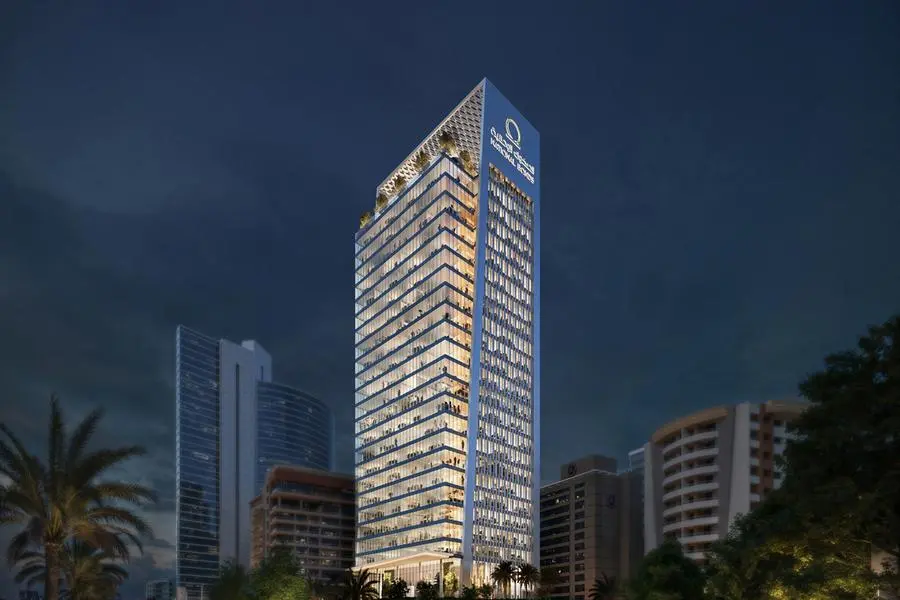
The Barsha Heights commercial launch in 2026 by National Properties sits in that category. It is an AED 500 million, 26-storey Grade A tower announced in March 2026 — the same fortnight that Goldman Sachs was documenting a 37–49% decline in residential transaction volumes. The same fortnight that Reuters was reporting early signs of residential market weakness. In the same fortnight, some off-plan sellers were accepting 12–15% discounts on premium units.
That timing is not incidental. It is the point. When a Sharia-compliant savings institution commits half a billion dirhams to a commercial building with a Q4 2028 completion date, during a period of active geopolitical stress, it is making a statement about the long-term trajectory of Dubai that no amount of residential sentiment data can replicate. And that statement, once understood, is exactly what nervous residential buyers need to hear.
What the Barsha Heights Commercial Launch 2026 Actually Delivers
National Properties, the real estate subsidiary of National Bonds, designed the Barsha Heights tower to address a specific gap in Dubai’s office supply hierarchy. It is not a speculative project built in anticipation of demand. It is a response to a Grade A supply crunch that has been running for four consecutive years, with annual office completions remaining below one million square feet per annum across the entire city.
The tower will add 225,000 square feet of net leasable area across 22 office floors, designed by NORR Architects and Engineers. Podium-level retail and café outlets with outdoor seating will activate the street interface, alongside wellness facilities, EV charging stations, and energy-efficient building systems. Construction begins Q2 2026, with handover targeted for Q4 2028.
The location choice is deliberate and precise. Barsha Heights, formerly known as TECOM, is a free zone district governed by the TECOM Authority, directly adjacent to Sheikh Zayed Road and within walking distance of Dubai Internet City Metro Station on the Red Line. It sits in a cluster alongside Dubai Internet City, Dubai Media City, and Dubai Knowledge Village — sub-markets that host technology firms, media companies, professional services, and regional headquarters. Office rents in the adjacent Business Bay corridor have risen 44% year-on-year, and citywide Grade A occupancy has held at approximately 95%. Barsha Heights itself is established, mixed-use, and fully absorbed. Adding 225,000 square feet of fresh Grade A stock to this district, in a landlord’s market with a historic supply deficit, is not a leap of faith. It is a calculated bet on a structural gap that the data confirms.
Table 1: National Properties Barsha Heights Tower — Project Specs vs. Existing District Benchmarks
| Variable | National Properties Tower (Announced) | Existing Barsha Heights Office Market |
|---|---|---|
| Developer/entity | National Properties (National Bonds subsidiary) | Mixed — TECOM Authority free zone occupiers and private towers |
| Development value | AED 500 million (USD 136 million) | Established asset base; existing towers AED 80K–125K/yr rental range |
| GLA added | 225,000 sq ft net leasable area | Existing stock: ~9.3M sq m citywide; Barsha Heights portion mature and near-full |
| Floors/configuration | 26 storeys; 22 office floors | Comparable towers: 20–30 floors; DAMAC Executive Heights 24 floors, 300K+ sq ft |
| Design architect | NORR Architects & Engineers (globally recognised) | Varied — existing stock ranges from late 2000s to 2020s-era towers |
| Key amenities | Podium retail/cafe; wellness facilities; EV charging; advanced building tech | Basic amenities typical — gym, parking, reception; newer towers offer upgraded spec |
| Connectivity | Direct Sheikh Zayed Road access; Dubai Internet City Metro (Red Line) walking distance | Dubai Internet City Metro Station serves full district; F31/F35 bus feeders |
| Construction start | Q2 2026 | N/A — district is established and operational |
| Completion target | Q4 2028 | N/A |
Sources: National Properties announcement (March 2026), ME Construction News, DAMAC Executive Heights market data, Cushman and Wakefield Barsha Heights guide, Property Finder.
What Commercial Capital Deployment Tells a Residential Buyer
A residential buyer deciding whether to commit to an off-plan apartment in March 2026 is working with a narrower information set than they realise. The transaction volume data they read in news reports captures sentiment velocity — how quickly buyers are moving in the current moment. What it does not capture is structural conviction — the willingness of long-horizon capital to remain deployed through a shock period.
Commercial real estate decisions operate on a fundamentally different clock. A developer committing AED 500 million to a tower with a 2.5-year build period is not reacting to the week’s transaction data. They are underwriting demand conditions they expect to exist in Q4 2028. That underwriting involves macroeconomic projections, population growth assumptions, business formation rates, and sector-specific demand forecasts for technology, media, and professional services in the Dubai corridor. When that underwriting concludes “go” during an active conflict, it tells the residential buyer something specific: the long-view assessment of Dubai’s economic trajectory has not changed.
This matters because the connection between commercial occupancy and residential demand is direct and well-documented. A 225,000 square foot office tower fills with employees who need somewhere to live. Those employees become rental tenants or owner-occupiers. The choice to build commercial space in Barsha Heights is simultaneously a bet on Dubai’s residential demand pipeline — and a bet being made with AED 500 million at stake.
For investors trying to understand what the 8.6% historic low in Dubai’s commercial vacancy rate means for the broader market, the answer runs directly through this logic: undersupplied commercial space creates employment density, employment density creates housing demand, and housing demand is what makes an off-plan residential investment viable at the far end of a construction period.
March 2026: What the Full Cross-Sector Launch Picture Showed
The Barsha Heights commercial launch did not happen in isolation. The same March 2026 window that produced the Reuters headline on residential weakness also produced a cross-sector sweep of capital deployment across the UAE market that has been underreported relative to its significance.
Table 2: UAE Cross-Sector Launch and Construction Activity — March 2026
| Sector | Developer / Entity | Project / Activity | Scale / Signal |
|---|---|---|---|
| Grade A commercial | National Properties | Barsha Heights 26-storey tower | AED 500M; 225,000 sq ft; Q4 2028 handover |
| Premium residential | Emaar Properties | Golf Valley, Emaar South | 262 units; AED 1.1M entry; 80/20 plan |
| Off-plan residential | Azizi Developments | Creek Views 4, Al Jaddaf | Sequel to two delivered phases; 50% completion on Phase 3 |
| Luxury residential | Anonymous (DLD record) | Palm Jumeirah off-plan apartment | AED 422M sale — third most expensive apartment in Dubai history |
| Off-plan residential | Zoya Developments | Nové, Dubailand | AED 200M+ investment; mid-market price point |
| Mid-market residential | OAM / AUM Development | Rise and Ryze Residences, Warsan | Dual Warsan launches; AED 599K entry; end-user focused |
| Active construction | Binghatti Holding | UAE-wide portfolio | AED 500M average weekly sales since late February 2026 |
| On-schedule delivery | Deyaar Development | Jannat project, Dubai Production City | Completion three months ahead of schedule; 2,000 units across pipeline |
Sources: Gulf News WAM report (March 29, 2026), Zawya, Khaleej Times, DLD transaction data, Trade Arabia.
Reading Table 2 as a whole rather than line by line produces a different picture than any single data point can offer. The residential transaction volume dip documented by Goldman Sachs captures one sliver of a market that was simultaneously: deploying half a billion dirhams into commercial infrastructure, completing projects three months ahead of schedule, selling a luxury apartment for AED 422 million at the top of the market, and sustaining AED 500 million per week in active sales volume at a mid-tier developer.
That is not the profile of a market in structural retreat. It is the profile of a market experiencing a sentiment pause in its transaction velocity while its underlying capital commitments remain intact. For residential buyers trying to calibrate risk, that distinction is the entire investment case. Transaction volume recovers. Structural impairment does not.
The Dubai off-plan market’s shift from boom to maturity in 2026 is precisely the context in which cross-sector signals become more important, not less. A maturing market does not reward momentum chasers. It rewards buyers who understand the difference between a sentiment shock and a structural break, and who read the full evidence set — including what institutional commercial capital is doing — rather than only the residential transaction headlines.
Why the Specific Location of This Tower Matters
Barsha Heights is not a peripheral district being developed speculatively. It is one of Dubai’s most mature, fully absorbed commercial hubs, with over 12,500 residential units across 95 completed projects, sitting inside a TECOM free zone that also includes Dubai Internet City, Dubai Knowledge Village, Dubai Media City, and Dubai Studio City. The district is metro-connected, road-connected, and commercially saturated.
Adding 225,000 square feet of Grade A stock to this ecosystem does not represent a development bet on an emerging location. It represents a confidence vote in an already-proven district, which is a meaningfully different signal. A developer willing to build in an emerging district is taking a location risk. A developer building in Barsha Heights is taking a market risk. In March 2026, National Properties concluded that the market risk was acceptable. That conclusion, backed by AED 500 million in capital, is worth taking seriously.
For residential buyers looking at the Dubai 2026 investment entry point across off-plan and pre-launch opportunities, the Barsha Heights tower provides a useful anchor. If long-horizon commercial capital is willing to hold a 2.5-year build position in a mature Dubai district during a geopolitical shock, the implied signal for residential assets in supply-constrained communities with genuine employment and population demand is constructive. It does not eliminate residential risk. But it contextualises that risk within a broader picture where the most sophisticated capital in the market is not running.
Translating the Signal Into a Residential Decision Framework
Understanding the confidence signal is one thing. Knowing what to do with it is another. Cross-sector capital deployment in March 2026 does not mean every residential launch is sound. The Dubai 2026 off-plan yield and return data is consistent on this point: returns of 8–10% are achievable in the right communities with the right developer profile, but they depend on location fundamentals, supply constraints, and developer execution quality — not on market-wide sentiment.
Table 3: Cross-Sector Confidence Signals and Their Meaning for a Residential Buyer
| Signal Source | What It Shows | What It Means for a Residential Buyer |
|---|---|---|
| AED 500M commercial tower launch | Institutional long-horizon capital (2.5-year build) deploying in an active conflict period | If sophisticated capital with full market access is still committing, the market is not structurally impaired |
| Emaar launches Golf Valley residential | UAE’s largest listed developer maintains pipeline without pulling product | Developer confidence at scale — Emaar does not launch into a demand vacuum |
| AED 422M luxury apartment sold | UHNW buyer pool intact during conflict period | The top of the market is not frozen; pricing power at the premium end is preserved |
| Deyaar delivers 3 months early | Construction execution continues on schedule despite sentiment shock | Off-plan handover risk is lower than headlines suggest; developers are not stalling |
| Binghatti: AED 500M weekly sales | Mid-tier developer sales volume sustained through conflict weeks | Buyer activity across multiple price bands, not just UHNW — breadth of confidence |
| Dual Warsan mid-market launches | Two developers independently identify the same district as viable in March 2026 | Demand that is not sentiment-dependent continues to attract product; structural confidence intact |
Sources: Goldman Sachs (March 2026), Betterhomes (March 27, 2026), DLD, Gulf News WAM, National Properties announcement.
The framework that emerges from reading Table 3 is straightforward. Not all signals matter equally. The AED 422 million luxury sale confirms UHNW demand is intact, but tells a middle-market buyer little about their segment. Deyaar’s early completion tells every off-plan buyer that construction execution risk is lower than the sentiment data implies. Binghatti’s sustained weekly sales volume tells a yield investor that the mid-market absorption rate is holding. And the National Properties commercial commitment tells every buyer that the 3–5 year employment and population growth story underpinning Dubai’s residential demand has not been revised by the people with the most at stake.
That is the confidence story the Barsha Heights commercial launch 2026 is telling. It is not a residential story. But it is the most honest signal available about whether Dubai’s residential thesis remains intact — because it comes from someone with no interest in talking a residential buyer into a decision.
Looking for the Right Dubai Entry Point in 2026?
Whether your focus is residential yield, off-plan capital appreciation, or understanding how commercial activity shapes residential fundamentals, the team at prelaunch.ae can help you navigate the current cycle with data rather than headlines. Fill out the form on prelaunch.ae for a tailored assessment of current Dubai launches across every price band.
Contact us directly at (+971) 52 341 7272 or email sales@mbrproperties.ae. The commercial capital is already in the ground. The question is whether your residential strategy is reading the same market.
Frequently Asked Questions
Q: What is the Barsha Heights commercial launch 2026, and who is behind it?
A: The Barsha Heights commercial launch 2026 refers to National Properties’ announcement of a 26-storey, AED 500 million Grade A office tower in Barsha Heights (formerly TECOM), Dubai. National Properties is the real estate subsidiary of National Bonds Corporation, a Sharia-compliant savings and investment company. The tower, designed by NORR Architects and Engineers, will add 225,000 square feet of net leasable office area to the district. Construction is scheduled to begin in Q2 2026, with completion targeted for Q4 2028.
Q: Why does a commercial launch in Barsha Heights matter to residential property buyers?
A: Commercial and residential demand in Dubai is structurally connected. Office towers generate employment, employment generates population inflows, and population inflows generate housing demand. When institutional capital with a 2.5-year build commitment deploys AED 500 million during a period of residential sentiment weakness, it is signalling a long-horizon view that Dubai’s economic fundamentals — population growth, business formation, employment across tech and professional services — remain intact. That signal directly informs the residential demand outlook for 2028 and beyond.
Q: Why did National Properties choose Barsha Heights specifically for this launch?
A: Barsha Heights sits in one of Dubai’s most established commercial corridors, adjacent to Dubai Internet City, Dubai Media City, and Dubai Knowledge Village. It benefits from direct Sheikh Zayed Road connectivity and walking-distance access to the Dubai Internet City Metro Station on the Red Line. Grade A office occupancy across Dubai is running at approximately 95%, with citywide rents up 22% year-on-year, while new supply has remained severely limited for four consecutive years. Barsha Heights, as a mature, metro-connected, free-zone district in this supply-constrained environment, represents a location with proven demand rather than speculative growth expectations.
Q: Does the volume of cross-sector launches in March 2026 mean the residential dip was overstated?
A: Not overstated — but incomplete as a standalone indicator. Goldman Sachs documented a real 37–49% decline in residential transaction volumes in early March 2026. That decline reflected genuine geopolitical sentiment pressure. But it measured transaction velocity, not structural conviction. The simultaneous deployment of commercial capital, on-schedule project deliveries, mid-market residential launches, and a AED 422 million luxury apartment sale show that the market’s underlying capital commitments remained active even as transactional sentiment paused. Both readings are accurate. The investor who only reads one of them will misprice risk.
Q: How should a residential investor use the Barsha Heights commercial launch signal in their decision-making?
A: Treat it as a confidence anchor rather than a direct investment case. National Properties’ AED 500 million commitment during a conflict period tells you that long-horizon institutional capital, with access to full market data and professional risk assessment, has concluded that Dubai’s 2028 demand outlook is viable. That assessment is relevant to any residential investor evaluating a project with a 2026–2028 handover timeline. It does not eliminate the need for individual project due diligence — developer track record, DLD registration, escrow compliance, and zone-level supply constraints remain essential checks — but it provides directional context for the broader market thesis.