When overseas investors encounter Abu Dhabi off-plan properties during launch events, the presented prices and payment plans often appear straightforward and non-negotiable. However, sophisticated developers employ proven pricing strategies and psychological anchoring techniques that can inflate actual costs by ten to twenty-five percent above what savvy negotiators ultimately pay for identical units. Understanding these developer tactics transforms the purchasing experience from passive acceptance of quoted terms to strategic negotiation that maximizes capital appreciation potential while minimizing total acquisition costs. This comprehensive analysis reveals the pricing psychology behind Abu Dhabi’s off-plan developments and provides actionable strategies for securing superior terms regardless of market conditions or project popularity.
Understanding Price Anchoring in Abu Dhabi Off-Plan Launches
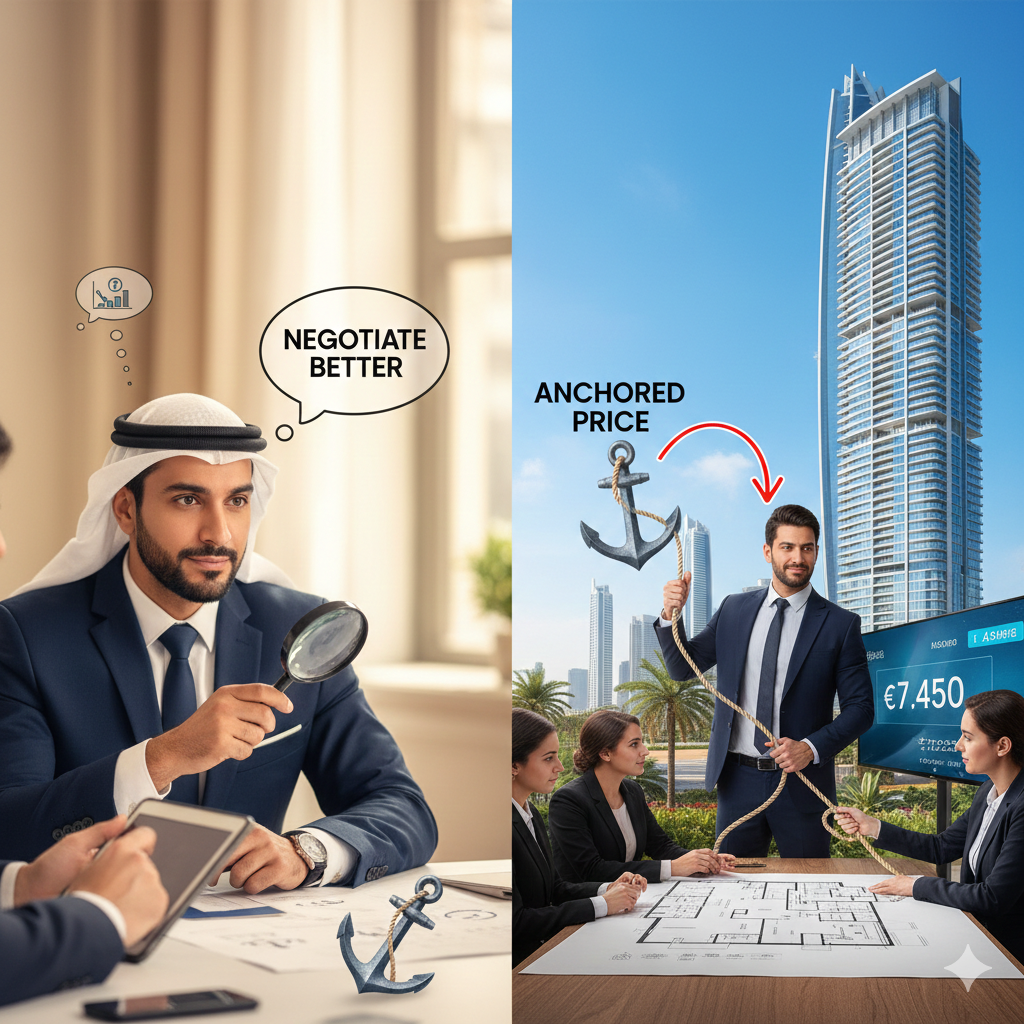
Price anchoring represents the foundational psychological technique developers use to establish perceived value before negotiations begin. This cognitive bias causes buyers to rely heavily on the first number they encounter—the “anchor”—when making valuation decisions, even when that initial reference point bears little relationship to actual market value or developer costs. In Abu Dhabi’s real estate market, developers deliberately set initial anchor prices knowing they’ll later offer “discounts” that still generate substantial profit margins while making buyers feel they’ve secured advantageous deals.
The most common anchoring tactic appears during pre-launch presentations where developers showcase premium penthouse units or beachfront villas priced at the absolute top of their range—often thirty to forty percent above median project pricing. After establishing this high anchor with AED 8 million penthouses, developers then reveal “more affordable” two-bedroom apartments at AED 1.8 million, which suddenly appear reasonable by comparison, despite potentially representing fifteen to twenty percent premiums over comparable completed units in neighboring communities. This pricing psychology mirrors tactics used across Dubai’s off-plan market, though Abu Dhabi developers tend toward more conservative anchoring given the emirate’s traditionally price-conscious buyer demographics.
Launch event urgency creates secondary anchoring effects through limited-time “early bird discounts” that establish artificial deadlines pressuring buyers toward immediate decisions without adequate due diligence. Developers announce that the first twenty units will receive ten percent discounts plus waived registration fees, creating perceived scarcity despite potentially having hundreds of unsold units across multiple phases. Smart investors recognize these urgency tactics as negotiation theater rather than genuine constraints, understanding that developers maintain flexibility throughout sales cycles regardless of stated deadlines.
The table below illustrates common anchoring scenarios and their impact on final negotiated prices:
| Anchoring Tactic | Initial Anchor Price | Typical “Discount” Offered | Final Price After Savvy Negotiation | Investor Savings vs Initial Anchor |
| Premium Unit Showcase | AED 3,500,000 (penthouse) | 15% early bird discount (AED 2,975,000) | AED 2,600,000 (negotiated terms) | AED 900,000 (25.7%) |
| Limited-Time Launch | AED 1,800,000 (apartment) | AED 180,000 off + waived fees | AED 1,550,000 (payment plan optimization) | AED 250,000 (13.9%) |
| “Last Units” Urgency | AED 2,200,000 (villa) | 5% “final discount.” | AED 1,980,000 (alternative phase/unit) | AED 220,000 (10%) |
| Package Deal Anchoring | AED 1,200,000 base + AED 150,000 “upgrades.” | Free upgrades (AED 1,200,000) | AED 1,080,000 (base negotiation) | AED 270,000 (20%) |
Payment Plan Manipulation and Hidden Cost Structures
Beyond headline pricing, Abu Dhabi developers employ sophisticated payment plan structures that obscure true acquisition costs while creating apparent affordability through extended terms and deferred payments. Understanding these financial engineering tactics enables investors to compare the total cost of ownership rather than being seduced by low monthly installments that ultimately deliver poor value.
The construction-linked payment plan represents the most common structure in Abu Dhabi’s off-plan developments, typically requiring ten to twenty percent down payment followed by installments tied to physical construction milestones such as foundation completion, structural topping, and mechanical fit-out. While this appears to protect buyers by linking payments to progress, developers actually set milestone percentages to frontload revenue extraction, often collecting sixty to seventy percent of the total price before projects reach fifty percent physical completion. This aggressive collection schedule means buyers fund most of the development well before receiving usable property, effectively providing developers with interest-free construction financing while assuming delivery risk.
Post-handover payment plans marketed as buyer-friendly alternatives frequently contain hidden costs through inflated base prices that offset the apparent benefit of extended terms. A property offered at AED 2 million with thirty percent payable over three years post-handover may actually cost ten to fifteen percent more than an equivalent unit sold with traditional milestone payments, with the premium buried in higher square-foot pricing rather than explicit interest charges. Sophisticated investors calculate the net present value of all payment streams rather than focusing on low monthly amounts, often discovering that “generous” post-handover terms deliver worse economics than negotiating lower base prices with conventional payment structures.
Service charge pre-payments and mandatory sinking fund contributions represent another hidden cost layer that developers introduce during contract finalization after buyers mentally commit to purchases. These charges—typically AED 20 to AED 40 per square foot annually for the first two to three years—get added to final settlement amounts, sometimes totaling AED 30,000 to AED 60,000 for standard apartments. Understanding these hidden costs becomes critical when comparing total acquisition expenses across competing developments, as headline prices alone provide incomplete financial pictures.
The most insidious cost manipulation involves upgrade packages and premium location charges that developers present as optional enhancements but structure contracts to make practically mandatory. A “standard” unit might feature basic finishes requiring AED 100,000 in upgrades to achieve livability comparable to completed properties in the area, while “premium” floor levels commanding AED 50,000 to AED 150,000 supplements actually represent the only units with acceptable views or layouts. Savvy negotiators challenge these tiered pricing structures by requesting base units at the presented headline price fully equipped to market standards, often succeeding in securing upgrades at fifty to seventy percent discounts or having them included in negotiated packages.
Developer Incentive Programs: Marketing Theater vs Real Value
Abu Dhabi developers deploy elaborate incentive programs during launch phases that create impressions of exceptional value while often delivering marginal actual benefit when subjected to financial analysis. Understanding which incentives provide genuine value versus marketing theater separates sophisticated investors from those swayed by superficial promotional offerings.
Waived registration fees represent one of the most commonly advertised incentives, with developers claiming to absorb the two percent Department of Municipalities and Transport registration fee on behalf of early buyers. This appears generous until investors realize that developers simply inflate base prices by corresponding amounts, effectively having buyers pay their own registration fees through higher purchase prices while creating the illusion of developer-funded benefits. The same tactic appears across Dubai’s off-plan market, where “zero commission” promotions often correlate with above-market square-foot pricing that more than compensates for waived broker fees.
Guaranteed rental returns for initial years following handover sound attractive, promising seven to nine percent annual returns regardless of actual market performance. However, these guarantees rarely deliver value equal to their promised percentages. Developers typically inflate purchase prices by ten to fifteen percent when offering rental guarantees, meaning a property priced at AED 2.2 million with guaranteed returns might cost only AED 1.9 million without the guarantee while generating similar or better rental income through normal market leasing. The guarantee also restricts owner flexibility in tenant selection, rental pricing, and lease terms, potentially leaving units vacant beyond guarantee periods as market conditions shift.
Furniture packages and fit-out incentives deserve particular scrutiny, as developers routinely overvalue these offerings by fifty to one hundred percent compared to independent market procurement. A “complimentary” AED 80,000 furniture package might include items readily available for AED 40,000 through retail channels, while “premium” finishes worth stated AED 120,000 cost developers AED 60,000 through bulk purchasing arrangements. Smart investors negotiate cash-equivalent credits at developer cost rather than accepting packaged offerings, then source furnishings and finishes independently at competitive prices while maintaining design control.
Free service charge periods for the first one to three years provide genuine value, particularly in communities with higher than average maintenance costs. However, investors should verify whether quoted service charges reflect realistic operating budgets or artificially low introductory rates that will escalate significantly in subsequent years. Projects advertising AED 12 per square foot service charges during free periods might reset to AED 25 per square foot afterward, effectively clawing back the apparent benefit through back-end cost increases.
Location Premium Tactics and Inventory Management
The strategic release of inventory across project phases represents a sophisticated pricing tactic where Abu Dhabi developers create artificial scarcity in desirable units while maintaining substantial reserves that become available at negotiated terms for persistent buyers. Understanding these inventory management practices enables investors to access preferred units at lower costs than initially quoted.
Phase-based pricing escalation establishes different price points for identical unit types across development phases, with each subsequent release commanding five to fifteen percent premiums over previous phases regardless of actual cost changes or market conditions. Developers justify these increases through “market appreciation” and “limited availability,” though actual construction costs remain essentially constant across phases. Savvy investors challenge phase-based premiums by negotiating access to later-phase inventory at earlier-phase pricing, arguments that frequently succeed when developers face absorption pressures or quarter-end sales targets.
View premiums and floor-level supplements create tiered pricing within identical unit types, with developers charging AED 50,000 to AED 200,000 for “premium” views or higher floors. However, the actual desirability of views varies dramatically based on project location and surrounding developments. A fifteen percent premium for “marina views” makes sense when overlooking active waterfront areas, but similar premiums for “park views” of undeveloped green spaces that may transform into future construction sites represent questionable value. Negotiators who demonstrate knowledge of surrounding area masterplans often secure view premiums eliminated or substantially reduced.
Corner unit supplements and end-unit pricing exploit buyer preference for additional windows and perceived space advantages, with developers adding ten to twenty percent premiums despite marginal actual floor area differences. Detailed layout analysis often reveals that corner units in many developments offer negligible practical advantages over standard units while commanding substantial price premiums. Strategic investors focus on per-square-foot value and functional layout rather than paying for the perceived status of corner positions unless objective benefits justify premiums.
The most effective negotiation leverage comes from identifying alternative unit availability within projects—comparable units on different floors, orientations, or phases that deliver similar value at lower prices. Developers maintain pricing flexibility across their inventory, with sales managers authorized to match or beat internal pricing to close deals. Buyers who demonstrate willingness to consider multiple options rather than fixating on single units gain substantial negotiating power, as developers prefer certainty of sales at slightly reduced margins over extended vacancy periods, hoping for premium pricing.
The Psychology of Launch Event Sales Pressure
Launch events for major Abu Dhabi off-plan projects operate as carefully choreographed psychological experiences designed to minimize rational decision-making while maximizing emotional commitment and urgency. Recognizing these environmental factors helps investors maintain objectivity despite immersive sales presentations and artificial time pressures.
The typical launch event begins with elaborate presentations showcasing project vision, location advantages, developer track record, and amenity packages through professional videos and architectural renderings. These presentations deliberately emphasize aspirational lifestyle benefits over quantitative financial metrics, appealing to emotional desires for prestige, security, and community belonging rather than analytical investment evaluation. The emotional high created by these presentations makes attendees more susceptible to subsequent pricing proposals, having already mentally committed to project desirability before financial discussions begin.
Sales team tactics during booking processes create additional pressure through claims of limited inventory and multiple competing buyers for desirable units. Statements like “we only have three remaining units in this phase” or “another client is considering this same apartment” exploit scarcity psychology despite potentially having dozens of comparable units available across the development. The presence of multiple apparent buyers during launch events—some of whom may actually be developer staff or associates—reinforces impressions of exceptional demand that require immediate decisions to avoid missing opportunities.
Deposit structures requiring AED 50,000 to AED 100,000 immediately to “secure” units create sunk-cost psychology that makes buyers reluctant to walk away even after discovering unfavorable terms during subsequent contract reviews. Developers understand that once buyers mentally commit to purchases and transfer initial deposits, the psychological barrier to cancellation becomes substantial regardless of contract cancellation rights. This tactic proves particularly effective with overseas investors who travel specifically to attend launch events and feel pressure to complete transactions during limited visits.
The most effective counter to launch event pressure involves treating initial presentations purely as information gathering rather than decision opportunities, explicitly communicating to sales teams that purchase decisions will occur only after independent due diligence, competitive comparisons, and professional advisor consultations. This stance immediately shifts power dynamics, as developers recognize they’re dealing with sophisticated buyers rather than impulse purchasers susceptible to urgency tactics. Professional investors often employ the “second meeting” strategy where they attend launch events for research but schedule separate negotiation sessions days or weeks later after emotional influences dissipate and rational analysis prevails.
Strategic Negotiation Tactics for Better Pricing
Effective negotiation for Abu Dhabi off-plan properties requires understanding developer motivations, identifying optimal timing for engagement, and employing specific tactics that leverage market dynamics rather than relying solely on persuasive arguments. The most successful negotiations combine multiple approaches simultaneously to create compound advantages.
Competitive comparison leverage provides the strongest negotiation foundation, requiring investors to obtain detailed pricing and terms from at least three to five comparable projects before entering serious discussions. Presenting developers with specific competing offers—including unit types, payment plans, rental yield projections, and total costs—demonstrates market knowledge and creates competitive pressure to match or beat alternatives. This approach works best when comparisons involve projects at similar development stages in comparable locations, making apples-to-apples evaluation straightforward.
Bulk purchasing strategies deliver significant advantages for investors acquiring multiple units simultaneously or coordinating purchases with partners or family members. Developers offer volume discounts ranging from five to fifteen percent on multi-unit transactions, plus enhanced terms like extended payment periods or upgraded finishes. Even investors planning single-unit purchases can leverage bulk buying through informal investor groups or by negotiating future purchase commitments contingent on satisfactory performance of initial acquisitions. Understanding developer sales targets and inventory pressures enables strategic timing of bulk offers when developers need volume to meet quarterly goals.
Payment plan optimization represents an underutilized negotiation lever where investors propose alternative payment structures that reduce total costs while potentially improving developer cash flow. Rather than accepting standard plans, propose variations such as larger down payments in exchange for substantial discounts, accelerated payment schedules that reduce developer financing costs, or hybrid structures combining milestone and time-linked elements. Developers maintain surprising flexibility around payment terms, particularly when proposed structures simplify their financial planning or provide early liquidity.
Fee negotiation extends beyond headline prices to encompass the full cost stack, including registration fees, broker commissions, service charge pre-payments, and administrative charges. Each fee component represents a potential negotiation point, with developers often more willing to waive or reduce fees than discount base prices that establish comparable sales records affecting future inventory pricing. Requesting itemized cost breakdowns and challenging each component individually often yields cumulative savings of five to ten percent beyond headline price reductions.
Relationship-based negotiation with sales managers and project directors can deliver advantages beyond immediate transaction terms. Establishing genuine rapport through professional conduct, market knowledge demonstration, and efficient decision-making creates preferences for working with specific buyers even at slightly reduced margins. Sales professionals facing difficult quarterly targets or managing challenging inventory often proactively contact preferred buyers with special opportunities, inventory releases, or flexible terms before broader market announcements. This approach requires balancing assertive negotiation with respectful collaboration, recognizing that sales teams control access to future opportunities beyond current transactions.
Timing Strategies: When to Buy for Maximum Leverage
The timing of purchase decisions dramatically impacts negotiating leverage and achievable terms, with different phases of development cycles and market conditions creating distinct advantage windows for overseas investors in Abu Dhabi’s off-plan market.
Pre-launch acquisition during soft marketing phases before official sales launches can deliver exceptional value for well-connected investors with developer relationships. During this period, developers test market pricing and gather initial commitments from VIP buyers before establishing official launch pricing. Investors willing to commit during soft phases often secure ten to twenty percent discounts versus launch prices, though this approach requires confidence in developer reputation and project viability without the benefit of public sales momentum validation.
Post-launch normalization creates negotiation opportunities three to six months after initial sales launches when early buyer urgency dissipates and developers face reality of normal sales velocity. Projects that sold thirty to forty percent of inventory during launch events often experience sales slowdowns as remaining buyers take time for due diligence and competitive evaluation. This period offers optimal conditions for patient negotiators who can wait beyond initial excitement while developers still maintain flexibility before market perception of project success or failure solidifies.
Quarter-end and year-end windows provide tactical advantages as developers push to meet sales targets for reporting periods. The final two weeks of calendar quarters represent peak negotiation leverage, particularly for projects behind sales forecasts or developers facing shareholder expectations. Understanding Abu Dhabi’s development market cycles and specific project performance enables strategic timing of serious offers when developers most need transactions.
Market correction periods following broader economic uncertainty or regional events create exceptional buyer leverage as developers prioritize sales certainty over maximum pricing. While timing market corrections requires patience and risk tolerance for delayed entry, buyers who can deploy capital during uncertain periods often secure twenty-five to thirty-five percent discounts versus peak pricing. However, this strategy demands strong developer selection focusing on financially stable entities that will complete projects regardless of market conditions, avoiding developers dependent on continuous sales to fund construction.
The most sophisticated timing approach combines multiple windows through staged acquisition strategies where investors secure initial units during optimal leverage periods while negotiating options or first rights of refusal for additional units at favorable pricing. This approach provides portfolio expansion flexibility without full capital commitment while locking in advantageous terms for future purchases if projects perform well.

Red Flags: When Pricing Seems Too Good to Be True
While negotiating better terms represents intelligent investing, extremely aggressive pricing or unusual incentives sometimes signal underlying project risks or developer financial stress that should trigger enhanced due diligence rather than immediate acceptance.
Below-market pricing exceeding twenty to thirty percent discounts versus comparable projects without clear justification through location disadvantages, reduced amenity packages, or smaller unit sizes deserves scrutiny. Developers under financial pressure sometimes use below-market pricing to generate quick cash flow, creating risks of construction delays, quality compromises, or project abandonment if sufficient capital isn’t raised. Understanding Abu Dhabi’s escrow account protections provides some security, though buyers still face opportunity costs and disruption if projects stall regardless of eventual fund recovery.
Excessive incentives combining multiple benefits like guaranteed rental returns, free upgrades, waived fees, and post-handover payment plans suggest developers are struggling to generate sales momentum at standard terms. While each incentive individually might be reasonable, the combination often indicates weak underlying demand or overpriced base offerings. Projects requiring elaborate incentive packages to attract buyers may face absorption challenges affecting future capital appreciation and rental market performance.
Payment plan red flags, including requests for payments outside established escrow accounts, unusually aggressive frontloading of payments before construction progress, or vague milestone definitions, create opportunities for developer misuse of buyer funds. Legitimate Abu Dhabi developers maintain transparent payment structures tied to verifiable construction milestones with all funds flowing through regulated escrow arrangements. Any deviation from these standards warrants immediate professional legal review and potentially transaction abandonment.
Developer reputation concerns, including limited track records, previous project delays, legal disputes with buyers, or unclear ownership structures, should trigger additional due diligence regardless of attractive pricing. The five to ten percent savings achieved through aggressive negotiation with questionable developers become meaningless if projects don’t complete on schedule or deliver promised quality. Conservative investors prioritize established developers like Aldar Properties and Modon Properties despite potentially higher pricing, recognizing that certainty of delivery and quality justifies premiums over riskier alternatives.
Case Study: Successful Negotiation in Practice
A practical example illustrates how combining multiple negotiation tactics delivers compound advantages beyond any single approach. An overseas investor targeting a two-bedroom apartment in an Al Reem Island development initially faced a launch price of AED 1.85 million with a sixty-forty payment plan requiring a twenty percent down payment.
Through systematic negotiation employing the strategies outlined above, the final transaction achieved AED 1.58 million purchase price—fourteen-point-six percent below initial quote—with an optimized fifty-fifty payment plan and waived registration fees worth AED 31,600. The negotiation process included competitive comparison leverage using comparable units at Yas Island and Saadiyat Island developments, timing the offer during quarter-end sales push, proposing a hybrid payment structure with a larger down payment for price reduction, and establishing rapport with the sales director through professional conduct and efficient decision-making.
The cumulative savings of AED 301,600, including price reduction and fee waiver,s represented the difference between a marginal investment returning seven percent gross yield and an exceptional acquisition generating nine-point-two percent gross yield on actual invested capital. This improvement in economics fundamentally changed the investment’s risk-return profile while acquiring an identical physical asset.
Conclusion: Empowered Investing Through Knowledge
The pricing tactics employed by Abu Dhabi developers in off-plan launches represent sophisticated marketing and sales strategies designed to maximize revenue extraction while creating perceptions of value and urgency. However, these tactics operate predictably according to established psychological principles and market dynamics, making them entirely manageable for investors equipped with knowledge and willing to employ strategic negotiation approaches.
Understanding price anchoring, payment plan manipulation, incentive theater, and inventory management enables investors to see beyond surface presentations to actual value propositions. Combined with strategic timing, competitive leverage, and professional negotiation tactics, sophisticated buyers consistently secure ten to twenty-five percent superior terms compared to passive purchasers accepting initial offers.
The Abu Dhabi off-plan market rewards preparation, patience, and professional engagement while penalizing impulsive decision-making and susceptibility to artificial urgency. As the emirate’s real estate market continues evolving with increasing international investment flows and new project launches, investors who master negotiation fundamentals and pricing psychology will consistently outperform those relying solely on market timing or location selection.
The difference between accepting quoted terms and securing optimized deals often determines whether investments deliver adequate returns or exceptional performance. In Abu Dhabi’s competitive landscape where yield compression continues across prime segments, the ability to acquire properties at superior terms through effective negotiation represents a sustainable competitive advantage that compounds across portfolio construction and holding periods.
Ready to master negotiation strategies and secure Abu Dhabi’s best off-plan opportunities? Fill up the form on our website prelaunch.ae to receive exclusive access to pre-launch projects, detailed pricing comparisons, and expert negotiation support. Our experienced team helps investors navigate developer tactics and secure optimal terms across Abu Dhabi’s premium developments.
Contact us today:  (+971) 52 341 7272
  sales@mbrproperties.ae
Discover how professional guidance and strategic negotiation can transform your Abu Dhabi real estate investments from standard transactions to exceptional value acquisitions, maximizing returns through superior pricing and terms.
Frequently Asked Questions
Q: Can overseas investors really negotiate Abu Dhabi off-plan prices, or are published prices fixed?
Published prices represent starting points for negotiation rather than fixed terms, particularly for overseas investors purchasing multiple units or timing acquisitions strategically. Developers maintain pricing flexibility and sales managers possess the authority to adjust terms based on buyer sophistication, market conditions, and sales targets. Investors employing competitive comparisons, bulk purchase strategies, and optimal timing consistently achieve ten to twenty percent better terms than passive buyers accepting initial offers.
Q: What represents the best timing for maximum negotiating leverage in Abu Dhabi’s off-plan market?
Quarter-end and year-end windows provide tactical advantages as developers push to meet reporting targets, with the final two weeks of quarters offering peak leverage, especially for projects behind sales forecasts. Post-launch normalization, three to six months after initial sales events, also creates opportunities as early urgency dissipates and developers face normal absorption rates. Market correction periods following economic uncertainty deliver exceptional leverage for patient investors able to wait for broader market softness.
Q: How can investors verify whether developer incentives provide genuine value or represent marketing theater?
Calculate the net present value of all costs, including incentives, versus comparable properties without incentive programs, adjusting for any base price inflation associated with the incentives. Guaranteed rental returns typically correlate with ten to fifteen percent price premiums that eliminate actual value despite promotional appeal. Furniture packages and upgrades should be valued at independent market procurement costs rather than developer-stated values, often revealing fifty to one hundred percent overvaluations. Free service charge periods provide genuine value only if quoted charges reflect realistic operating budgets rather than artificially low introductory rates.
Q: What payment plan structure delivers the best value for overseas investors in Abu Dhabi off-plan properties?
Payment plan optimization depends on individual cash flow capabilities and financing strategies, but generally, negotiated base price reductions deliver superior value compared to extended payment terms. Rather than accepting developer-structured post-handover plans with inflated base prices, propose alternative arrangements such as larger down payments in exchange for substantial price discounts, accelerated milestone payments reducing developer financing costs, or hybrid structures balancing cash flow management with minimized total costs. Understanding Abu Dhabi’s fifty percent LTV mortgage regulations helps structure payment plans that accumulate required equity while optimizing overall financing economics.
Q: How much can investors realistically save through effective negotiation on Abu Dhabi off-plan purchases?
Sophisticated negotiators combining multiple tactics—competitive comparison, strategic timing, payment optimization, bulk purchasing, and professional relationship development—consistently achieve ten to twenty-five percent cumulative savings versus initial quoted terms, including base price reductions and fee waivers. Individual results vary based on project demand, market conditions, and investor negotiation skills, but even conservative approaches focusing solely on competitive leverage and fee negotiation deliver five to ten percent improvements that significantly enhance investment returns over holding periods.
Q: Should overseas investors work with real estate agents when negotiating Abu Dhabi off-plan purchases, or negotiate directly with developers?
Both approaches offer distinct advantages depending on investor sophistication and market knowledge. Direct developer negotiation eliminates commission costs and provides unfiltered communication, benefiting experienced investors comfortable with contract review and market analysis. However, professional agents with established developer relationships often access inventory before public releases, understand negotiation parameters, and leverage relationships for enhanced terms. The optimal strategy involves obtaining market intelligence from multiple agents while negotiating final terms directly, combining broad market access with relationship benefits while maintaining control over final negotiations and eliminating commission expenses where possible.