As Abu Dhabi’s off-plan market continues its explosive growth trajectory into 2026, with off-plan transactions accounting for 68% of all residential deals, investors face an unprecedented challenge: how to quickly evaluate and compare dozens of new launches hitting the market monthly. The sheer volume of upcoming real estate projects in Abu Dhabi can be overwhelming, especially when each developer promises exceptional returns, prime locations, and flexible terms.
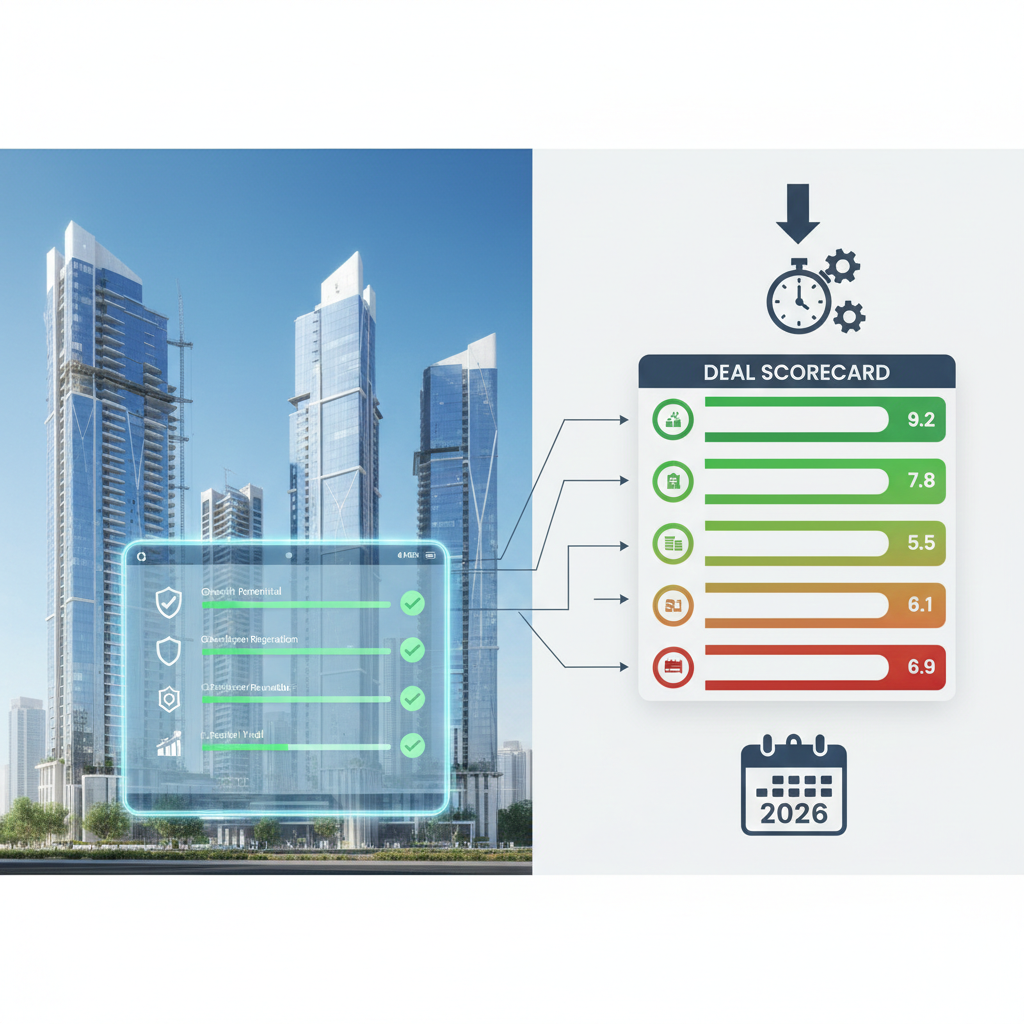
What savvy investors need isn’t more information—it’s a systematic framework for filtering through the noise. Enter the “Deal Scorecard”: a simple, actionable ranking system designed specifically for evaluating 2026 Abu Dhabi property launches. This scoring methodology allows you to objectively assess any off-plan development in Abu Dhabi within minutes, comparing projects across five critical dimensions that determine long-term investment success.
Why You Need a Deal Scorecard for Abu Dhabi Off-Plan Properties
The Abu Dhabi real estate market in 2026 is fundamentally different from previous years. With approximately 12,800 new units scheduled for delivery and residential prices rising 17.3% year-on-year, the market dynamics demand a more sophisticated evaluation approach than simple gut instinct or developer reputation alone.
Traditional methods of property evaluation—relying solely on brand names, location prestige, or payment plan flexibility—no longer suffice in a market where international buyers account for 42% of transactions and competition for premium units intensifies daily. The Deal Scorecard system addresses this challenge by quantifying subjective factors and creating comparable metrics across diverse projects, from luxury canal view apartments in Abu Dhabi on Al Reem Island to new villa projects in Abu Dhabi on Yas Island.
The 5-Pillar Deal Scorecard Framework
Our Deal Scorecard evaluates every off-plan project in Abu Dhabi across five weighted categories, each contributing to a maximum score of 100 points. This system balances immediate financial considerations with long-term value drivers, ensuring you’re not just buying at launch prices but investing in genuine appreciation potential.
1. Location & Connectivity Score (25 Points Maximum)
Location remains the single most critical factor in determining both rental yields and capital appreciation for Abu Dhabi off-plan properties. However, not all “prime” locations are created equal, especially when evaluating projects scheduled for 2026-2028 handovers.
Scoring Criteria:
- Proximity to employment hubs (8 points): Distance to ADGM, Maryah Island financial district, or major business parks
- Transportation access (7 points): Connectivity to main highways, future metro lines, and Abu Dhabi International Airport
- Future infrastructure catalysts (5 points): Planned developments like Disneyland Abu Dhabi, new museums, or commercial centers
- Community maturity (5 points): Established vs. emerging neighborhoods with proven rental demand
Example Application:
A luxury apartment on Saadiyat Island near the Louvre Abu Dhabi might score:
- Employment hubs: 6/8 (15 minutes to ADGM)
- Transportation: 6/7 (highway access, future metro station planned)
- Future catalysts: 5/5 (Guggenheim Museum, Zayed National Museum under development)
- Community maturity: 5/5 (established cultural district with proven demand) Total Location Score: 22/25
Meanwhile, a villa project in a new Al Shamkhah development might score:
- Employment hubs: 4/8 (35+ minutes to business districts)
- Transportation: 4/7 (limited public transport, single highway access)
- Future catalysts: 2/5 (limited announced infrastructure)
- Community maturity: 2/5 (emerging area with unproven rental demand) Total Location Score: 12/25
This framework particularly benefits investors exploring best areas to invest in Abu Dhabi, as it quantifies the location premium beyond marketing hype.
2. Developer Track Record Score (20 Points Maximum)
Developer reputation directly correlates with on-time delivery, construction quality, and post-handover property values. The Abu Dhabi off-plan market has seen its share of delays and quality issues, making this evaluation critical.
Scoring Criteria:
- Completion history (8 points): Percentage of projects delivered on schedule in past 5 years
- Financial stability (5 points): Years in operation, parent company backing, credit ratings
- Quality standards (4 points): Awards, certifications (LEED, Estidama), customer reviews
- Handover transparency (3 points): Clear timelines, regular construction updates, escrow compliance
Benchmark Developers:
- Aldar Properties: Typically scores 18-20/20 (government-backed, consistent delivery record)
- Reportage Properties: Generally scores 15-17/20 (solid track record, competitive pricing)
- Newer/Smaller Developers: Often score 8-12/20 (higher risk, but potentially higher returns)
For investors researching the top 10 off-plan projects launching in Abu Dhabi, developer scoring separates genuine opportunities from speculative ventures.
3. Payment Plan Flexibility Score (20 Points Maximum)
Flexible payment structures are cornerstone benefits of pre-launch off-plan properties, but not all payment plans offer equal value or risk profiles.
Scoring Criteria:
- Down payment requirement (5 points): Lower percentages (5-10%) score higher than 20%+ requirements
- Construction-linked instalments (5 points): Spread over 18+ months preferred vs. front-loaded schedules
- Post-handover options (6 points): 12-36 month post-handover payment periods add significant value
- Interest-free structure (4 points): Zero-interest instalments vs. mortgage-dependent schemes
Payment Plan Comparison Table:
| Payment Structure | Down Payment | During Construction | Post-Handover | Scorecard Rating |
| Plan A: 10/40/50 | 10% (5 pts) | 40% over 24 months (4 pts) | 50% over 36 months (6 pts) | 19/20  |
| Plan B: 20/60/20 | 20% (3 pts) | 60% construction-linked (3 pts) | 20% over 12 months (3 pts) | 13/20 |
| Plan C: 30/70/0 | 30% (2 pts) | 70% during construction (2 pts) | No post-handover (0 pts) | 8/20 |
This scoring method proves particularly valuable when evaluating flexible payment plans for off-plan developments in Abu Dhabi, helping investors maximize cash flow efficiency.
4. ROI & Rental Yield Potential (20 Points Maximum)
Return on investment metrics separate speculative purchases from wealth-building assets in the Abu Dhabi off-plan market.
Scoring Criteria:
- Projected capital appreciation (8 points): Based on location, developer, and market trends (15-30% target by handover)
- Estimated rental yields (7 points): Conservative projections (6-9% annual yields)
- Exit strategy flexibility (5 points): Resale liquidity, rental demand stability, short-term rental viability
ROI Calculation Example:
Yas Island Smart Home Apartment (1-bedroom, AED 1.5M):
- Launch price: AED 1.5M
- Projected completion value (2028): AED 1.95M (+30% appreciation = 8/8 points)
- Annual rental yield: AED 130,000 (8.7% yield = 7/7 points)
- High liquidity market, Airbnb-friendly policies (5/5 points) Total ROI Score: 20/20
This framework aligns with analysis from high-yield investment zones in Abu Dhabi, where waterfront properties consistently outperform inland developments.
5. Project Amenities & Future-Proofing Score (15 Points Maximum)
Modern amenities and sustainable features increasingly drive property values and rental premiums in Abu Dhabi’s competitive market.
Scoring Criteria:
- Smart home technology (4 points): IoT systems, app-controlled features, AI security
- Sustainability credentials (4 points): LEED/Estidama ratings, solar panels, EV charging
- Community facilities (4 points): Pools, gyms, parks, retail integration, co-working spaces
- Unique differentiators (3 points): Branded residences, architectural significance, exclusive access
Example Comparison:
Branded Residence (Mandarin Oriental): 14/15 points (smart features, 5-star amenities, hotel management, LEED certified)
Standard Mid-Market Project: 7/15 points (basic gym/pool, limited tech, standard finishes)
Investors exploring branded residences in Abu Dhabi benefit significantly from this amenity-focused scoring approach.
How to Use Your Deal Scorecard: Practical Application
Once you’ve scored a project across all five categories, total the points for a maximum possible score of 100. Here’s how to interpret your results:
90-100 Points: Exceptional Opportunity — Rare deals combining all success factors. These are priority investments worthy of immediate allocation, typically representing top-tier pre-launch off-plan projects from established developers in prime locations.
75-89 Points: Strong Investment — Solid fundamentals with one or two areas of compromise. These projects offer excellent risk-adjusted returns and comprise the majority of successful Abu Dhabi off-plan investments.
60-74 Points: Moderate Opportunity — Acceptable projects with notable trade-offs. Suitable for specific strategies (e.g., aggressive capital appreciation focus, accepting lower initial yields, or emerging location plays with extended holding periods).
Below 60 Points: Proceed with Caution — Projects scoring below 60 typically indicate significant risk factors, whether excessive pricing, questionable locations, unproven developers, or weak payment structures. Consider alternatives unless you have specialized knowledge justifying the investment.
Real-World Scorecard Examples: 2026 Abu Dhabi Launches
Let’s apply the Deal Scorecard to three hypothetical 2026 Abu Dhabi property launches representing different market segments:
Project Alpha: Saadiyat Cultural District Apartment
- Location Score: 23/25 (prime cultural zone, museum proximity, proven appreciation)
- Developer Score: 19/20 (Aldar Properties, perfect track record)
- Payment Plan Score: 16/20 (20/60/20 structure)
- ROI Score: 18/20 (25% appreciation projected, 7.2% yield)
- Amenities Score: 13/15 (smart features, LEED Gold, luxury finishes)
Total Score: 89/100 — Strong Investment
Project Beta: Yas Island Family Villa
- Location Score: 21/25 (entertainment hub, Disneyland proximity, family demand)
- Developer Score: 17/20 (established mid-tier developer)
- Payment Plan Score: 19/20 (10/40/50 structure with 36-month post-handover)
- ROI Score: 19/20 (30% appreciation target, 8.1% yield, Airbnb potential)
- Amenities Score: 14/15 (resort-style amenities, sustainability features)
Total Score: 90/100 — Exceptional Opportunity
Project Gamma: Al Shamkhah Affordable Townhouse
- Location Score: 13/25 (emerging community, limited infrastructure)
- Developer Score: 11/20 (newer developer, limited portfolio)
- Payment Plan Score: 18/20 (excellent 5/45/50 structure compensating for location)
- ROI Score: 14/20 (moderate 18% appreciation, 8.5% yield from affordability)
- Amenities Score: 8/15 (basic facilities, limited smart features)
Total Score: 64/100 — Moderate Opportunity
These examples demonstrate how the scorecard identifies trade-offs: Project Gamma’s exceptional payment plan and high yield compensate for location weaknesses, making it suitable for cash-flow-focused investors rather than premium capital appreciation seekers.
Advanced Scorecard Strategies for Sophisticated Investors
Weighting Adjustments: Modify category weights based on your investment thesis. Conservative investors might increase Developer Score weight to 25 points while reducing ROI Score. Aggressive growth investors might weigh Location and ROI more heavily.
Comparison Matrix: When evaluating multiple off-plan developments in Abu Dhabi simultaneously, create a simple spreadsheet with projects as rows and scoring categories as columns. This visualization immediately highlights relative strengths and weaknesses.
Market Cycle Timing: In early 2026, with supply constraints driving 17.3% price growth, Location and ROI scores become more critical than Payment Plan flexibility. Adjust your evaluation priorities based on current Abu Dhabi market dynamics.
Portfolio Balancing: Use the scorecard to ensure diversification. A portfolio of three 90+ point projects in Saadiyat Island creates concentration risk; consider balancing with 75-85 point opportunities in emerging areas like Al Ghadeer or Al Reef to optimize risk-adjusted returns.
Red Flags That Override Positive Scores
Certain warning signs should trigger immediate caution regardless of total scorecard points:
Developer Red Flags:
- No escrow account confirmation from RERA
- History of project cancellations or major delays
- Unclear ownership structure or financial backing
- Aggressive sales tactics or pressure to “decide immediately.”
Project Red Flags:
- Unrealistic ROI projections (40%+ appreciation promises)
- Below-market pricing with unclear justifications
- Limited or no construction progress 12+ months post-launch
- Changing project specifications or timeline extensions
Location Red Flags:
- Excess supply in the immediate area (3+ major projects within 1km)
- Declining rental rates in established neighboring communities
- Lack of infrastructure confirmation for “planned” amenities
- Limited resale market data or transaction history
Keeping Your Scorecard Current: 2026 Market Updates
The Abu Dhabi real estate market evolves rapidly, requiring periodic scorecard recalibration. Monitor these key indicators quarterly:
Supply Pipeline Changes: New project announcements can shift Location Scores as competition increases or decreases in specific areas. The 12,800 units delivering in 2026 are distributed unevenly; track concentration in your target zones.
Regulatory Updates: Changes to Golden Visa requirements, escrow regulations, or foreign ownership rules can impact Developer and Payment Plan scoring frameworks.
Infrastructure Developments: Confirmed Disneyland Abu Dhabi timelines, metro expansions, or new commercial centers can dramatically upgrade Location Scores for nearby projects.
Macroeconomic Factors: Interest rate changes, oil prices, and non-oil GDP growth (currently 6.1% in Q1 2025) affect affordability and demand, potentially requiring ROI Score adjustments.
Conclusion: Scoring Your Way to Smarter Abu Dhabi Investments
The Abu Dhabi off-plan market in 2026 presents extraordinary opportunities for informed investors willing to look beyond surface-level marketing and apply systematic evaluation frameworks. The Deal Scorecard transforms subjective property assessment into objective, comparable metrics, enabling confident decision-making even for newcomers to the UAE real estate market.
Remember that scoring is a tool for comparison and prioritization, not a guarantee of investment success. The highest-scoring projects still require due diligence on contracts, site visits where possible, and alignment with your personal investment goals, timeline, and risk tolerance.
As the market continues its record-breaking growth trajectory, with off-plan sales exceeding AED 102 billion in H1 2025, the investors who succeed will be those who combine systematic evaluation methods like the Deal Scorecard with expert guidance and market intelligence.
For comprehensive analysis of specific upcoming real estate projects in Abu Dhabi, explore our detailed guides on top 10 off-plan projects launching in Abu Dhabi for 2025, dive into high-yield investment zones in Abu Dhabi, or discover best areas to invest in Abu Dhabi 2025.
Looking for branded residences that consistently score 85+? Review our comprehensive analysis of the rise of branded residences in Abu Dhabi. Interested in affordable high-yield opportunities? Explore Al Ghadeer and Al Reef prelaunch opportunities.
For detailed insights into mega-developments reshaping the market, don’t miss our analysis of the Al Mamoura Mixed-Use Mega Project or the Sobha Abu Dhabi Super-Parcel.
Ready to Apply the Deal Scorecard to Current Opportunities?
Don’t navigate the complex Abu Dhabi off-plan market alone. Fill out the form on our website prelaunch.ae to receive:
 Pre-scored property evaluations for current launches Exclusive access to pre-launch projects before public release Customized scorecard templates aligned with your investment criteria Regular market updates and scoring adjustments based on evolving conditions
Contact us directly at (+971) 52 341 7272 or sales@mbrproperties.ae for personalized investment guidance and priority access to the highest-scoring opportunities in Abu Dhabi’s 2026 pipeline.
Frequently Asked Questions
Q: How often should I re-score a project I’m considering? A: Re-evaluate monthly if the handover is 18+ months away, as market conditions, infrastructure developments, and developer updates can shift scores significantly. For imminent launches, weekly monitoring ensures you catch important changes.
Q: Can a lower-scoring project still be a good investment? A: Absolutely. The scorecard identifies trade-offs and relative strengths. A 68-point project with exceptional cash flow might perfectly suit an investor prioritizing immediate rental income over capital appreciation. Align the scoring with your specific investment thesis.
Q: How do I verify the information used for scoring? A: Request official developer documentation, RERA registration confirmation, and independent market reports. Cross-reference location claims with mapping tools, and verify payment plan details in signed reservation contracts. For infrastructure claims, check government announcement databases.
Q: What score should I target as a first-time Abu Dhabi investor? A: First-time investors should prioritize projects scoring 80+ with particularly high Developer Scores (18+/20). This approach minimizes execution risk while you build market knowledge. As you gain experience, you can expand into 70-79 point opportunities offering higher returns with calculated risks.
Q: How does the Abu Dhabi scorecard differ from Dubai property evaluation? A: Abu Dhabi’s market emphasizes different factors—government backing, cultural infrastructure, and family-oriented communities score higher than pure entertainment/lifestyle amenities. Developer scores also weigh local government relationships more heavily given Abu Dhabi’s development model.
Q: Should I invest only in 90+ scoring projects? A: Not necessarily. Portfolio theory suggests diversification across scores (e.g., two 90+ projects, one 75-80 project) can optimize risk-adjusted returns. The 75-80 range often includes emerging areas with outsized appreciation potential that perfect scores in established zones cannot match.