Among mid-market apartments in Dubai, two names dominate the launch headlines: Binghatti and Danube Properties. Both are very active in areas like Jumeirah Village Circle (JVC) and other emerging communities, but their off-plan payment plans, risk profiles, and investor appeal are very different.
This neutral guide compares Binghatti vs Danube on:
- Payment plan structure
- Handover timelines and practical risk
- Impact on cash flow, ROI, and exit strategies
So you can decide which style suits your own Dubai real estate investment strategy.
1. Developer overview: two mid-market launch machines
| Factor | Binghatti | Danube Properties |
| Core positioning | Mid-market high-rise specialist | Affordable-luxury developer with aggressive installment plans |
| Key areas (for investors) | JVC, Business Bay, Dubai Silicon Oasis, Dubai Marina | JVC, Al Furjan, Arjan, Dubai Sports City, other mid-market hubs |
| Signature feature | Distinctive façades, compact layouts, traditional 20/50/30-type plans | Danube 1% payment plan and heavy post-booking installments |
| Typical buyer | Yield-focused and first-time investors with moderate budgets | Salary-based buyers and expats are attracted to low monthly payments |
Across the UAE, the average gross rental yield is about 5.45% as of Q4 2025, with areas like JVC and similar mid-market communities often delivering higher-than-average returns, especially on studios and 1BR units.
2. Payment plans: Binghatti vs Danube side by side
2.1 Typical Binghatti payment structures
Binghatti generally uses more traditional construction-linked payment plans. Examples from recent projects in JVC include:
- 20% down payment,
- 50–60% during construction,
- 20–30% on handover,
- Usually no large post-handover 1% plans.
This keeps the structure familiar for investors, mortgage banks, and resale buyers: most of the property is paid by handover, and the last chunk is either settled in cash or via a standard mortgage.
2.2 Typical Danube 1% payment plan
Danube’s 1% payment plan is its main differentiator:
- A down payment is often around 20% to secure the unit.
- The remaining balance is paid in 1% monthly installments during the construction period.
- Any remaining amount (if not fully paid) is collected at handover or via financing.
Danube markets this as a way for buyers to “own from 1% per month” and lower the barrier to entry for expats and salaried end-users.
2.3 Comparison table: payment plans
| Feature / Question | Binghatti | Danube |
| Labelled selling point | Traditional mid-market payment plan | Danube 1% payment plan |
| Typical down payment | ~10–20% | ~20% (sometimes marketed as low as 1% initial) |
| During construction | 50–60% via milestones | Balance is 1% of the property price per month |
| On handover | 20–30% | Remaining balance (if any) or refinance/mortgage |
| Post-handover instalments | Rare/limited | Often structured so you are almost fully paid pre-handover |
| Fit for mortgages | Straightforward for banks | More complex; many buyers only seek a mortgage close to handover |
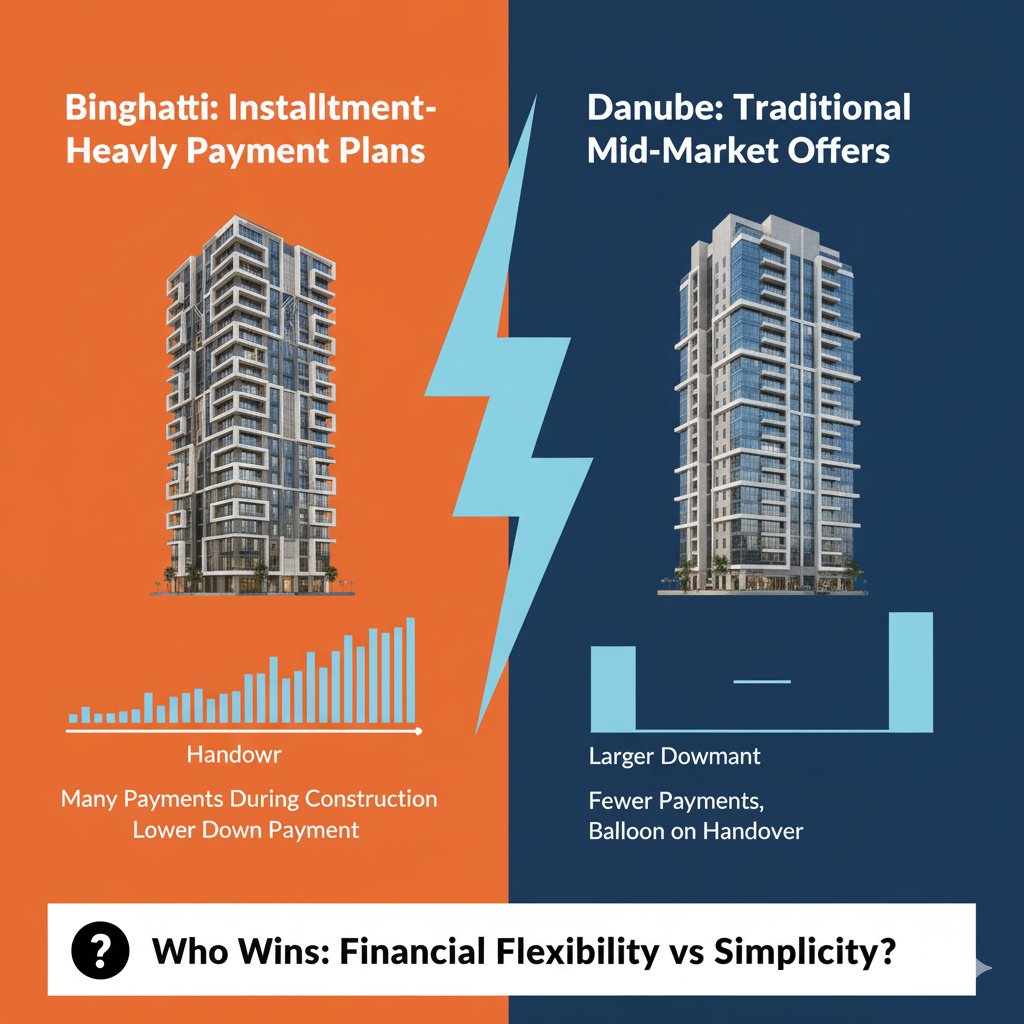
For investors comparing Binghatti vs Danube payment plans, the key difference is that Danube front-loads your monthly cash flow, while Binghatti keeps a more conventional “deposit + construction + handover” pattern.
3. Handover timelines and practical risk
3.1 Typical timelines
Both developers market handover dates that are fairly standard for off-plan properties in Dubai: often 3–4 years from launch, with phased completions.
- Binghatti projects like Binghatti Onyx, Binghatti Phoenix, Binghatti Ruby often show handovers in the 2–3 year window from launch.
- Danube announces similar timeframes, with its 1% plan designed to run until completion.
3.2 Delay reality
In practice, investors in Dubai should assume:
- Off-plan projects may have up to 6–12 months of allowable delay written into the SPA, with limited penalties.
- Online discussions and reviews reference some handover delays and snagging issues for various mid-market developers, including Danube and others, which is common in this segment.
This is not unique to Binghatti or Danube, but the impact on you differs because of the payment model:
- With Binghatti, you are paying construction-linked instalments; delays may shift milestone dates but not radically change your monthly burden.
- With Danube, 1% monthly instalments continue, so a long delay can mean extra months of payments before you can rent or flip.
For investors, the question becomes: how comfortable are you with paying 1% monthly for longer than expected if completion moves?
4. Cash flow, leverage, and ROI implications
4.1 JVC and mid-market yields
JVC remains one of Dubai’s most active and high-yield districts:
- Average apartment prices in recent reports: AED 850–1,300 per sq ft, still below many prime areas.
- Studios and 1BRs often achieve 8%+ gross rental yield, with larger units around 6.5–7%.
These yields underpin the appeal of Binghatti JVC apartments for sale and Danube JVC projects alike.
4.2 How Binghatti’s structure affects ROI
For Binghatti:
- You typically commit a 20% down payment and then pay the rest in stages.
- If you aim to take a mortgage at handover, your equity is clear, and banks are used to this structure.
- Delays may push back income start dates, but your instalments are spaced around build milestones rather than a fixed 1% every month.
This can feel more manageable for investors who want flexibility or expect to refinance at completion.
4.3 How Danube’s 1% structure affects ROI
For Danube:
- The Danube 1% payment plan is attractive in marketing: “own from 1% a month”.
- In reality, you are paying a fixed 1% of the full property price every month (after an initial down payment), so by handover, you may have paid most or all of the purchase price.
- This is helpful if you are replacing rent with installments and plan to live in the unit.
For investors, the risk is:
- If your income drops or you lose your job, the fixed 1% monthly payment can become a strain.
- If the handover is delayed, you continue paying 1% longer without rental income.
- You may have less room to use bank leverage because you have already paid down most of the property.
In short, Danube’s plan shifts risk from the bank to you: you act like your own financier with a heavy monthly commitment.

5. Investor risk profile: who should choose which?
5.1 Binghatti: better suited to…
- Investors who want classic mid-market off-plan structures.
- Buyers planning a mortgage at handover or a resale close to completion.
- Those comfortable with construction-linked instalments rather than a rigid monthly 1%.
Binghatti’s approach can be more flexible if you want to adjust your strategy mid-way—refinance, sell, or hold and rent.
5.2 Danube: better suited to…
- Salary-based buyers who are comfortable treating the 1% per month as “rent replacement”.
- End-users or long-term hold investors who want to fully pay down the home pre-handover.
- People with stable income who prioritise low initial capital and a simple monthly schedule over traditional banking.
However, given the fixed monthly burden, job security and emergency buffers are crucial for Danube buyers.
Conclusion
In the Binghatti vs Danube debate, the key issue is how you want to pay, not just what you want to buy.
- Binghatti offers more traditional mid-market payment plans (20/50/30-style), making it easier to combine with mortgages, adjust strategies, and manage risk via banks and construction milestones.
- Danube offers installment-heavy 1% payment plans, making property ownership more psychologically accessible for many expats – but shifting much of the financing risk and monthly obligation onto you.
If you:
- Prefer flexibility, bank leverage, and more conventional risk-sharing → Binghatti-style plans may be smarter.
- Prefer predictable monthly instalments, want to avoid banks early on, and have a stable income → Danube 1% plans can work, provided you accept the heavier cash flow demand.
For long-term ROI, both developers operate in high-yield mid-market communities in Dubai. The question is less about which brand is “better” and more about which payment and risk structure fits your personal financial reality.
If you want a personalised breakdown of Binghatti vs Danube – including real unit options, updated pricing, and custom cash-flow scenarios for both 20/50/30 and 1% plans – our team can help you choose the right structure.
- Visit prelaunch.ae and fill up the form on our website to receive curated options and detailed ROI projections.
- Or contact us directly at:
Phone: (+971) 52 341 7272
Email: [email protected]
FAQs
Q1. Is the Danube 1% payment plan cheaper than a mortgage?
Not necessarily. The Danube 1% payment plan is a different structure, not automatically cheaper. You still pay the full property price; the main difference is timing and who carries the financing risk (you vs the bank). It can feel easier monthly, but you should compare it to a mortgage scenario with a broker or advisor.
Q2. Are Binghatti projects better for investors than Danube projects?
Both developers operate in mid-market investment areas in Dubai and can deliver good yields. Binghatti may suit investors who prefer classic payment plans and flexibility at handover, while Danube may appeal to those who like fixed monthly instalments and want to avoid early bank involvement.
Q3. What happens if I cannot keep paying the 1% monthly to Danube?
If you miss payments, you risk penalties and, in a worst-case scenario, termination under the SPA terms. It is critical to read the contract, understand Dubai Land Department rules, and maintain a financial buffer. Always get independent legal or financial advice before committing.
Q4. Do Binghatti or Danube guarantee on-time handover?
No developer can genuinely “guarantee” on-time handover. Most SPAs in Dubai allow for certain delays. You should assume potential slippage and structure your finances so that a 6–12 month delay does not cause a crisis.
Q5. Which is better for a first-time investor: Binghatti or Danube?
If you have stable income and like the idea of paying a fixed 1% per month instead of rent, Danube can be attractive. If you prefer traditional payment plans and the option to use a mortgage at handover, Binghatti may feel more comfortable. The “better” choice depends entirely on your cash flow, risk tolerance and exit strategy.