In real estate investment, the most valuable signals are not price charts or transaction volumes. Those are lagging indicators — they confirm what has already happened. The leading indicators are the decisions made by developers who have operated successfully across multiple market cycles, in multiple geographies, over decades. When a developer of that calibre commits to a new market at city scale, it means they have done the analysis, weighed the risk, and concluded that the long-term return justifies a generational commitment.
Sobha Realty has been building in the UAE for more than two decades. It has delivered residential communities in Dubai that are consistently among the most sought-after in the emirate. And in 2025, it has chosen to enter Abu Dhabi — not with a single tower, not with a boutique project, but with Sobha City: a fully integrated, city-scale master-planned community that represents the developer’s most ambitious commitment to any single location outside its Indian home market.
This article analyses what that decision means — for Abu Dhabi’s off-plan property market, for investors currently comparing Dubai vs Abu Dhabi off-plan investment, and for buyers who want to understand whether Sobha Realty Abu Dhabi investment represents a genuine opportunity or simply well-executed marketing. For a full overview of what Sobha City delivers as a product, start with our complete Sobha City Abu Dhabi buyer’s guide.
Five Decades of Discipline: Understanding the Sobha Track Record
Sobha Realty was founded by Mr PNC Menon, a craftsman whose career began in interior fit-out and evolved into a philosophy of total ownership over construction quality. That philosophy produced a structural decision that still defines the company today: Sobha would own every part of the build process, rather than delegating it to a supply chain of contractors whose incentives may not align with the developer’s quality commitments.
Over five decades, that model has been applied across six countries: the UAE, India, the United Kingdom, the United States, Italy, and Australia. Sobha has delivered millions of square feet of residential, commercial, and hospitality real estate in each of these markets — in every case, to the same standard, using the same backwards-integrated production model. The company does not have a different quality threshold for different geographies. The discipline is consistent.
For off-plan investors in Abu Dhabi, that track record is not background information — it is the primary risk mitigation argument. Buying off-plan means buying a promise. The probability that the promise is kept is directly proportional to the developer’s history of keeping it. Sobha Realty has a five-decade, six-country, independently verifiable record of doing exactly that.
Abu Dhabi’s Market Fundamentals in 2025: Why the Timing Is Structural
Developer confidence does not exist in a vacuum. Sobha Realty’s decision to enter Abu Dhabi at city scale in 2025 is inseparable from the market conditions that made that decision rational. Those conditions are not cyclical noise — they are structural shifts that have been building since 2022 and show no sign of reversing.
| Market Indicator | 2025 Data Point |
| Total H1 2025 transactions | AED 53.2 billion |
| Off-plan share of all deals | 68% (up from 55% in 2024) |
| Residential price growth (YoY Q3 2025) | +15.5% |
| Prime area price growth (Yas, Saadiyat) | 20%+ in select segments |
| International buyer share | 42% of all transactions |
| Foreign direct investment growth (2022-2024) | +363% |
| Non-oil GDP growth (Q1 2025) | +6.1% |
| Population growth (YoY 2025) | +4.2% to 3.5 million |
| Off-plan vs ready ROI differential | Off-plan delivers 31% higher returns |
Each of these figures tells part of the story. Together, they describe a market where organic demand is growing (population up 4.2%), global capital is arriving (international buyers at 42%, FDI up 363%), the government is enabling ownership (Golden Visa, freehold expansion), and prices are rising on a base that is not yet at the premium ceiling that comparable global markets command. That combination — growth, accessible entry, and strong institutional backing — is precisely the environment where a disciplined developer with a long-term horizon chooses to plant its flag.
Abu Dhabi’s new Law No. (2) of 2025 has also strengthened the regulatory framework further, introducing triple-layer protection for developers, purchasers, and financiers, and requiring at least 20% project completion before developers can access escrow funds. For off-plan investors comparing Abu Dhabi and Dubai, this places Abu Dhabi’s regulatory environment among the most investor-protective globally.
City Scale vs Tower Scale: Why the Commitment Matters
There is a fundamental difference between a developer launching a single residential tower in a new market and a developer launching a master-planned city. A tower is a product. A master-planned community is a decade-long commitment to a specific location, a specific community, and a specific vision of what urban life should look like.
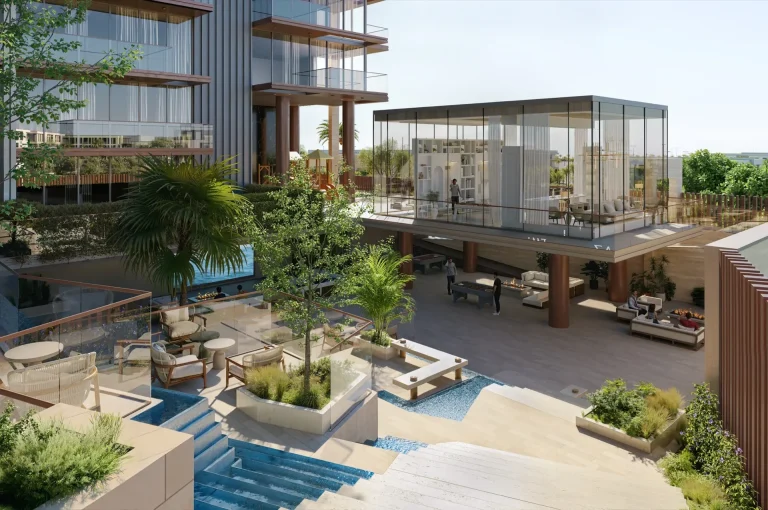
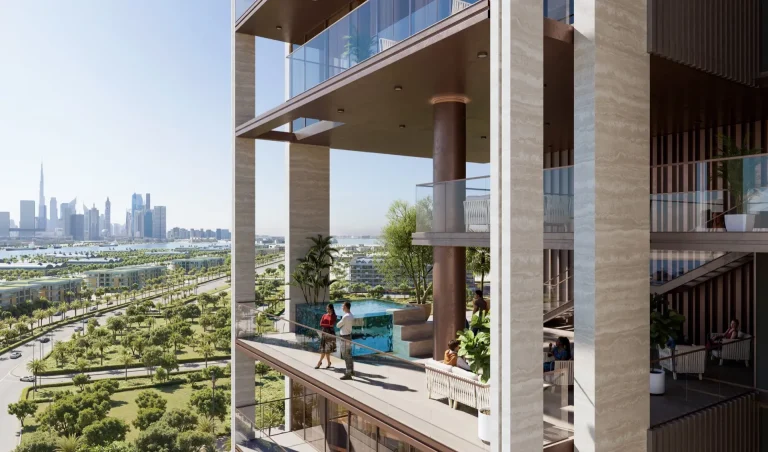
Sobha City is the latter. With 50,000+ trees, a 20 km wellness loop, a 2 km waterfront promenade, a Par-3 golf course, estate villas, retail corridors, community spaces, and an anticipated completion spanning to December 2029, this is a commitment that cannot be unwound, rebranded, or quietly repositioned if market conditions change. Sobha Realty is structurally locked into delivering this community to its stated standard — and the track record across five decades and six countries provides strong evidence that their definition of delivery matches what buyers have been shown.
For investors, city-scale developments carry a compounding advantage that towers do not: as the community reaches completion and critical mass, the value of the earliest-acquired units rises not just from market appreciation but from community maturity. The first buyers in a well-executed master-planned community benefit from the infrastructure investment of every subsequent phase — not just their own unit’s specifications.

Sobha City and Abu Dhabi Vision 2030: Structural Alignment
One of the most durable risk mitigators in any real estate investment is alignment with government policy. Developments that support — and are supported by — long-term government planning benefit from preferential infrastructure investment, regulatory tailwinds, and the sustained demand that follows government-led population and economic growth.
Sobha City is explicitly aligned with Abu Dhabi Vision 2030 across multiple dimensions:
- Sustainability: The masterplan’s landscape-led cooling strategy, 60% green space ratio, shaded walkway network, and reduced car dependency directly support Abu Dhabi’s Estidama sustainability framework — the emirate’s built environment rating system that governs energy, water, and ecological performance in new developments.
- Walkable urbanism: Abu Dhabi Vision 2030 prioritises walkable, mixed-use communities that reduce transport emissions and support active lifestyles. Sobha City’s integrated masterplan — with daily conveniences, wellness infrastructure, and community spaces within walking distance of every residential cluster — is a direct built expression of that policy direction.
- Quality residential supply: Abu Dhabi’s 2030 plan calls for diversified, high-quality residential supply to attract and retain international talent. Sobha City’s estate villa product — at a standard that competes with any comparable offering globally — contributes directly to the emirate’s ability to position itself as a destination for world-class residential living.
- Economic diversification: The non-oil sector now contributes over 56% of Abu Dhabi’s GDP. Residential real estate — particularly large-scale, internationally recognised developments — supports financial services, hospitality, retail, and construction employment. Sobha City’s scale makes it a meaningful contributor to Abu Dhabi’s diversification agenda.
Government-aligned developments in the UAE have historically outperformed on capital appreciation, because the infrastructure investment that follows policy commitments is both substantial and sustained. Sobha Realty has chosen a location and product philosophy that places Sobha City at the intersection of the UAE capital’s highest-priority growth vectors.
Dubai vs Abu Dhabi: How Should Off-Plan Investors Think About the Choice?
The most common strategic question facing UAE off-plan investors in 2025 is not which project to buy — it is which emirate to buy in. Dubai has had the dominant share of off-plan investor attention for the past five years. Its transaction volumes, developer pipeline, and international brand recognition are all exceptional. But the question for a disciplined investor is not where the market has been — it is where the value is.
| Factor | Dubai Off-Plan | Abu Dhabi Off-Plan |
| Market maturity | Highly developed | Earlier-stage premium cycle |
| Price growth (2025 YoY) | +15.6% | +15.5% overall; 20%+ prime |
| Off-plan transaction share | 71.3% of residential | 68% of residential |
| International buyer share | High; well-established | 42% and growing rapidly |
| Entry price ceiling | Premium in most zones | Below are comparable global cities |
| Regulatory protection | RERA: strong framework | ADREC + 2025 Law; triple protection |
| Master-planned community supply | Abundant | Limited; growing |
| Golden Visa threshold | AED 2 million | AED 2 million |
The table reflects a market that is moving in the same direction as Dubai — but from a lower base, with stronger regulatory momentum, and with a constrained supply of high-quality master-planned product. For investors who entered Dubai’s off-plan market in 2019 or 2020, the returns from that entry point have been exceptional. The equivalent entry point in Abu Dhabi — based on the current cycle’s fundamentals — may well be 2025 and 2026.
Within Abu Dhabi’s off-plan landscape, Sobha City occupies a unique position: it is the only city-scale master-planned community currently available from a globally recognised developer with a verified five-decade track record. That combination of developer credibility, product quality, location, and market timing is not replicated elsewhere in the Abu Dhabi off-plan pipeline as it stands today.
The specific location advantages that give Sobha City its long-term investment edge — including proximity to Yas Island, Zayed International Airport, and the upcoming Disneyland Abu Dhabi — are covered in detail in our Sobha City location and connectivity guide.
The Backwards Integration Advantage: Quality as an Investment Thesis
Most investment analysis of Abu Dhabi off-plan property focuses on location, price, and developer brand. Fewer analyses engage with the question of construction quality as an investment variable — but for long-term investors, it is one of the most important.
A property that is delivered at the standard shown in the sales presentation retains its positioning in the rental market, commands the asking price at resale, and does not require significant remedial expenditure in its early years of occupation. A property that is delivered below that standard — because quality was delegated to a subcontractor chain with insufficient oversight — depreciates against its marketed position from day one.
Sobha’s backward integration model — owning construction, interior fit-out, MEP, and landscaping within the same corporate structure — is the mechanism by which the delivery standard is controlled. When every tradesperson on a Sobha site is a Sobha employee, working to Sobha specifications, supervised by Sobha managers, the gap between promise and delivery is structurally minimised. This is not an assertion — it is an observable outcome across Sobha’s delivered portfolio in Dubai, where resale pricing in Sobha communities has consistently held at or above comparable developments in adjacent locations.
For HNW investors and long-term capital allocators evaluating the Sobha Realty Abu Dhabi investment, build quality is not a soft differentiator. It is a financial variable that affects yield, resale liquidity, and total return over the investment horizon.
Investment Signals: How to Read the Sobha City Launch
For investors trained to read developer behaviour as market intelligence, the Sobha City launch carries several compounding signals:
- City-scale commitment in a new emirate signals sustained, long-term developer investment — not opportunistic market entry. Sobha cannot exit Abu Dhabi without consequence, which means the company’s incentives are permanently aligned with the community’s quality and the emirate’s growth.
- Master-plan design led by nature and sustainability signals alignment with Abu Dhabi Vision 2030 — the government policy framework that will drive infrastructure investment, regulatory support, and population growth in communities that meet its standards.
- December 2029 ACD signals an entry window that captures the full appreciation period leading to Disneyland Abu Dhabi’s anticipated opening — the single largest demand catalyst in Abu Dhabi’s near-term pipeline.
- Backwards-integrated developer signals reduced delivery risk relative to projects built through subcontractor chains — a variable that directly affects the probability of receiving what was purchased at the price it was purchased for.
- Global developer entering a new market signals that independent analysis — conducted by a company with the resources and track record to conduct it rigorously — supports a positive long-term view of Abu Dhabi’s residential market fundamentals.
Individually, each of these signals is informative. Together, they represent the kind of investment-grade convergence that disciplined capital allocators look for and rarely find simultaneously in a single project. For buyers evaluating the residential villa product that underpins this investment thesis, our detailed guide covers every specification: Sobha City Estate Villas — 6-Bedroom Homes With Private Pools and December 2029 Delivery.
Act on the Signal: Register Your Interest in Sobha City Abu Dhabi
The convergence of a five-decade developer, a city-scale masterplan, a strategically located site near Yas Island, a December 2029 delivery aligned with Abu Dhabi’s most significant upcoming demand catalysts, and a market in the early stages of its premium cycle represents one of the clearest off-plan investment opportunities in the UAE available in 2025. The investors who act at this stage — before completion, before the Disneyland Abu Dhabi opening, before the full weight of international capital pricing in Abu Dhabi’s growth trajectory — will capture the maximum appreciation window.
Fill out the enquiry form at prelaunch.ae to receive the latest Sobha City brochure, pricing, and payment plan options directly from our advisory team.
Or contact us directly:
- Phone: (+971) 52 341 7272
- Email: sales@mbrproperties.ae
Our consultants at MBR Properties specialise in Abu Dhabi and Dubai off-plan investment with direct developer relationships, exclusive pre-launch access, and guidance provided at no additional cost to the buyer.
Frequently Asked Questions
Q: Is Sobha Realty a reliable developer for Abu Dhabi off-plan investment?
A: Yes. Sobha Realty has a five-decade track record of delivering residential real estate across six countries — UAE, India, UK, USA, Italy, and Australia — using a backwards-integrated model that means Sobha owns and controls every element of the construction process. This significantly reduces delivery risk relative to developers who depend on subcontractor chains.
Q: What makes Abu Dhabi’s off-plan market attractive for investors in 2025?
A: Abu Dhabi recorded AED 53.2 billion in H1 2025 real estate transactions, with off-plan deals accounting for 68% of all residential sales. Residential prices grew 15.5% year-on-year in Q3 2025, with prime areas posting 20%+. International buyers represented 42% of transactions. The market is in an earlier stage of its premium cycle than Dubai, with a lower entry price base and strengthened regulatory protections under Abu Dhabi’s 2025 property law.
Q: How does Sobha City align with Abu Dhabi Vision 2030?
A: Sobha City’s masterplan directly supports Abu Dhabi Vision 2030 through its landscape-led cooling strategy, 60% green space ratio, walkable community design, and commitment to reduced car dependency — all priorities under Abu Dhabi’s Estidama sustainability framework.
Q: Should I invest in Dubai or Abu Dhabi off-plan property in 2025?
A: Both markets offer strong fundamentals. Dubai’s market is more mature with higher transaction volumes. Abu Dhabi’s market is in an earlier stage of its premium cycle — with comparable price growth, strengthening international demand, tighter regulatory protection, and constrained supply of high-quality master-planned product. For investors seeking earlier-cycle entry with strong developer credentials, Abu Dhabi’s 2025 window — particularly through a project like Sobha City — represents a compelling case.
Q: What is the significance of Sobha Realty entering Abu Dhabi at the city scale?
A: A city-scale master-planned community represents a permanent, decade-long commitment to a market. It signals that Sobha’s internal analysis supports a sustained positive view of Abu Dhabi’s residential fundamentals — and that the developer is willing to stake its global reputation on delivering that view in built form.