The uncomfortable truth about the Dubai property crash 2026 that most agents won’t tell you: not every community faces equal risk. While YouTube influencers and Instagram property gurus paint Dubai’s entire market with the same broad brush—either all bull or all bear—the reality involves surgical precision. Some communities are sitting on powder kegs of oversupply, infrastructure deficits, and speculative excess. Others possess defensive moats that should weather even aggressive corrections with minimal damage.
Understanding the difference between Dubai areas to avoid 2026 and resilient communities could mean the difference between catastrophic losses and modest gains, between panicked selling and confident holding. This analysis strips away the hype to reveal three specific areas where data suggests serious vulnerability, alongside the one community that possesses nearly bulletproof fundamentals against the incoming supply tsunami. For investors evaluating risk areas outside of plan Dubai, understanding these distinctions isn’t optional—it’s survival.
The Supply Reality Check: Why 2026 Is Different
Before identifying specific vulnerable zones, let’s establish why 2026 represents a genuinely unique challenge rather than typical market noise. Dubai faces delivery of approximately 47,000 residential units in 2026, followed by another 72,000 in 2027—totaling 119,000 units across just two years. To contextualize this magnitude, Dubai delivered roughly 30,000-35,000 units annually between 2018-2020, meaning we’re seeing near-triple normal supply levels.
However, this supply isn’t distributed evenly. Some communities receive minimal new inventory while maintaining strong demand fundamentals. Others face the nightmare scenario: massive new supply hitting areas already showing infrastructure strain and weakening price momentum. The difference between these scenarios determines whether you’re holding tomorrow’s bargain or today’s value trap, as explored when analyzing broader market corrections and their selective impacts.
| Risk Factor | Jumeirah Village Circle | Business Bay Corridors | Select Dubai South Pockets | Palm Jumeirah |
| 2026 New Supply | 5,000-6,000 units | 4,500-5,500 units | 3,000-4,000 units | 800-1,200 units |
| % of Existing Stock | 12-15% | 8-10% | 15-20% | 2-3% |
| Infrastructure Readiness | Poor | Mixed | Developing | Excellent |
| Crash Risk Rating | HIGH | MEDIUM-HIGH | MEDIUM | VERY LOW |
Crash Zone #1: Jumeirah Village Circle – The Oversupply Epicenter
Projected Price Impact: -10% to -15% through 2027
Risk Rating: HIGH
If any single Dubai community embodies textbook oversupply conditions, Jumeirah Village Circle takes the unwanted crown. This once-charming family-friendly area now faces existential challenges that should make investors extremely cautious about new commitments here.
The Numbers Tell a Brutal Story
JVC currently houses approximately 40,000+ residential units spread across dozens of mid-rise buildings. In 2026 alone, another 5,000-6,000 units will complete—representing 12-15% additional supply atop an already saturated base. This isn’t modest infill development; it’s structural oversupply that overwhelms absorption capacity even under optimistic demand scenarios.
The community’s original appeal centered on affordability (AED 900-1,400 per sq ft) and family-oriented layouts with reasonable proximity to key employment zones. However, these advantages erode rapidly when multiple competing communities offer identical value propositions. Dubai South, Dubailand districts, and Town Square all target the same affordable family segment, creating a race to the bottom on pricing as developers compete for limited buyer pools.
Infrastructure: The Achilles Heel
Perhaps more concerning than raw supply numbers is JVC’s infrastructure deficit. The community’s road network, designed when the population was half its current levels, now suffers chronic congestion. Parking shortages plague many buildings. Schools struggle with capacity constraints despite multiple new openings. Retail offerings remain underwhelming given population density.
When infrastructure can’t keep pace with density increases, residential appeal diminishes regardless of pricing. Families—JVC’s core demographic—increasingly bypass the area for alternatives offering a better quality of life, even if slightly more expensive. This dynamic creates downward price pressure that raw supply statistics alone don’t capture, echoing patterns seen when analyzing Dubai property price trends across multiple cycles.
Investor-Heavy Ownership Amplifies Volatility
Approximately 60%+ of JVC properties serve as rental investments rather than owner-occupied homes. While this creates robust rental markets during boom times, it amplifies downside during corrections. Investor owners lack emotional attachment to properties and will liquidate quickly if rental yields compress or capital depreciation accelerates. This cascade effect—multiple investors simultaneously seeking exits—creates precisely the selling pressure that transforms modest corrections into crashes.
The Verdict: JVC represents a clear Dubai area to avoid 2the 026 warning sign. If you own here, prepare for price weakness and potentially lower rental yields as supply peaks. If considering a purchase, wait until late 2027 when post-correction pricing should create genuine value opportunities. The community will likely recover eventually, given strong fundamentals in terms of location and established infrastructure, but timing matters enormously.
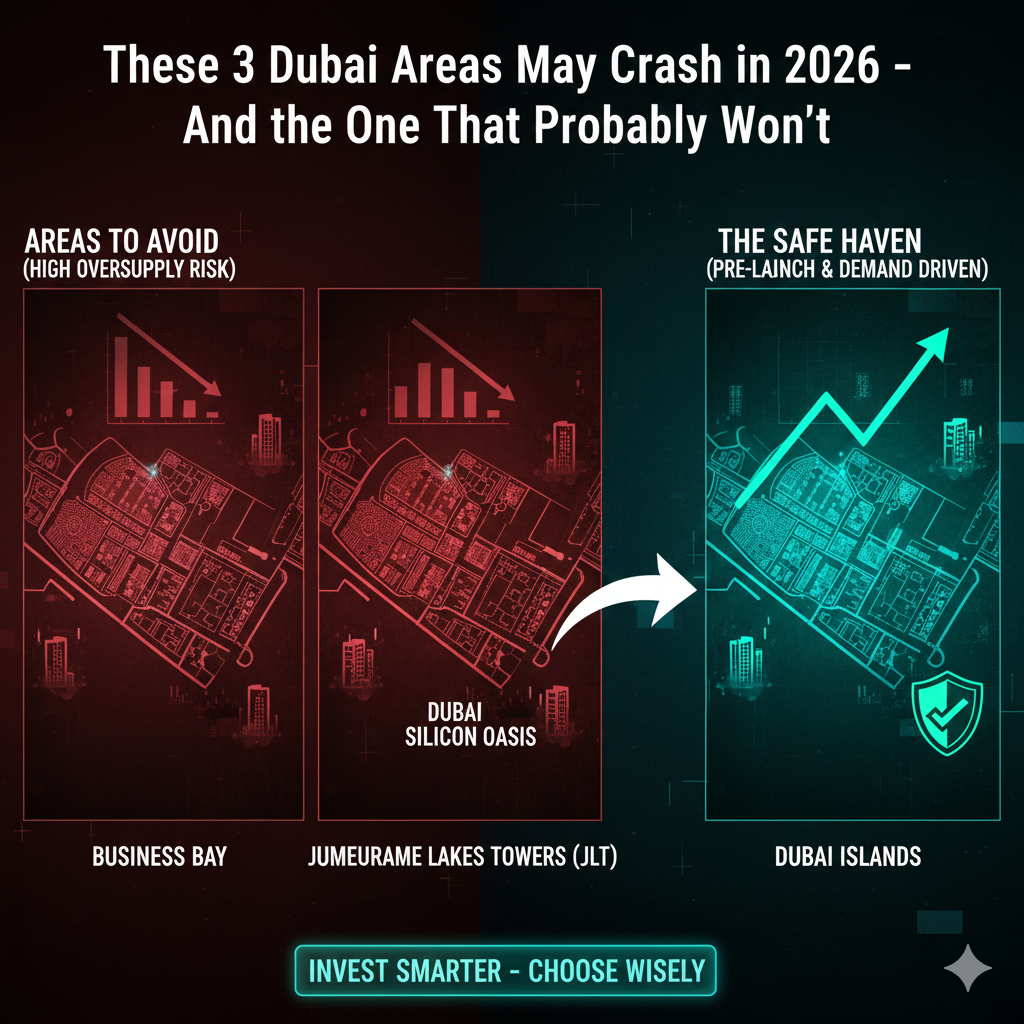
Crash Zone #2: Business Bay Secondary Corridors – Premium Pricing, Commodity Product
Projected Price Impact: -8% to -12% in vulnerable buildings
Risk Rating: MEDIUM-HIGH (location-specific)
Business Bay presents a more nuanced crash risk than JVC because outcomes vary dramatically between canal-front premium properties and secondary corridor commodity towers. This geographic specificity makes Business Bay the hardest area to evaluate for risk areas in the off-plan Dubai assessment.
The Premium-Commodity Divide
Properties directly fronting Dubai Water Canal or featuring unobstructed Burj Khalifa views command AED 2,200-2,800 per sq ft and attract genuinely affluent buyers seeking lifestyle amenities. These properties possess differentiating characteristics that justify premium pricing and should remain relatively resilient even during corrections.
However, “back row” towers located on secondary streets away from water features face entirely different dynamics. These buildings offer commodity apartment products at near-premium pricing (AED 1,800-2,200 per sq ft) without clear differentiation from less expensive alternatives in adjacent areas. When 4,500-5,500 new units completed in Business Bay during 2026, these undifferentiated secondary properties bear the brunt of absorption challenges.
Commercial Occupancy: The Wild Card
Business Bay’s residential appeal hinges partly on its evolution as a secondary business district, creating live-work proximity benefits. When commercial occupancy rates run healthy (75%+ occupied), residential demand follows naturally as professionals seek housing near offices. However, commercial space in Business Bay has shown concerning softness, with multiple towers reporting 50-60% occupancy rates.
If this commercial weakness persists—or worsens as new office supply completes—the residential market loses a key demand driver. Office workers who might have rented or purchased in Business Bay instead remain in established communities or opt for Dubai Marina and Downtown alternatives with superior lifestyle amenities, similar to patterns discussed when examining safe community Dubai property 2026 options.
Investment Strategy for Business Bay
The key distinction here involves precision rather than blanket avoidance. Canal-front buildings by established developers (Emaar, DAMAC premium projects) should weather corrections with 3-5% maximum drawdowns. Secondary corridor buildings—particularly those by lesser-known developers in congested pockets—face legitimate 8-12% correction risk.
If you own secondary corridor property, consider preemptive selling before peak supply hits in Q3-Q4 2026. If evaluating new purchases, strictly target canal-front premium stock or wait until corrections create 15%+ discounts in secondary areas.
Crash Zone #3: Dubai South Employment-Dependent Pockets – Timing Risk
Projected Price Impact: -5% to -10% if employment hubs delay
Risk Rating: MEDIUM
Dubai South occupies a fascinating middle ground in crash risk assessment. Unlike JVC’s clear oversupply or Business Bay’s commodity excess, Dubai South’s vulnerability stems primarily from a timing mismatch between residential delivery and employment hub activation.
The Promise vs. Reality Gap
The Dubai South masterplan envisions a thriving district housing 300,000+ residents supported by logistics zones, Expo City employment, and aviation-sector jobs from nearby Al Maktoum International Airport expansion. This vision is legitimate and likely to materialize over 5-10 year horizons. The question is whether the 2026-2027 residential supply arrives before employment demand fully activates.
Current Dubai South residential inventory approaches 15,000 units, with another 8,000-9,000 completing in 2026. If employment hubs scale as projected, this supply will be absorbed smoothly through actual end-user demand from workers seeking proximity to jobs. However, if employment growth disappoints or delays—perhaps due to airport expansion timeline slippage or slower-than-expected corporate relocations—Dubai South faces temporary oversupply, creating price pressure.
Pricing and Competition
Dubai South’s affordable positioning (AED 800-1,200 per sq ft) theoretically provides downside protection by targeting budget-conscious segments. However, this pricing band faces intense competition from JVC, Dubailand, and Town Square, all offering similar value propositions. During corrections, the cheapest areas often face the steepest percentage declines as buyers delay purchases entirely rather than discriminate between competing affordable options.
The community’s saving grace involves infrastructure investment preceding residential delivery—roads, utilities, and basic services are operational, unlike previous Dubai developments where promises preceded reality by years. This infrastructure readiness suggests Dubai South should avoid JVC-style crashes even in pessimistic scenarios, though modest corrections remain plausible if employment timing disappoints.
Strategic Approach
Dubai South represents calculated risk rather than a clear avoidance zone. Properties near operational employment centers (Expo City, existing logistics facilities) carry lower risk than speculative pockets dependent on future development. If considering Dubai South investment, verify proximity to actual job centers rather than masterplan promises, ensure developer is tier-one with strong delivery track record, and prepare for potential 5-10% interim corrections before long-term appreciation resumes, similar to strategies outlined when examining broader UAE off-plan investment approaches.
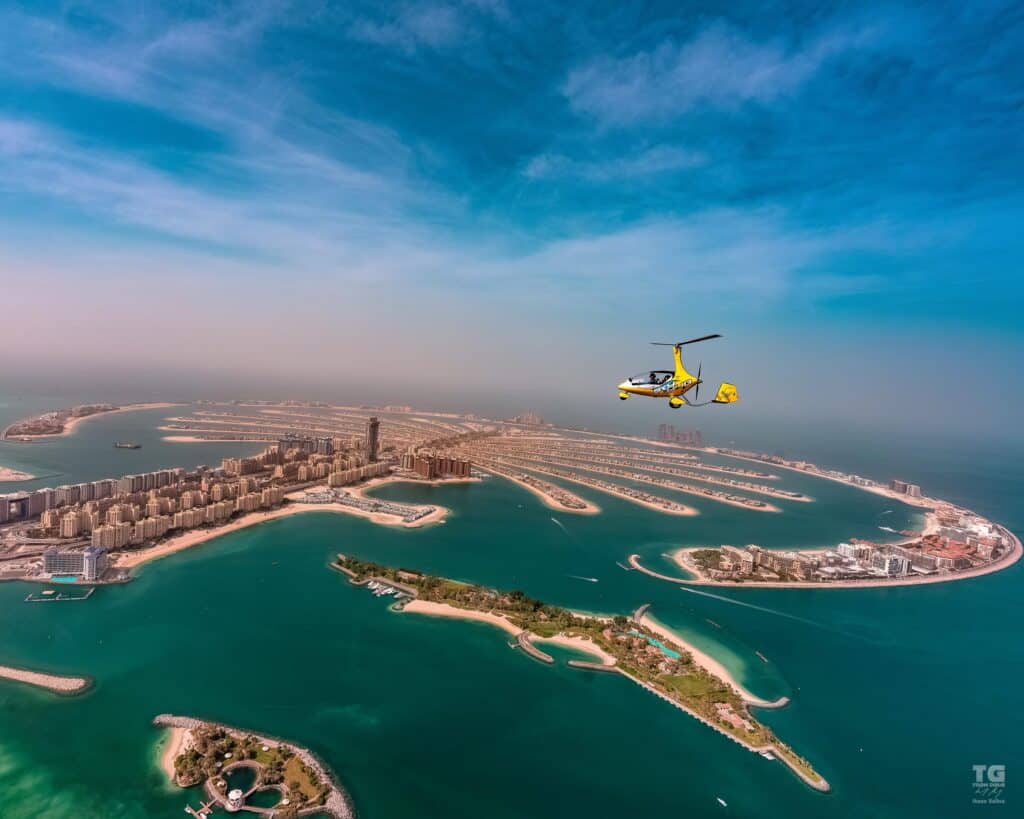
The Defensive Haven: Palm Jumeirah – Why This Icon Stays Strong
Projected Price Impact: 0% to +4% through 2027
Risk Rating: VERY LOW
If the three communities above represent varying degrees of crash risk, Palm Jumeirah exemplifies the opposite—a safe community, Dubai property 2026 investment with defensive characteristics that should weather even aggressive market corrections with minimal damage.
Supply Scarcity Creates Natural Price Support
The Palm’s most powerful defensive attribute is simple: land scarcity. Unlike mainland communities, where developers can continually acquire adjacent parcels and launch new projects, the Palm is a fixed geography. Only 800-1,200 new units will be completed in 2026—representing a mere 2-3% additional supply atop an existing base of approximately 40,000 units.
This supply-constrained dynamic creates natural price floors. Even if broader market corrections push prices down 10-15% in oversupplied areas, the Palm’s scarcity limits downside to perhaps 3-5% at most. Historical precedent supports this pattern: during the 2014-2019 downturn, Palm Jumeirah prices declined roughly 20% while mainland communities like Dubai Sports City fell 35-40%.
International Demand Provides Stability
The Palm attracts genuinely international buyer pools—wealthy Europeans, Asians, and Middle Easterners viewing Dubai as a secondary residence or lifestyle investment rather than pure financial speculation. This buyer demographic demonstrates lower price sensitivity and longer holding periods than typical investors chasing capital gains. When corrections occur, international lifestyle buyers often view them as opportunistic entry points rather than signals to flee.
Additionally, the Palm’s brand recognition transcends Dubai property markets. It’s one of the world’s iconic engineering achievements, featured in countless films, shows, and travel content. This global awareness creates a persistent demand that local market cycles impact less severely than generic communities dependent entirely on the UAE economic conditions.
Rental Yield Floor Limits Downside
Even pessimistic scenarios for Palm Jumeirah involve modest price corrections from current levels, not crashes. The reason involves rental yield floors that activate during price weakness. Currently, Palm apartments generate 4-5% yields and villas 3-4%. If prices decline meaningfully, yields rise proportionally, eventually reaching thresholds (6-7%) that attract new investor demand purely for income returns.
This self-correcting mechanism—where price declines automatically improve investment metrics—creates natural support levels that prevent cascading crashes. The Palm won’t escape 2026-2027 market dynamics entirely unscathed, but the downside appears limited to single-digit percentage corrections rather than the 10-15%+ crashes facing vulnerable areas, validating approaches discussed when examining ultra-luxury property resilience.
The Investment Case
For conservative investors prioritizing capital preservation over maximum gains, Palm Jumeirah represents optimal positioning during uncertain periods. You likely won’t achieve spectacular appreciation in 2026-2027, but you almost certainly won’t suffer catastrophic losses either. The community offers the rare combination of downside protection, moderate rental yields, and positioning for eventual market recovery whenever broader conditions improve.
| Defensive Characteristic | Palm Jumeirah | JVC | Business Bay | Dubai South |
| New Supply as % of Stock | 2-3% | 12-15% | 8-10% | 15-20% |
| International Buyer Appeal | Very High | Low | Medium | Low |
| Infrastructure Quality | Excellent | Poor | Mixed | Good |
| Downside Protection | Strong | Weak | Medium | Medium |
Strategic Action Plan: Positioning for 2026 Uncertainty
Understanding which areas face crash risk versus defensive strength means little without converting knowledge into strategic action. Here’s how to position yourself depending on current holdings and investment objectives.
If You Currently Own in High-Risk Zones (JVC, Secondary Business Bay)
Consider preemptive selling during early to mid-2026 before peak supply hits and correction narratives dominate market psychology. Yes, you might leave some upside on the table if corrections prove less severe than projected, but protecting capital matters more than capturing every percentage point. Alternatively, if committed to holding, prepare psychologically and financially for 10-15% paper losses and potentially compressed rental yields. Ensure adequate reserves to weather 12-18 months of potential weakness without forced selling.
If Evaluating New Purchases in Risk Zones
Wait. Patience costs nothing except opportunity cost, and the downside protection from waiting until post-correction clarity emerges far exceeds any modest appreciation you might capture by buying prematurely. If you absolutely must enter these markets, demand significant discounts—15%+ below current comparable sales—to compensate for elevated risk exposure.
If Targeting Defensive Communities (Palm, Dubai Marina, Downtown)
Defensive areas rarely offer spectacular timing opportunities because their stability attracts consistent demand, preventing deep distressed sales. However, late 2026 or early 2027 may present modest 5-8% corrections even in defensive zones as broader market psychology turns negative. These windows represent optimal entry points for conservative investors, as detailed when examining strategic timing for 2025-2026 investment windows.
If Considering Alternative Emirates
Don’t overlook opportunities outside Dubai entirely. Abu Dhabi’s supply-constrained market offers 8-9% rental yields with minimal crash risk, while Ras Al Khaimah provides emerging value at 30-50% discounts to Dubai pricing. Geographic diversification across multiple UAE emirates can provide portfolio stability that pure Dubai concentration cannot, particularly when examining comparative opportunities in Abu Dhabi’s highest ROI zones.
The Bottom Line: Data Over Drama
The Dubai property crash 2026 narrative contains kernels of truth wrapped in layers of exaggeration. Yes, significant supply arrives. Yes, certain communities face legitimate oversupply challenges. But blanket crash predictions ignore critical nuance: Dubai’s market isn’t monolithic. Some areas possess defensive characteristics that should weather corrections gracefully, while others face genuine vulnerability requiring either avoidance or extraordinary caution.
Your success in 2026-2027 depends less on predicting overall market direction—which remains genuinely uncertain—and more on selecting specific communities and property types aligned with your risk tolerance and investment horizon. Conservative investors should favor defensive havens like Palm Jumeirah despite premium pricing and modest appreciation potential. Opportunistic investors might wait for corrections in fundamentally sound but temporarily oversupplied areas like Dubai South. Aggressive speculators… well, aggressive speculators probably shouldn’t be operating in highly uncertain environments where multiple scenarios remain plausible.
The winners in Dubai’s 2026-2027 market won’t be those who made perfect predictions—perfect predictions are impossible in complex adaptive systems. Winners will be those who understand probability distributions, position defensively where appropriate, size positions conservatively, and maintain dry powder to capitalize on opportunities as market dynamics clarify. That’s not sexy or dramatic, but it’s effective.
Partner with Experts Who See Through the Hype
Navigating Dubai’s complex property landscape during uncertain periods requires more than reading articles—it demands partnership with specialists who combine deep local expertise with data-driven analysis. At Prelaunch.ae, we help clients separate genuine opportunities from value traps, identify defensive positioning aligned with individual risk profiles, and execute strategies maximizing risk-adjusted returns regardless of market direction.
Our team monitors supply pipelines, absorption rates, infrastructure development, and pricing trends across every Dubai community, providing clients with granular insights that transform uncertainty into strategic advantage. Whether you’re seeking to preserve capital in defensive communities or capitalize on eventual corrections in oversupplied zones, we provide personalized guidance tailored to your specific circumstances.
Ready to position your portfolio for 2026 market dynamics? Fill out the form on our website prelaunch.ae, to receive comprehensive community risk assessments, exclusive pre-launch access in supply-constrained areas, and strategic guidance from experts who prioritize your long-term success over short-term commissions.
Contact our team directly:
- Phone: +971 52 341 7272
- Email: sales@mbrproperties.ae
Don’t let 2026 uncertainty paralyze your decision-making or expose you to unnecessary risks. Partner with Prelaunch.ae to navigate Dubai’s evolving market with confidence, clarity, and strategic positioning that separates crash victims from correction winners.
Frequently Asked Questions
Q: Will Dubai’s entire property market crash in 2026, or only specific areas?
The evidence strongly suggests selective corrections in oversupplied areas rather than systemic market-wide crashes. Communities like Jumeirah Village Circle receiving 12-15% additional supply atop saturated bases face legitimate 10-15% correction risk. Business Bay secondary corridors and certain Dubai South pockets show medium risk with potential 8-12% declines. However, supply-constrained defensive areas like Palm Jumeirah, Dubai Marina, and Downtown Dubai should experience minimal impact—perhaps 0-5% corrections at most—due to limited new inventory and sustained international demand. The differentiation between these outcomes depends on supply-demand dynamics specific to each community rather than broad market forces.
Q: Should I sell my JVC property before the 2026 correction hits?
If you own JVC property and can sell without significant transaction costs or tax implications, seriously consider preemptive exit during early-to-mid 2026 before peak supply completes. The community faces structural oversupply that could pressure prices 10-15% through 2027, and investor-heavy ownership creates cascade risk where multiple sellers compete simultaneously. However, if you’re holding for long-term rental income and can weather 12-18 months of price weakness without forced selling, the correction may eventually create recovery opportunities as supply normalizes post-2027. Your decision should balance transaction costs against potential correction magnitude and your individual liquidity requirements.
Q: Are there any safe off-plan investments in Dubai for 2026 delivery?
“Safe” involves degrees rather than absolutes, but off-plan projects in supply-constrained prime locations offer better risk profiles than commodity developments in oversupplied zones. Target projects in Palm Jumeirah, Dubai Marina, or Downtown Dubai by tier-one developers (Emaar, Nakheel, Meraas) where limited competing supply provides natural downside protection. Alternatively, consider projects with 2028-2029 delivery dates rather than 2026 completions—you capture extended payment plans while avoiding peak supply period risks. The safest approach involves waiting until late 2026 or early 2027 when post-correction pricing creates clearer value opportunities with reduced timing risk.
Q: How does Palm Jumeirah remain resilient when other Dubai areas face corrections?
Palm Jumeirah’s defensive characteristics stem from multiple reinforcing factors: severe land scarcity limiting new supply to just 2-3% of existing stock annually, international buyer appeal transcending local market cycles, established infrastructure eliminating execution risk, and brand recognition creating persistent global demand. Additionally, rental yield floors provide natural price support—if prices decline meaningfully, yields automatically rise, attracting income-focused investors who establish support levels. Historical precedent supports this resilience: during 2014-2019 corrections, the Palm declined roughly 20% while mainland communities fell 35-40%. These structural advantages don’t make the Palm crash-proof, but they create substantial downside protection unavailable in commodity communities.
Q: Should I wait until 2027 to buy Dubai property after all corrections complete?
Waiting until late 2026 or early 2027 provides maximum clarity about which communities successfully absorbed supply versus those facing prolonged weakness. However, perfect timing remains impossible—if you wait for absolute bottoms, you might miss optimal entry windows entirely. A more pragmatic approach involves staged entry: allocate 30-40% of intended capital during mid-2026 when initial correction signs emerge, reserve 30-40% for late 2026/early 2027 deployment if corrections deepen, and maintain 20-30% dry powder for opportunistic additions through 2027. This strategy balances timing risk against missing opportunities while maintaining flexibility to adapt as market dynamics evolve beyond current predictions.