In the high-stakes arena of Dubai’s off-plan property market, a peculiar phenomenon has emerged that defies conventional real estate wisdom. Projects that would traditionally require months of marketing and careful buyer cultivation now sell out completely within 48 hours of launch, often with waiting lists stretching into the hundreds. These viral off-plan launches create buying frenzies so intense that investors commit millions of dirhams with minimal due diligence, driven by an overwhelming fear of missing out on what appears to be the investment opportunity of a lifetime. The transformation from cautious analysis to impulsive commitment happens almost instantaneously, leaving industry observers and traditional marketers scrambling to understand what separates these 48-hour sell-out projects from conventional launches that struggle for months to achieve similar results.
The mechanics behind these rapid sell-outs represent far more than aggressive marketing or favorable pricing. These launches orchestrate sophisticated psychological operations that exploit fundamental human decision-making biases, social dynamics, and emotional triggers to create artificial urgency that overrides rational evaluation. Understanding the launch event choreography, social proof mechanics, and inventory depletion timing strategies that drive these phenomena reveals a playbook that combines behavioral psychology, scarcity manipulation, and social engineering to generate demand intensity that transforms ordinary property launches into cultural events that dominate conversations across investor networks and social media platforms.
As Dubai’s real estate market continues its explosive growth trajectory with off-plan transactions accounting for over 70% of residential sales in 2025 and total transaction values exceeding AED 326 billion, the pressure on developers to create standout launches has intensified dramatically. The market has become so saturated with quality projects offering attractive payment plans and prime locations that differentiation through product features alone no longer guarantees success. This competitive intensity has birthed a new breed of property launch strategies that prioritize psychological manipulation over fundamental value proposition, creating spectacles that generate demand through perception management rather than tangible superiority. For investors, developers, and market observers seeking to understand how modern real estate marketing has evolved into theater designed to bypass rational analysis, examining the anatomy of the 48-hour sell-out provides essential insights into where the industry stands and where it’s heading.
The Anatomy of Launch Event Choreography: Engineering the Perfect Storm
The foundation of every 48-hour sell-out phenomenon begins months before the official launch with meticulous launch event choreography designed to create an atmosphere of exclusivity, urgency, and inevitability that primes potential buyers for rapid commitment. These launches do not merely announce property availability but rather orchestrate multi-sensory experiences that transform real estate transactions into aspirational lifestyle events that buyers feel privileged to participate in, rather than commercial decisions requiring careful evaluation.
The pre-launch phase typically begins six to eight weeks before the official event with carefully calibrated information leaks and exclusive previews distributed through select channels. Developers initiate private conversations with high-net-worth investors, institutional buyers, and real estate influencers, providing confidential project details under non-disclosure agreements that create an inner circle of privileged insiders who feel special access to information unavailable to the general market. This insider cultivation serves multiple strategic purposes, including securing anchor commitments that can be announced during the public launch to demonstrate demand, generating authentic enthusiasm from credible sources who genuinely believe in the exclusive opportunity, and creating a perception hierarchy where public launch attendees feel they’re accessing something previously restricted to elite circles.
The strategic advantage of accessing pre-launch property opportunities before general market release creates legitimate competitive advantages that developers exploit to generate urgency. Early investors do secure better pricing, superior unit selection, and exclusive terms unavailable during public launches, validating the perception that delay costs money and opportunity. This reality foundation makes the manufactured urgency more credible because the scarcity and exclusivity are partially genuine rather than entirely fabricated, lending authenticity to the FOMO messaging that drives rapid commitments.
The actual launch event represents the culmination of this careful preparation, designed as an immersive theater rather than an informational presentation. Venues are selected not for convenience but for psychological impact—five-star hotel ballrooms, luxury yacht settings, or iconic landmark locations that subconsciously communicate prestige and exclusivity before any words are spoken. The physical environment incorporates elements borrowed from luxury fashion launches and technology product reveals rather than traditional real estate presentations, including dramatic lighting that focuses attention on architectural models and screens, curated music that builds emotional energy throughout the event, strategic seating arrangements that create social pressure through visibility and proximity, and carefully timed reveals that maintain suspense and anticipation rather than frontloading all information.
The presentation choreography follows a predictable yet effective sequence designed to build emotional momentum toward the commitment moment. Events typically open with developer credibility establishment through highlight reels showcasing previous successful projects and testimonials from satisfied investors, followed by market opportunity framing that positions the current launch within broader trends suggesting inevitable appreciation, then detailed project reveal emphasizing unique differentiators and lifestyle benefits, strategic pricing announcements that emphasize value relative to alternatives and limited-time launch discounts, and finally immediate action calls with on-site transaction facilitation and countdown timers displaying remaining availability in real time.
The bulk and corporate buyer strategies employed by sophisticated developers further amplify launch momentum by securing large block purchases before or during public events. These early commitments from institutional investors serve dual purposes of guaranteeing substantial sales regardless of retail buyer response and creating powerful social proof that sophisticated money managers with access to comprehensive analysis teams believe in the opportunity strongly enough to commit millions. When retail investors see that corporate buyers have secured entire floors or multiple units, the implicit message suggests that professional due diligence has already occurred and individual investors are simply following smart money rather than pioneering unproven concepts.
| Launch Choreography Element | Psychological Purpose | Execution Timeline | Impact on Urgency | Risk to Buyers |
| Pre-Launch Insider Cultivation | Create an exclusivity perception | 6-8 weeks before launch | Medium – builds anticipation | Low – genuine early access |
| Venue & Environmental Design | Communicate luxury & prestige | Event day execution | Medium – influences mood | None – atmospheric |
| Information Reveal Pacing | Maintain emotional momentum | Throughout the 90-minute event | High – prevents reflection | Medium – limits analysis time |
| Social Proof Integration | Trigger herd behavior | Real-time during the event | Very High – overrides skepticism | High – bypasses due diligence |
| Scarcity Countdown Displays | Force immediate decisions | Final 30 minutes | Extreme – eliminates deliberation | Very High – pressure tactics |
Social Proof Mechanics: The Herd Instinct That Overrides Analysis
The most powerful psychological lever in the 48-hour sell-out playbook involves sophisticated exploitation of social proof dynamics that transform individual investment decisions into collective movements where rational analysis becomes secondary to perceived consensus. Human beings are fundamentally social creatures whose decision-making processes prioritize conformity with group behavior, especially in uncertain situations where the correct choice is ambiguous and the consequences of contrarianism carry reputational risk. Launch strategists understand these dynamics intimately and engineer social proof mechanics that create the appearance of overwhelming consensus even when such consensus may be artificially manufactured.
The social proof cascade typically begins with anchor commitments secured during the pre-launch phase from recognizable investors, celebrities, or business figures whose participation lends credibility and social validation to the project. Developers announce these commitments prominently during launch events with statements like “we’re pleased to announce that prominent business leader X has secured the penthouse” or “international investment group Y has committed to three full floors,” immediately establishing that respected market participants have conducted their analysis and reached positive conclusions. These anchor announcements create the foundation upon which broader social proof builds, suggesting to subsequent buyers that they’re joining a validated opportunity rather than taking a speculative leap.
The live commitment displays that characterize modern launches amplify social proof to unprecedented levels through real-time visualization of purchasing decisions. Large screens display continuously updating unit availability, showing specific apartments transitioning from “available” to “reserved” to “sold” as attendees complete transactions. This visual representation of disappearing inventory creates multiple psychological pressures including the perception that everyone else in the room is buying while you’re deliberating, the social embarrassment of being the person who doesn’t act while others secure opportunities, the competitive instinct to ensure you secure desirable units before they’re gone, and the bandwagon effect where people assume that widespread action indicates correct decision-making regardless of individual analysis.
The strategic use of exclusive VIP events and early access opportunities creates tiered social proof that operates across multiple buyer segments. High-net-worth individuals receive invitations to ultra-exclusive pre-launch events where they can secure properties before public announcements, institutional buyers receive private viewings and dedicated relationship management, and retail investors access public launches that already showcase significant inventory sold to “smart money” in previous tiers. This tiered structure ensures that each buyer segment sees evidence of higher-status participants who have already committed, reinforcing the perception that investment quality has been validated by more sophisticated analysts with better information access.
The social media amplification strategies that follow successful launches extend social proof beyond physical event attendees to broader investor networks through carefully orchestrated content campaigns. Developers encourage attendees to share their purchase experiences on Instagram, LinkedIn, and other platforms with project-specific hashtags, creating organic-looking but strategically guided content streams that flood social feeds with purchase announcements and celebration posts. This user-generated content proves far more persuasive than traditional advertising because it comes from peers rather than marketers, carries authentic enthusiasm rather than commercial messaging, demonstrates real commitment through actual purchases rather than abstract endorsements, and creates fear of exclusion among network connections who haven’t yet participated in the opportunity.
The influencer partnerships that drive many viral launches represent professionalized versions of organic social proof, with real estate influencers, lifestyle bloggers, and investment content creators receiving early access or compensation in exchange for coverage that amplifies launch momentum. These influencers provide third-party validation that appears independent while actually serving developer marketing objectives, reaching audiences that traditional advertising cannot penetrate effectively, and lending credibility through their established expertise and follower trust. The most sophisticated developers provide influencers with compelling narratives and exclusive information that enable them to create genuinely interesting content rather than obvious advertisements, ensuring the social proof appears authentic rather than purchased.
The WhatsApp and Telegram group dynamics that pervade Dubai’s investment community serve as informal yet powerful social proof amplifiers where launch momentum becomes self-reinforcing through peer-to-peer communication. When multiple group members announce they’ve secured units in a new launch, it triggers cascading interest from others who trust their network’s judgment more than developer marketing. These closed communication channels create echo chambers where enthusiasm amplifies without counterbalancing skepticism, positioning non-participants as potentially missing out on opportunities their trusted peers have already validated. The hottest off-plan projects that generate sustained buzz typically benefit from this organic advocacy that money cannot buy but strategic launch choreography can catalyze.
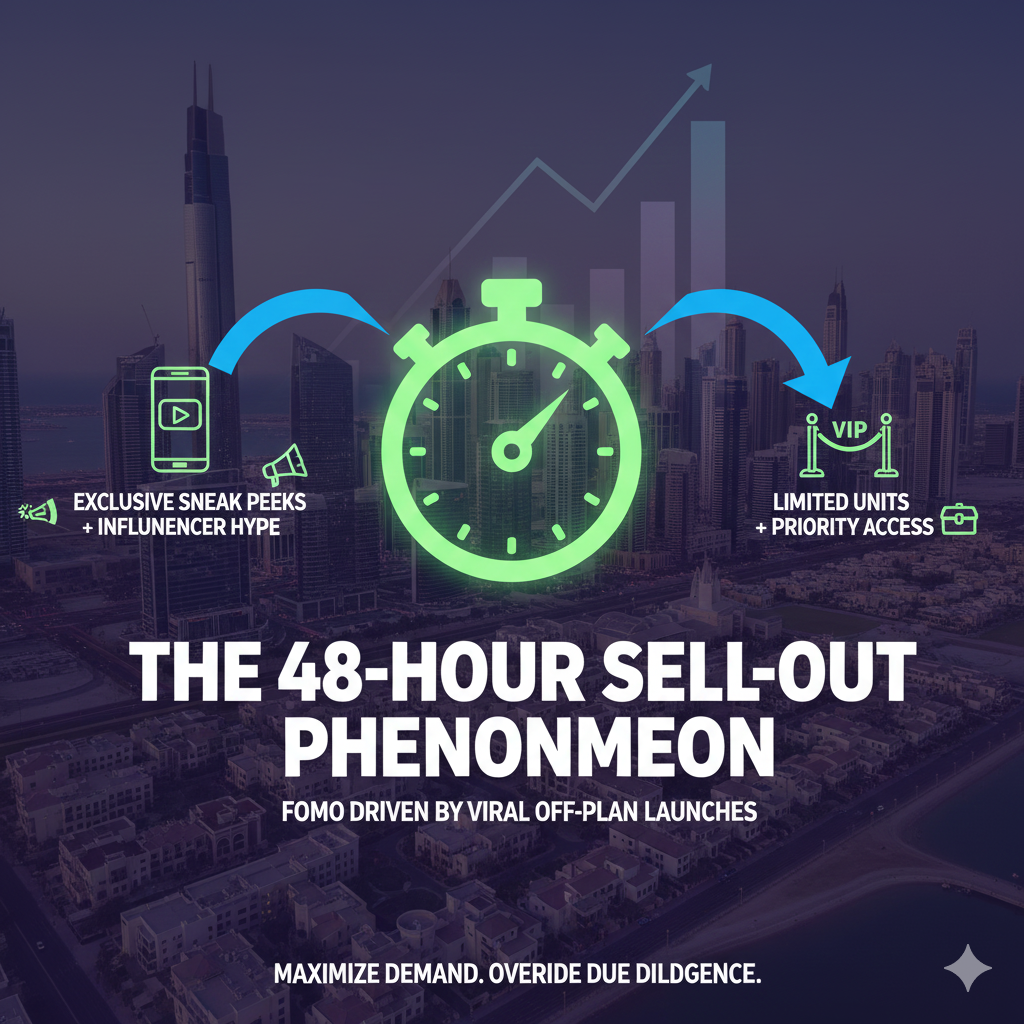
Inventory Depletion Timing Strategies: Manufacturing Scarcity for Maximum Pressure
While social proof provides the psychological validation that makes rapid commitments feel safe rather than reckless, inventory depletion timing strategies create the urgency that makes immediate action feel necessary rather than optional. The careful manipulation of perceived scarcity represents perhaps the most cynical yet effective element of the 48-hour sell-out phenomenon, exploiting fundamental human loss aversion that makes the pain of missing opportunity significantly more acute than the satisfaction of securing it. Developers orchestrate availability narratives that may or may not reflect genuine constraints but consistently create the impression that delay means definite loss regardless of actual inventory realities.
The release schedule architecture that drives many rapid sell-outs involves deliberately restricting initial availability to create artificial scarcity even when substantial inventory exists. Rather than releasing all units simultaneously during launch events, developers might release only 30-40% of total inventory during the initial launch phase, holding back the majority of units for subsequent release phases that occur days or weeks later. This staged release approach serves multiple strategic purposes including creating genuine scarcity for the initial release that justifies premium pricing and urgency messaging, generating sold-out narratives that can be publicized to create FOMO for subsequent release phases, allowing developers to test market pricing and adjust subsequent releases based on initial demand intensity, and maintaining marketing momentum across extended periods rather than exhausting interest in single events.
The unit category sequencing that sophisticated developers employ recognizes that different buyer segments respond to different inventory depletion patterns. Launches typically prioritize selling premium units first, including penthouses, full-floor apartments, and exclusive corner units that generate headline-grabbing sale prices and signal quality positioning. These trophy sales create an aspirational association where even buyers purchasing standard units feel connected to luxury through brand association. Following premium exhaustion, mid-tier units release with messaging emphasizing that premier inventory has sold out and remaining opportunities represent last chances at favorable pricing before the market reprices to reflect actual demand intensity demonstrated through premium sales velocity.
The countdown timer psychology that permeates modern launches exploits time-bound scarcity to force decision compression that might not otherwise occur. Digital displays showing time remaining for launch discounts or special payment terms create artificial deadlines that force buyers to commit before fully processing information or conducting a thorough analysis. These countdown mechanisms might reflect genuine commercial terms, but their prominent display and minute-by-minute updates serve primarily to generate panic buying driven by loss aversion rather than value assessment. The psychological research demonstrating that time-limited offers consistently outperform identical unlimited offers even when the limitation is arbitrary validates why every successful launch incorporates countdown elements prominently.
The waitlist creation strategies that extend urgency beyond actual sell-outs represent masterful manipulation of desire through unattainability. When projects announce sold-out status with an invitation to join waitlists for potential future availability, they transform rejection into aspiration, where buyers who couldn’t secure units feel excluded from desirable communities rather than relieved to have avoided rushed commitments. These waitlists serve as CRM databases for subsequent releases or future projects while generating continued social proof through their very existence. The strategic flexible payment plan structures that developers offer exclusively during launch windows create additional scarcity dimensions beyond pure inventory availability, positioning favorable financing terms as limited resources that expire alongside unit availability.
The secondary market pricing narratives that follow successful sell-outs complete the scarcity manipulation cycle by demonstrating that buyers who acted quickly made profitable decisions while those who hesitated lost money. Developers and brokers prominently publicize instances where launch buyers flip properties for 15-30% premiums within weeks of initial purchase, positioning rapid sell-outs as predictive of strong appreciation rather than potentially indicative of manipulated demand or overpricing. These secondary market success stories become marketing materials for subsequent launches, creating self-fulfilling prophecies where launch urgency feels validated by apparent short-term gains that may or may not reflect sustainable value.
| Scarcity Mechanism | Implementation Method | Buyer Psychology Exploited | Authenticity Level | Long-Term Risk |
| Staged Inventory Release | Release 30-40% initially, hold 60-70% | Loss aversion, FOMO | Medium – strategy is deliberate | Low if the market remains strong |
| Premium Unit Prioritization | Sell expensive units first | Aspirational association | High – reflects genuine stratification | Low – premium is always limited |
| Launch Discount Expiration | Time-limited pricing advantage | Decision compression urgency | Medium – discounts are real but arbitrary | Medium – pressure may force mistakes |
| Real-Time Availability Display | Live updating of sold units | Competitive panic buying | Low – displays may be manipulated | High – artificial urgency |
| Waitlist Invitation Post-Sellout | Convert rejection into aspiration | Desire through exclusion | Low – creates false scarcity | High – generates resentment if discovered |
The FOMO Override: When Emotion Replaces Due Diligence
The ultimate objective of the 48-hour sell-out phenomenon extends beyond merely accelerating sales timelines to fundamentally transforming the decision-making process from rational evaluation to emotional commitment. The fear of missing out that these launches cultivate represents a complete override of traditional property due diligence Dubai processes that would normally precede multi-million dirham commitments, replacing systematic analysis with intuitive judgment based primarily on scarcity perception and social validation rather than fundamental value assessment. Understanding how FOMO overrides due diligence reveals both the power and the danger of these accelerated launch models that benefit developers and early flippers while potentially harming end-users who discover post-purchase that emotion-driven commitments don’t align with actual needs or investment theses.
The due diligence compression that characterizes rapid sell-outs manifests across multiple dimensions of normal investment analysis that simply cannot occur within 48-hour windows, regardless of buyer sophistication. Location analysis that would traditionally involve multiple site visits at different times of day to assess traffic patterns, neighborhood amenities, and environmental factors gets compressed into single rushed viewings or even purchases based solely on project location rather than experiential validation. Developer track record research that should examine complete delivery histories, including delays, quality issues, and dispute resolutions, gets superficialized into brand recognition and recent successes without deeper investigation of potential red flags. Financial modeling that should incorporate detailed cash flow projections, appreciation scenarios, and risk-adjusted return calculations gets reduced to back-of-envelope calculations focused primarily on launch discounts and potential flip profits rather than long-term fundamentals.
The project specification analysis that comprehensive due diligence requires becomes impossible when decisions occur before detailed technical documentation is available or when presentation theatrics prevent careful document review. Buyers commit to projects based on architectural renderings and specification summaries without examining construction contracts, reviewing detailed finish schedules, or understanding precisely what’s included versus what constitutes paid upgrades. This specification ambiguity creates potential for significant post-purchase disappointment when delivered products don’t match buyer expectations formed during high-pressure launch environments designed more for emotional engagement than technical communication.
The exit strategy planning that sophisticated off-plan investors should conduct before purchasing gets entirely skipped during FOMO-driven buying frenzies, where the focus centers exclusively on securing units rather than understanding optimal holding periods, resale market dynamics, or liquidity scenarios. Buyers purchase without a clear understanding of when or how they’ll exit positions, whether they intend to hold through completion for rental income or flip during construction phases, or what market conditions might necessitate emergency sales. This strategic ambiguity leaves buyers exposed to market timing risks and potentially locked into positions that don’t serve their actual investment objectives.
The payment plan analysis that should examine affordability across complete construction periods and potential interest rate scenarios gets replaced by a focus on initial deposit requirements and launch discounts without comprehensive modeling of total cash outflows. Buyers commit to payment structures without fully understanding cumulative payment obligations, what happens if they cannot meet scheduled payments, or how changing financial circumstances might impact their ability to complete purchases. This payment planning deficiency creates risk of buyer defaults during construction that damage credit profiles and forfeit deposits already paid.
The comparative analysis that rational investment decisions require becomes impossible when projects sell out before buyers can evaluate alternatives, forcing decisions based on available options rather than optimal choices across the complete market. The manufactured urgency prevents the shopping process that would normally involve visiting multiple projects, comparing specifications and pricing across developers, and selecting properties that best match specific investment criteria. Instead, buyers commit to whatever appears available during the narrow window when they’re paying attention, potentially missing superior alternatives that launch weeks later or that remain available but lack the theatrical urgency that drives impulsive commitments.
The Developer Perspective: Strategic Advantages of Rapid Sell-Outs
From the developer standpoint, engineering 48-hour sell-out phenomena delivers strategic advantages that extend far beyond accelerated sales velocity to encompass financial structuring, market positioning, and competitive differentiation that justifies the substantial investment required to orchestrate these elaborate launch productions. Understanding the developer calculus reveals why these strategies have proliferated despite their manipulation of buyer psychology and potential for creating unsustainable demand intensity that may not reflect genuine long-term project fundamentals.
The capital velocity advantages that rapid sell-outs provide allow developers to accelerate project funding timelines that traditional marketing approaches would extend across months or quarters. When projects sell out during launch weekends, developers secure substantial deposit funds immediately that can flow into construction financing, reducing reliance on bank loans or investor capital that carries cost. This capital acceleration improves project economics by reducing financing expenses and enabling developers to negotiate better contractor terms through confirmed funding rather than speculative commitments. The financial advantages compound when developers can launch subsequent projects based on capital raised from previous rapid sell-outs, creating virtuous cycles where success breeds success through demonstrated execution capability and market demand validation.
The market positioning benefits that accrue to developers with track records of rapid sell-outs create brand equity that transcends individual project merits. Developers known for launching projects that sell out within hours command premium pricing power and buyer loyalty that competitors struggle to match, even with superior products. This brand positioning manifests through preferential treatment from brokers who prioritize presenting projects from developers with sell-out histories, media coverage that amplifies launch success stories into broader market narratives about developer excellence, and buyer anticipation that creates ready markets for future launches before specific project details are even announced. The reputational advantages of being recognized among Dubai’s premier developers justify the substantial marketing investments required to engineer rapid sell-outs that might otherwise seem inefficient compared to traditional approaches.
The inventory management flexibility that staged release strategies provide allows developers to optimize pricing across market cycles rather than committing all inventory to single pricing moments. When only partial inventory releases are made during initial launches, developers retain options to adjust pricing upward if initial releases demonstrate strong demand or to hold inventory off market if conditions soften, avoiding forced sales during unfavorable periods. This optionality proves particularly valuable in Dubai’s dynamic market, where conditions can shift rapidly based on broader economic factors, regulatory changes, or supply-demand rebalancing. The strategic approach to navigating Dubai’s evolving market conditions requires flexibility that a complete inventory commitment would eliminate.
The competitive differentiation that viral launches provide separates developers in increasingly crowded markets where product quality alone no longer guarantees success. With numerous well-capitalized developers offering high-quality projects with attractive payment terms in prime locations, the attention economy becomes as critical as the product economy. Projects that generate viral buzz and social media amplification cut through market noise to capture buyer attention that conventional marketing cannot match, regardless of media spending. This attention capture proves especially valuable when multiple new residential projects launch simultaneously, creating winner-take-most dynamics where viral projects absorb disproportionate buyer attention while worthy competitors struggle for visibility despite comparable fundamentals.

The Investor Risk Calculus: When FOMO Leads to Regret
While rapid sell-outs create obvious advantages for developers and benefits for early flippers who can realize quick gains, the investor risk profile associated with FOMO-driven purchasing deserves careful consideration for buyers contemplating whether to participate in these accelerated launch frenzies. The decision compression and due diligence override that characterize 48-hour sell-outs expose buyers to risks that more deliberate purchasing processes would identify and mitigate, creating potential for post-purchase regret when emotional commitments collide with rational reassessment in calmer moments following launch excitement.
The specification disappointment risk emerges when delivered projects don’t match expectations formed during high-energy launch events that emphasize vision over detailed reality. Buyers discover that finishing quality doesn’t match show unit presentations, that amenity specifications were vague and actual implementations prove disappointing, that unit sizes feel smaller than floor plans suggested, or that views and orientations don’t deliver expected value. These specification gaps create buyer dissatisfaction that wouldn’t occur if purchases followed comprehensive due diligence, including careful specification review and realistic expectations setting, rather than theatrical presentations designed for emotional engagement.
The market timing risk intensifies when rapid sell-outs occur at cyclical peaks rather than optimal entry points, leaving buyers exposed to potential corrections that erase launch discounts and create underwater positions. The very intensity of demand that drives sell-outs may indicate market tops where sustainable fundamentals have been overtaken by speculative excess and FOMO psychology. Buyers who commit during peak excitement may find themselves holding properties through correction periods where similar projects launch at lower pricing or where resale markets soften, leaving them unable to execute planned flip strategies. The importance of understanding Dubai’s property market cycles becomes critical for avoiding peak-buying that rapid sell-outs may encourage precisely when caution would serve investors better.
The liquidity trap risk materializes when buyers who purchased based on flip intentions discover that secondary markets cannot absorb inventory at premium pricing, leaving them committed to projects they never intended to hold long-term. The rapid sell-outs that suggested strong demand may reflect strategic marketing rather than genuine end-user demand, meaning that when early buyers attempt to flip during construction, they discover limited buyer pools willing to pay premiums above launch pricing. This liquidity shortfall forces unplanned holding through completion or distressed sales at losses that negate the whole investment thesis that justified rapid commitments without comprehensive analysis.
The payment default risk escalates when buyers commit to payment schedules without fully modeling cash flow requirements across complete construction periods, then discover they cannot meet payment obligations as scheduled. The failure to complete payments triggers contract penalties, deposit forfeitures, and credit damage that prove far more costly than the FOMO pain that would have resulted from not purchasing. The pressure to commit quickly without complete financial planning exposes buyers to scenarios where changed circumstances make completion impossible, transforming what seemed like opportunities into liabilities that damage financial positions.
Identifying Authentic Value Versus Manufactured Hype
For sophisticated investors seeking to participate in Dubai’s dynamic off-plan market without falling victim to manipulative launch tactics, developing the ability to distinguish authentic investment opportunities from manufactured hype becomes essential. While rapid sell-outs can legitimately indicate exceptional projects that justify urgency, they can also reflect sophisticated marketing separating buyers from rational analysis. Understanding the signals that differentiate genuine opportunities from artificial urgency enables strategic participation that captures upside while avoiding regrettable FOMO-driven mistakes.
The fundamental analysis that should precede any significant investment commitment includes examining factors that create legitimate value independent of launch theatrics. Location advantages that position projects in genuinely supply-constrained or high-growth areas rather than oversupplied segments justify premium positioning regardless of launch velocity. Developer track records demonstrating consistent on-time delivery, quality construction, and satisfied buyer communities validate that execution capability matches marketing promises. Pricing analysis showing clear discounts relative to comparable completed properties or reasonable premiums justified by superior specifications provides a rational foundation for purchase decisions beyond mere scarcity perception.
The market conditions assessment that contextualizes individual project performance within broader trends helps investors avoid peak-buying driven by temporary momentum rather than sustainable fundamentals. Understanding current inventory pipelines in specific locations reveals whether rapid sell-outs reflect genuine scarcity or merely successful marketing in oversupplied segments where alternatives abound. Analyzing absorption rates and price trends across recent quarters indicates whether market momentum supports launch pricing or whether corrections may loom that could undermine even quality projects. The comprehensive approach to evaluating Dubai property market dynamics provides essential context for distinguishing individual project performance from sector-wide trends.
The launch mechanics transparency that ethical developers provide contrasts sharply with the manipulative tactics that characterize problematic rapid sell-outs. Genuine opportunities typically feature honest disclosure about inventory availability, including total unit counts and release schedules, realistic timelines for construction completion without aggressive promises, transparent pricing that clearly explains value proposition versus alternatives, and pressure-free environments that encourage rather than discourage comprehensive due diligence. When launch events prohibit document review, rush commitment decisions, or obscure critical information, these red flags suggest manufactured urgency designed to override analysis rather than genuine opportunities that withstand scrutiny.
Conclusion: Navigating the Spectacle Economy of Modern Property Launches
The emergence of the 48-hour sell-out phenomenon represents a fundamental transformation in how Dubai’s off-plan property market operates, where psychological manipulation and theatrical production have become as critical to success as product quality and value proposition. The sophisticated launch event choreography, social proof mechanics, and inventory depletion timing strategies that drive these rapid commitments demonstrate how behavioral psychology and emotional engineering can override centuries of rational real estate practice that emphasized careful analysis and deliberate decision-making. For developers, these techniques deliver undeniable advantages through accelerated capital raising, enhanced market positioning, and competitive differentiation in crowded markets. For buyers, the calculus proves more complex with genuine opportunities mixed with manufactured hype requiring sophisticated discrimination to avoid regrettable commitments driven by FOMO that overrides due diligence.
The spectacle economy that characterizes modern property launches shows no signs of abating as competition intensifies and developers seek ever more aggressive differentiation strategies in markets offering abundant quality alternatives. Understanding the mechanics that drive viral launches empowers investors to participate strategically when authentic opportunities justify urgency while maintaining discipline to resist artificial scarcity that serves seller interests more than buyer welfare. The most successful market participants will be those who can separate signal from noise, recognizing when rapid commitment serves their interests versus when patience and comprehensive analysis would produce superior outcomes, even if it means missing theatrical launch events that prioritize entertainment over education.
As Dubai’s property market continues evolving with unprecedented transaction volumes and sustained developer activity, the ability to navigate launch theatrics while maintaining investment discipline becomes increasingly valuable. The fundamental principles of location analysis, developer evaluation, pricing assessment, and strategic planning that have always separated successful real estate investors from unfortunate speculators remain as relevant as ever despite theatrical attempts to make them seem obsolete in the face of artificial urgency. Investors who master the psychological awareness to recognize manipulation while retaining the analytical rigor to identify genuine value will consistently outperform those who either cynically exploit FOMO mechanisms or naively succumb to them.
The future of property launches will likely intensify rather than moderate these theatrical elements as developers invest more heavily in creating cultural events that transcend traditional real estate marketing. The combination of social media amplification, influencer partnerships, and immersive experience design will continue pushing boundaries of what constitutes property sales versus entertainment spectacle. Within this evolving landscape, the investors who thrive will be those who view launch events with appropriate skepticism while maintaining openness to genuine opportunities that justify urgency—a balanced perspective that neither dismisses rapid sell-outs as mere manipulation nor accepts them uncritically as validation of exceptional value. This sophisticated discernment, more than any other factor, will separate long-term investment success from short-term speculation that confuses marketing excellence with investment merit.
Ready to Access Genuine Pre-Launch Opportunities Without the Hype?
At Prelaunch.ae, we provide sophisticated investors with transparent access to Dubai’s most promising off-plan projects through analysis-driven guidance that prioritizes your long-term success over short-term sales pressure. Our team cuts through launch theatrics to deliver honest assessments of project fundamentals, developer track records, market positioning, and authentic value propositions that withstand scrutiny beyond 48-hour excitement windows.
Whether you’re seeking genuine early-access advantages through legitimate pre-launch opportunities or need expert analysis to evaluate viral projects generating market buzz, our investment specialists provide the objective intelligence and strategic guidance that separates sustainable value creation from manufactured hype. We help you identify when urgency serves your interests versus when patience produces superior outcomes.
Fill out the inquiry form on our website prelaunch.ae to receive curated project recommendations based on comprehensive analysis rather than marketing theatrics. Our team conducts thorough due diligence on your behalf, examining factors that launch events obscure to ensure your commitments align with genuine investment merit rather than artificial scarcity.
Contact our investment specialists directly:
- Phone: (+971) 52 341 7272
- Email: sales@mbrproperties.ae
Let Prelaunch.ae transform your approach to Dubai property investment through analytical rigor, transparent guidance, and strategic timing that captures authentic opportunities while avoiding regrettable FOMO-driven mistakes. We separate marketing spectacle from investment substance so you can commit with confidence based on fundamentals that matter.
Frequently Asked Questions (FAQs)
1. Are 48-hour sell-outs genuine or artificially manufactured through marketing tactics?
The truth lies in the middle—some rapid sell-outs reflect authentic demand for exceptional projects in supply-constrained locations from quality developers, while others result from sophisticated marketing that manufactures urgency through staged inventory releases, social proof manipulation, and scarcity theater. Distinguishing genuine opportunities from manufactured hype requires examining fundamental factors including location supply-demand dynamics, developer track records, pricing relative to alternatives, and whether launch tactics encourage or discourage comprehensive due diligence. Projects that withstand scrutiny beyond theatrical presentations typically represent legitimate opportunities worthy of urgency.
2. What specific red flags indicate that a rapid sell-out is manufactured hype rather than authentic demand?
Warning signs include opacity about total inventory with vague statements about “limited availability” without specific unit counts, aggressive countdown timers and pressure tactics that prevent document review or careful consideration, reluctance to provide detailed specifications or construction timelines for verification, lack of transparency about who’s buying with claims of sold-out status without evidence of diverse buyer base, and pricing that doesn’t show clear advantages relative to comparable alternatives beyond vague launch discounts. Ethical developers provide comprehensive information and encourage rather than discourage due diligence even during rapid launches.
3. How can investors participate in legitimate rapid launches without falling victim to FOMO-driven mistakes?
Successful participation requires pre-qualifying opportunities before launch events by researching developer track records, analyzing location fundamentals, and establishing maximum pricing thresholds based on comparable analysis. Attend launches with predetermined investment criteria and commitment limits that prevent emotional override of rational planning. Bring or consult legal advisors who can review contracts on-site rather than committing to later review. Focus on fundamental value drivers rather than social proof or scarcity messaging. Be willing to walk away if pressure tactics prevent adequate analysis, recognizing that missing manufactured urgency preserves capital for genuine opportunities.
4. What due diligence can realistically occur within 48-hour decision windows?
While comprehensive analysis becomes impossible, investors can conduct abbreviated due diligence including developer track record verification through completed project visits and buyer testimonial research, location reconnaissance through site visits at different times and competitive alternative exploration, financial modeling of payment obligations across construction periods and holding scenarios, legal review of sales contracts focusing on cancellation rights and dispute resolution mechanisms, and market comparable analysis through recent transaction research and broker consultations. Pre-launch research that occurs before launch events enables rapid decisions when opportunities prove legitimate without compromising fundamental analysis.
5. How do developers benefit financially from engineering rapid sell-outs versus traditional marketing approaches?
Rapid sell-outs accelerate capital raising that reduces financing costs and improves project economics through early contractor engagement with confirmed funding. They create brand equity that commands premium pricing and buyer loyalty across future projects, justifying marketing investments through long-term positioning advantages. They provide inventory management flexibility through staged releases that optimize pricing across market cycles rather than committing all units to single pricing moments. They generate competitive differentiation and attention capture in crowded markets where quality alone no longer guarantees success, creating winner-take-most dynamics where viral projects absorb disproportionate buyer interest.
6. What happens to buyers who commit during FOMO-driven launches then discover projects don’t meet expectations?
Disappointed buyers face limited recourse beyond contractual specifications with most discovering that theatrical launch presentations don’t constitute binding commitments about subjective quality perceptions. They may attempt resales during construction but often discover secondary markets cannot absorb inventory at premium pricing, forcing unplanned holding through completion or distressed sales at losses. They might pursue developer negotiations for specification upgrades or compensation but typically find limited leverage beyond clear contractual violations. The emotional regret of FOMO-driven purchasing often proves more painful than the opportunity cost that would have resulted from missing launches, validating why due diligence compression carries genuine risks.
7. Are there legitimate reasons beyond marketing manipulation why projects should sell out rapidly?
Yes—genuine scarcity in supply-constrained locations with limited developable land creates authentic rapid sell-outs independent of marketing theatrics. Exceptional developer reputations with track records of delivering superior communities at favorable pricing justify rational urgency when new projects launch. Significant launch discounts relative to current market pricing create genuine value propositions worthy of rapid commitment. Unique project characteristics including exclusive partnerships, landmark locations, or innovative designs that cannot be replicated elsewhere validate urgency independent of artificial scarcity. The challenge lies in distinguishing these authentic drivers from manufactured urgency designed primarily to bypass buyer analysis.
8. How will the 48-hour sell-out phenomenon evolve as buyers become more sophisticated about manipulation tactics?
As buyers develop awareness of manipulation techniques, developers will likely evolve toward even more sophisticated psychological operations including personalization through data analytics that customizes urgency messages to individual buyer profiles, immersive technologies like virtual reality that enhance emotional engagement beyond current theatrical presentations, blockchain-verified scarcity that provides cryptographic proof of inventory status eliminating skepticism about manufactured shortages, and community-building approaches that cultivate buyer loyalty through ongoing engagement rather than one-time transaction pressure. The arms race between marketing sophistication and buyer awareness will intensify rather than resolve, requiring continuous education and analytical discipline from investors seeking to avoid manipulation while capturing genuine opportunities.