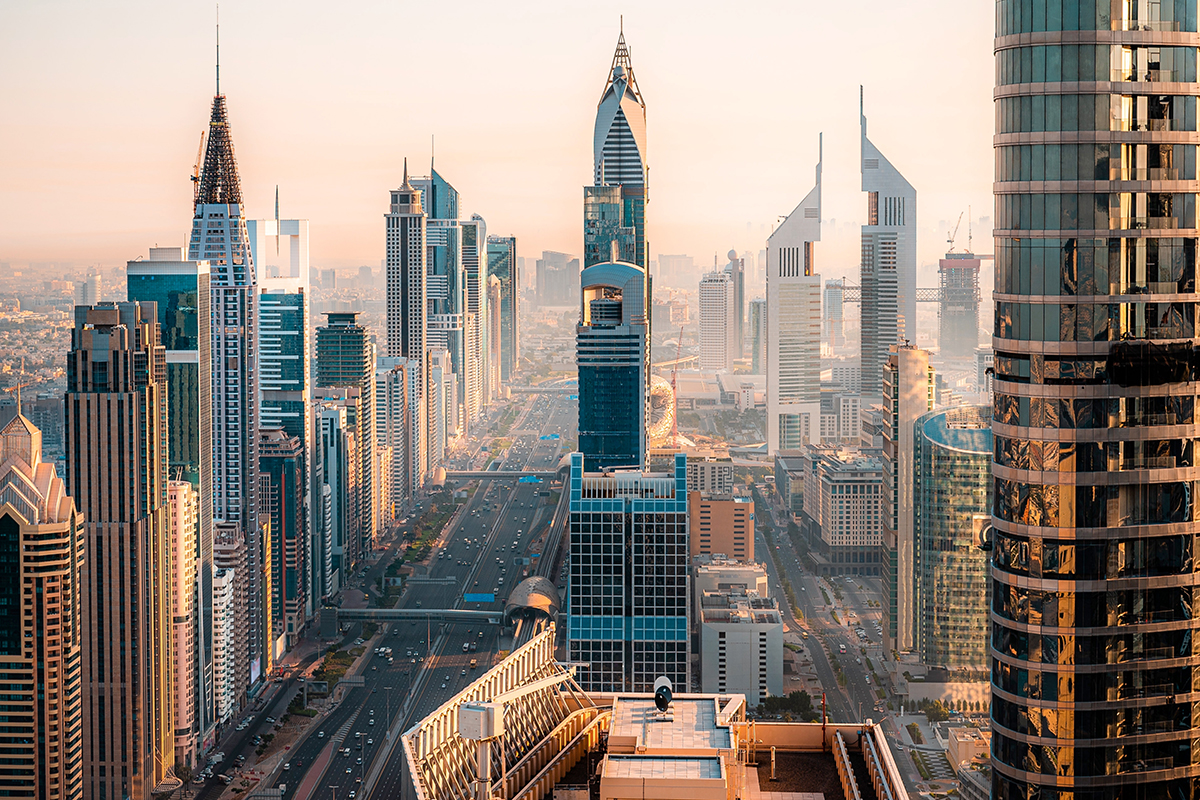
Fear arrived without warning on February 28, 2026. US and Israeli forces struck Iranian infrastructure, Tehran retaliated with over 1,130 drones and missiles aimed at Gulf targets, and the Dubai Financial Market Real Estate Index (DFMREI) — which had climbed 180% since October 2023 — fell roughly 30% in under two weeks, wiping out every gain made in 2026 in a matter of days.
If you are an investor or end-buyer who has been watching a Dubai prelaunch off-plan property and now finds yourself staring at those headlines, the instinct is to freeze. Perhaps to cancel the site visit. Perhaps to wait.
Here is the counterintuitive truth: absorption still matters more than the headlines. The story of Dubai real estate has never been “zero risk.” It has always been “how fast does demand absorb new supply?” That question has not changed. What has changed is the noise surrounding it. This article separates the signal from the noise — with real data, a buyer checklist, and a frank look at what geopolitical tension actually does to prelaunch property in Dubai.
The War Shock: What Actually Happened to Dubai’s Property Market
Before dissecting absorption, let’s place the shock in a precise context.
| Metric | Data (March 2026) |
| DFMREI Peak (Feb 27) | 16,910 points |
| DFMREI by March 14 | ~11,500 points (≈ –30%) |
| Physical transactions (Mar 2–9) | 3,570 deals worth AED 11.93 billion — rising over the final 3 days of that window |
| Viewing activity (Mar 6–9 vs Mar 2–5) | +75% surge in viewings — buyers returning, not retreating |
| Off-plan commitments | Buyers are largely holding — not walking away from pre-signed agreements |
Sources: Dubai Land Department, Allsopp & Allsopp, The National, Business Standard, March 2026
The critical distinction: the DFMREI is an equity index, not a property price index. It measures how listed developer stocks trade — a sentiment barometer, not a valuation of your apartment in JVC or villa in Dubai Hills. Property transaction values have not declined 30%. The fear is real; the collapse is not yet.
Demand Signal: Why Prelaunch Absorption Was Already Being Tested Before the War
Here is what the Dubai off-plan market 2025–2026 looked like entering the crisis — and why absorption was already the central conversation:
| Demand Strength Indicators | Figure |
| Total 2025 real estate transactions | 270,000+ deals — a record |
| 2025 total sales value | AED 917 billion (~$250 billion) — the highest in Dubai’s history |
| Off-plan share of total transactions (2025) | 65% — nearly two in three deals were off-plan |
| H1 2025 off-plan sales | ~64,000 deals worth AED 209 billion (+43% value YoY) |
| Jan 2026 residential transactions | AED 55.18 billion — up 43.9% year-on-year |
| Jan 2026 cash purchases (% of total) | ~60% — signalling a low-leverage, resilient buyer base |
| Jan–Feb 2026 combined transactions | AED 133.3 billion across 34,452 deals |
| Projected price growth 2026 | +10% (pre-conflict consensus estimate) |
Sources: DLD, Anarock, prelaunch.ae, January 2026 market data
The story before the war was not “Dubai is safe.” It was “Dubai off-plan demand is structurally deeper than any single event can erase.” Off-plan made up 65% of Dubai transactions in 2025. Reuters has noted that foreign demand will be crucial as new supply rises steeply in 2026–2027, with analysts projecting 100,000–120,000 unit completions annually at peak. The absorption question was already the defining one. The war added urgency, not a new question.
Understand the full investor picture for 2026 off-plan vs rentals to see where demand is genuinely concentrating.
Supply Test: Will the Pipeline Overwhelm the Market?
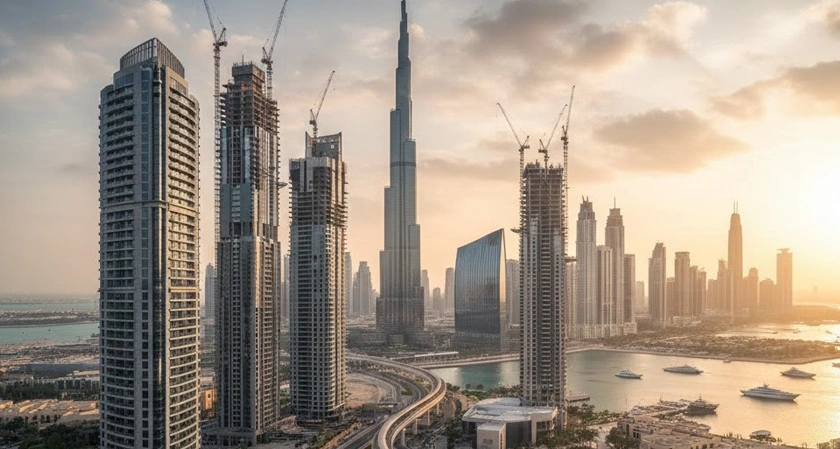
Even before the first Iranian drone crossed into UAE airspace, supply was the Dubai real estate risk 2026 that serious analysts were focused on. Now, that conversation is more urgent than ever.
| Supply Zone | Risk Level | Reason |
| JVC / Dubai South | HIGH | Heavy mid-market apartment completions in 2026 |
| Business Bay (mid-market) | MEDIUM-HIGH | Large pipeline; rental yields may moderate |
| Palm Jumeirah / Emirates Hills | LOW | Constrained supply; HNWI demand resilient |
| Dubai Hills Estate | LOW-MEDIUM | Controlled villa release; strong end-user pull |
| Branded residences (Downtown) | LOW | The luxury segment is less supply-exposed; cash buyers dominate |
Source: DLD pipeline data, ValuStrat, prelaunch.ae analysis, 2026
With approximately 250,000 units planned for delivery between 2023 and 2026 — and 2026 representing the peak — the Dubai oversupply 2026 risk is real but concentrated. It is not evenly distributed across the market. Developers with strong brand equity, established escrow compliance, and genuine community infrastructure are proving far more resilient than smaller, leveraged names.
This is exactly why absorption at launch is the metric that separates a great prelaunch opportunity from a dangerous one. If a developer cannot sell 60–70% of a new release in the first weeks — even in normal times — that project is carrying unsold inventory into a market that already has its hands full. In a post-war sentiment environment, that risk multiplies.
Read the full Dubai oversupply 2026 risk map and safe investment zones to understand exactly where supply is concentrated and where it is not.
The Post-War Buyer Checklist: 6 Things to Verify Before Signing Off-Plan
The answer to the war shock is not panic — it is deeper due diligence on prelaunch off-plan properties in Dubai. Here is the buyer checklist every investor should run before committing in March 2026 and beyond:
| Check | What to Verify | |
| 1 | Developer Track Record | Has the developer delivered on time before? Look for DLD-registered completed projects. In a stressed market, developer quality is the single most predictive variable. |
| 2 | Launch Absorption Rate | What percentage of units sold in the first 30 days of launch? Below 50% absorption is a red flag. Strong launches — even during uncertainty — absorb 60–80% of inventory quickly. |
| 3 | Escrow Compliance | Confirm all payments flow into a RERA-monitored escrow account. This is non-negotiable and legally required in Dubai — but verify independently. |
| 4 | Payment Plan Structure | Does the plan require large instalments during construction milestones — or heavy post-handover payments? Flexible 1/80/19 or 20/80 structures offer more breathing room. |
| 5 | Location vs Supply Pipeline | Is the project in a high-supply corridor (JVC, Dubai South mid-market) or a supply-constrained area (Palm, Dubai Hills luxury)? Know where your project sits on the risk map. |
| 6 | Developer Financial Backing | Government-linked developers (Emaar, Nakheel, Meraas) carry implicit sovereign backing. Smaller developers carry more delivery risk in a sentiment-stressed environment. |
Investors who panicked after Russia invaded Ukraine and avoided Dubai investment properties in 2022 missed returns of 40–60% over the following 18 months. The data pattern is consistent: those who studied launch response and developer quality, rather than reacting to geopolitical noise, captured outsized gains.
For a full guide on maximising ROI with prelaunch off-plan property in the UAE, read our ultimate investor guide to UAE pre-launch properties.
Why Absorption Still Matters More Than the Headlines
This is not a “no risk” story. The missiles were real. The drone debris that struck near Burj Al Arab was real. The 30% drop in the DFMREI was real. S&P Global Ratings has warned that luxury could soften if the conflict persists, and smaller developers with overleveraged positions face genuine stress.
But here is what is also real:
| The Fear Narrative Says… | The Data Shows… |
| Dubai’s safety narrative is shattered | 95%+ of Iranian strikes were intercepted; no major real estate asset was damaged |
| Buyers are fleeing the market | 3,570 deals in the first week of conflict; viewings up 75% by day 6 |
| Off-plan commitments are collapsing | Buyers largely holding pre-signed agreements; developers not reporting mass cancellations |
| This is like 2008 | ~60% of Jan 2026 transactions were cash; bank exposure to real estate fell from 20% to 14% of loans since 2009 |
| Foreign demand has disappeared | HNWIs from conflict-adjacent markets are actively enquiring about Dubai property as a contingency asset |
Sources: The National, Allsopp & Allsopp, DLD, UAE Central Bank, March 2026
The Dubai property market resilience stems from a foundation that simply did not exist in 2008: a RERA-regulated escrow system, a cash-heavy buyer base, a population of 4+ million with genuine housing demand, and a government that has a proven playbook — Golden Visa expansions, transfer fee reductions, developer incentives — for stimulating real estate demand when external shocks strike.
Understanding whether a correction creates a buying window for off-plan investors starts with the same analysis. Read our detailed piece on whether 2026 becomes Dubai’s best off-plan buyer’s market in a decade.
Foreign Demand: The Variable That Decides Everything
Foreign demand is not a nice-to-have in Dubai’s off-plan market — it is the engine. In Q2 2025, 58% of property transactions were driven by international investors from India, the UK, China, and Russia. In January 2026, the ultra-luxury segment saw 990 homes above AED 10 million change hands — a rate maintained almost entirely by high-net-worth foreign buyers.
The war has reorganised, not collapsed, this demand. Families from conflict-adjacent countries are securing long-term rentals and property in Dubai as contingency assets. Israeli investors — who entered following the 2020 Abraham Accords — remain present in the market, with Dubai property priced at roughly half of Tel Aviv equivalents while delivering superior yields. Iranian diaspora wealth, which had been a meaningful contributor to Gulf real estate, is in a state of flux but has not disappeared.
Investors from Asia and Europe are pausing — but pausing is not exiting. The Dubai Golden Visa property threshold of AED 2 million continues to make ownership a gateway to long-term UAE residency, a structural pull that does not evaporate during a sentiment shock. The 0% personal income tax remains. The 6–8% rental yields remain.
See how investors from Ras Al Khaimah and Abu Dhabi are also diversifying within the UAE — a trend accelerating as international buyers seek the best off-plan opportunities across the UAE in 2026.
The Bottom Line: Study Absorption, Choose Developer Quality, Do Not Panic
The missiles shook sentiment. The equity index lost 30%. The headlines are alarming. But 3,570 deals were still closed in the first week of the conflict. Viewings rose 75% in days 6–9 versus days 1–3. Off-plan buyers held their commitments. High-net-worth investors from conflict zones enquired about Dubai as a contingency home.
The Dubai prelaunch off-plan market in March 2026 is not a story of zero risk. It never was. It is a story of structured risk that rewards informed buyers over panicking ones. Absorption still matters. Developer quality still matters. Location fundamentals still matter. What has changed is that the war has made shallow analysis more expensive than it has ever been.
Whether you are looking at your first off-plan unit or expanding a portfolio, this moment calls for better data, not less conviction. Dubai’s population is above 4 million and growing. The UAE Golden Visa still runs through a AED 2 million property investment. Rental yields between 6–8% annually still outpace most developed markets. The government has a proven stimulus playbook and the sovereign wealth to execute it.
Study the launch response. Verify the developer. Check the escrow. Then decide.
Ready to Find the Right Prelaunch Property in Dubai?
Join 12,000+ investors accessing exclusive pre-launch opportunities before they hit the open market.
Fill up the form on our website at prelaunch.ae and our experts will guide you through the best options tailored to your goals and budget.
📞 (+971) 52 341 7272 |
Our experts are available 9AM–7PM, 6 days a week.
Frequently Asked Questions
Q1: Should I cancel my Dubai off-plan purchase because of the Iran war?
Not necessarily. The data shows that physical property transaction values have not crashed in line with the equity index. Your decision should depend on the developer’s track record, your payment plan structure, and your investment horizon — not the headline index number. If you are holding a unit from a government-linked developer like Emaar or Nakheel with a solid escrow arrangement, the fundamentals of that investment have not materially changed.
Q2: Will Dubai off-plan prices fall due to the conflict?
A short-term moderation is possible, particularly in high-supply mid-market corridors like JVC. Fitch Ratings had already projected a potential 10–15% price correction in 2026 due to supply pressures — the war has introduced additional uncertainty but not a wholly new structural weakness. Prime, supply-constrained areas are expected to remain more resilient.
Q3: What is prelaunch absorption and why does it matter?
Prelaunch absorption refers to the percentage of units sold in the opening days or weeks of a project’s launch. A high absorption rate — typically 60–80% — indicates genuine market demand for that specific project, location, and developer. In a market under supply pressure, low absorption is an early warning that a project may struggle to appreciate before handover.
Q4: Is Dubai real estate still a safe-haven asset?
“Safe haven” has always been relative. Dubai survived the 2008 global crash, the Arab Spring, COVID-19, and the Russia-Ukraine war — and property values recovered and surpassed previous peaks after each event. The conflict has tested the Dubai real estate safe-haven narrative more seriously than ever before. For investors with a 5+ year horizon and quality assets in resilient segments, the structural case remains intact.
Q5: Are developers offering better deals because of the war?
Some reports indicate that smaller, less established developers may begin offering improved payment plan terms as buyer sentiment softens. Overleveraged sellers in the secondary market may also reprice. This creates a selective window — but requires careful due diligence to distinguish genuine value from distressed product with structural problems. See our full guide on navigating smart strategies for prelaunch investors in a shifting Dubai market.
Q6: Should first-time buyers still consider off-plan in 2026?
Off-plan made up 65% of Dubai’s total transactions in 2025 — not because buyers were reckless, but because the payment plan structure, lower entry price point, and appreciation potential make it the most financially rational pathway for the majority of buyers. Those fundamentals do not disappear in a conflict. They require more careful project selection — which is exactly what this article is designed to help with.