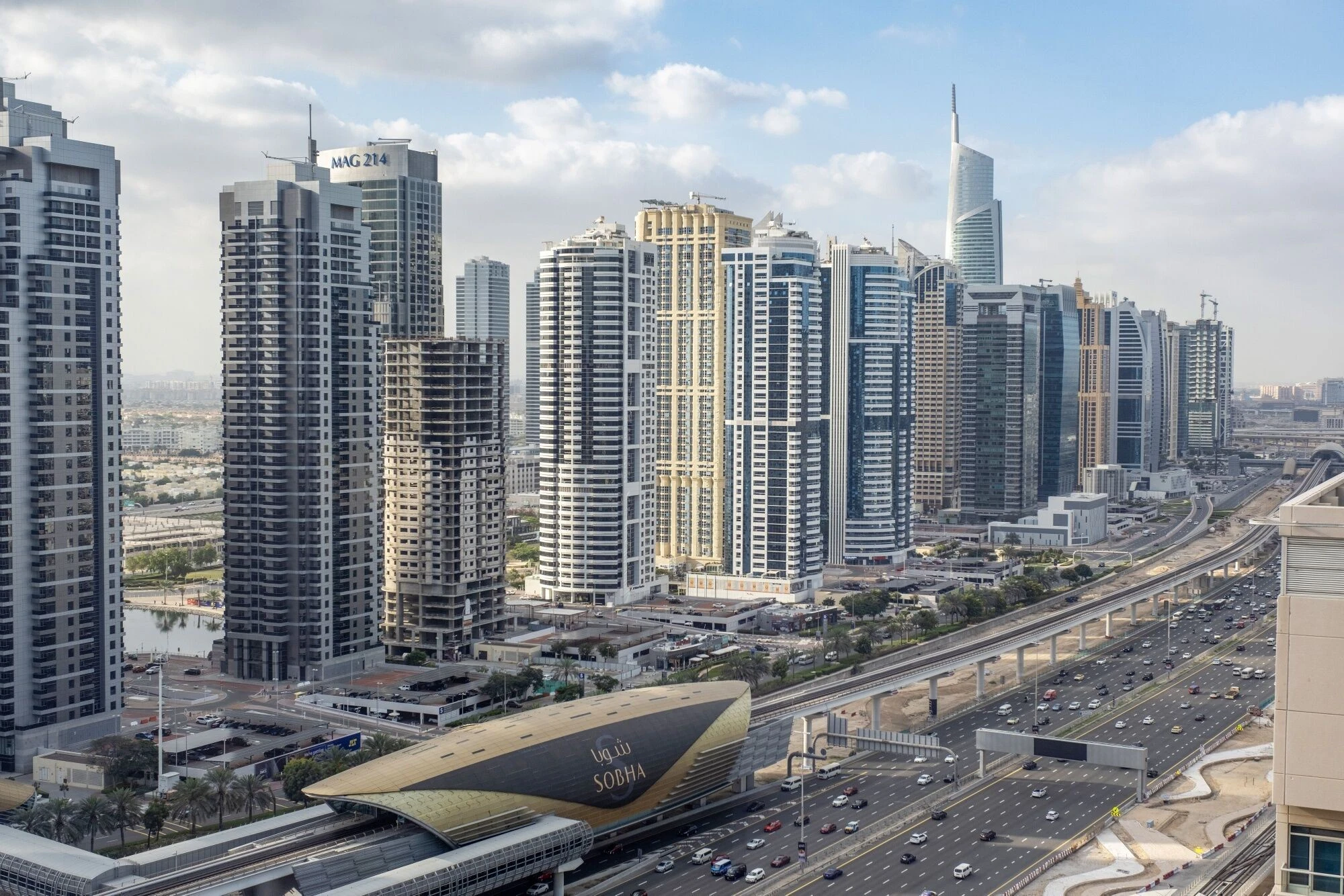
Turn on the news, and you will hear missiles, market jitters, and macro uncertainty. Turn to the Dubai Land Department‘s 2025 annual repor,t and you will see something different: Dh916 billion in total real estate transactions, over Dh680 billion in property sales, and more than 200,000 deals — all recorded in a single year. Those numbers are not a coincidence. They are the fingerprint of a market that entered the current era of geopolitical noise from a position of genuine structural depth, not speculative froth.
For investors navigating today’s headlines, the question is not whether conflict rattles sentiment — it always does, temporarily. The real question is whether the market you are investing in has the liquidity, breadth, and fundamentals to absorb that shock. On every one of those measures, Dubai’s off-plan and prelaunch property market stands on unusually solid ground. Here is why the numbers make the case better than any reassuring press release.
The Scoreboard: Dubai Real Estate 2025 at a Glance
Before unpacking what these figures mean for investors, it helps to see them laid out clearly. The table below captures the headline metrics from Dubai’s record-breaking 2025 real estate year, sourced from the Dubai Land Department and confirmed across multiple market reports.
| Metric | 2025 Figure | YoY Change |
|---|---|---|
| Total Real Estate Transaction Value | Dh916–917 billion (~$250 billion) | +20% |
| Total Property Sales Value | Dh682.5 billion | +30.6% |
| Total Sales Transactions | 214,912 deals | +18.8% |
| Total Real Estate Procedures (all types) | 3.11 million | +7% |
| Total Investors in Market | 193,100 | +24% |
| New Investors Entering Market | 129,600 | +23% |
| Q4 2025 Quarterly Sales Value (record) | Dh187.47 billion | +26.9% |
| December 2025 Monthly Sales Value (record) | Dh64.82 billion | +52% |
| Luxury Deals (>Dh10 million) | ~6,000 deals | +15% |
| Women Investors (value) | Dh154 billion via 76,700 deals | +31% |
Source: Dubai Land Department Annual Report 2025 / Dubai Media Office / Gulf News / The National. These are not projections — they are confirmed, closed transactions.
What Dh916 Billion Actually Means for Market Depth
The difference between a deep market and a shallow one is not just size — it is the breadth and diversity of participants. A single record year driven by a handful of mega-transactions tells one story. A year in which 193,100 individual investors participated, 56.6% of them UAE residents, and 129,600 were first-time buyers tells a completely different and far more resilient one.
Dubai’s 2025 market was not lifted by one nationality or one segment. Investors from over 150 countries participated. Indian buyers — historically the largest group at 20–22% of foreign purchases — remained active. At the same time, European, Chinese, and GCC capital continued to flow in. Even women investors strengthened their presence, committing Dh154 billion across 76,700 transactions, up 31% in value year-on-year. That is not a monolithic market vulnerable to a single point of failure. That is distributed, organic demand.
For context, the Dh916 billion total places Dubai’s annual real estate volume ahead of most European capitals and on par with markets far larger in total geography. For investors comparing global options, liquidity depth is a core part of the value proposition, particularly when exploring off-plan and pre-launch opportunities in Dubai during a period of uncertainty.
The Off-Plan Engine: 65% of All Transactions
One of the most important structural facts about Dubai’s market is that approximately 65% of all 2025 property transactions involved off-plan projects — properties sold before construction was complete. That figure is both a strength and a nuance investors need to understand.
It is a strength because off-plan volumes signal forward confidence. Buyers committing capital to a project with a 2027 or 2028 handover date are making a medium-term bet on Dubai’s trajectory — and in 2025, hundreds of thousands of them did exactly that. The off-plan segment saw a 43% quarterly surge in apartment transactions in Q2 2025 alone, contributing to an AED 60.15 billion sales figure for that quarter.
It is also where the prelaunch advantage is most powerful. Properties acquired at the pre-launch stage — before a project is publicly marketed — typically price in at 20–30% below future completed-unit values. During periods of headline uncertainty, those entry buffers become protection layers. As one market analysis from prelaunch.ae notes, pre-launch properties offer price protection that ready units cannot match, particularly when short-term sentiment dips.
| Segment | 2025 Transactions | Value (AED) | Key Driver |
|---|---|---|---|
| Off-Plan (Residential) | 138,992 sales | The majority of AED 541.3bn residential total | Population growth + investor confidence |
| Ready / Secondary Market | ~61,787 sales | ~32.5% of residential value | End-user demand + cash buyers |
| Commercial Real Estate | 12,850 deals | AED 135.1 billion | Office, industrial, logistics |
| Luxury (>AED 10M) | ~6,000 deals | ~$9.05 billion | HNWI inflows + limited supply |
| Ultra-Luxury (>AED 20M) | 22% of high-end | Growing YoY | Global wealth migration |
Source: Springfield Properties Dubai Real Estate Report 2025 / DLD / ANAROCK.
Conflict, Sentiment, and the Historical Playbook
The current regional tensions — involving strikes near UAE infrastructure and consequent market nervousness — are real. Inquiry levels at some brokerages have dipped. Financial markets reacted with a brief sell-off. These facts deserve acknowledgement rather than dismissal.
But history is instructive. During the COVID-19 pandemic, Dubai’s real estate market paused — and then recovered fully within 12–18 months, outpacing many comparable global cities. During the 2008 global financial crisis, the market corrected sharply, but it was a market then running on leverage and speculation. The 2025 market is structurally different: driven by resident end-users, cash buyers, and long-term investors, not the speculative flipping that defined an earlier era.
As researchers at ANAROCK noted after the latest escalation, “markets already experiencing strong expansion tend to respond to geopolitical shocks differently. In most cases, the initial impact is a slowdown in transaction activity rather than an immediate correction in prices.” That is the key insight: sentiment volatility does not equal fundamental collapse, especially in a market where cash purchases dominate prime transactions and mortgage exposure is regulated.
Investors who understand this dynamic — and who are exploring options like flexible payment plans on Dubai off-plan properties — often find that short-term uncertainty creates the entry windows that long-term returns are built on.
The Prelaunch Liquidity Argument in Three Numbers
Three metrics from 2025 form the core argument for why prelaunch liquidity remains deep:
1. Dh187.47 Billion in Q4 2025 Alone
The final quarter of 2025 was the highest quarterly sales value ever recorded in Dubai’s history. October, November, and December each broke monthly records consecutively. This did not happen because of speculative frenzy — it happened because genuine end-user and investor demand was consistently converting into signed transactions.
2. 193,100 Investors — Up 24% Year-on-Year
The market’s investor base expanded by nearly a quarter in a single year. That expansion was not concentrated in one nationality or profile. It included 129,600 first-time investors, residents (56.6% of total), women (Dh154 billion), and international buyers across more than 150 nationalities. A market with this many new entrants has structural momentum that does not evaporate overnight.
3. 4.8 Years: Average Time for a Renter to Become an Investor
Dubai Land Department data shows the average renter converts to a property buyer in 4.8 years. With Dubai’s population crossing four million in 2025 and the city adding nearly 18,000 new residents in a single month (August 2025), the pipeline of future buyers converting from renter to owner is wide and steady. That conversion pipeline underpins demand regardless of short-term headline risk.
Where Prelaunch Investors Are Looking: Top Areas by Value
Despite headline caution, buyer interest has not evaporated — it has become more selective. Investors are concentrating on locations with infrastructure adjacency, developer track records, and communities designed for genuine liveability. The table below shows the top-performing areas from 2025 by total sales value:
| Rank | Area | 2025 Sales Value (AED) |
|---|---|---|
| 1 | Business Bay | 38.31 billion |
| 2 | Jumeirah Village Circle | 24.52 billion |
| 3 | Al Yalayis 1 | 23.75 billion |
| 4 | Dubai Investment Park Second | 23.16 billion |
| 5 | Dubai Marina | High (top 10 by value) |
| 6 | Dubai Hills Estate | Top 10 by volume and value |
| 7 | Downtown Dubai | Top-tier by per-sq-ft price (AED 30,000+/sqm) |
Source: Dubai Land Department 2025 / Gulf News. For a deeper comparative analysis of the Business Bay vs Downtown Dubai off-plan market, prelaunch.ae has covered the supply dynamics, pricing, and investment timelines in detail.
Dubai’s Golden Visa, D33, and the Policy Backbone
No market analysis is complete without noting the policy architecture that backs Dubai’s numbers. The Dubai Real Estate Sector Strategy 2033 — which targets Dh1 trillion in annual transaction volume — and the Dubai Economic Agenda D33 are not aspirational slogans. They are funded, legislated roadmaps that shape developer planning, infrastructure spending, and investor incentives.
The UAE Golden Visa — available for investments of AED 2 million or more — offers 10-year residency and continues to attract wealth migration. The tax-free environment (zero capital gains, zero income tax on rental yields) remains unmatched among comparable global cities. Rental yields across Dubai average 6–9%, with select communities delivering above that range. These are not temporary incentives — they are structural features of why the UAE off-plan property investment proposition continues to draw global capital.
Developer escrow protection — mandated under Dubai Law No. 8 of 2007 — means buyer funds in off-plan projects are held in regulated accounts and released only against construction milestones. This legal architecture is a fundamental investor protection that did not exist in the 2008 cycle and is now a baseline expectation for every new launch.
What Smart Investors Are Doing Right Now
The playbook for sophisticated investors in a sentiment-impacted market is not to exit — it is to sharpen criteria. Here is what disciplined prelaunch investors are prioritising:
Developer track record: Projects from Emaar, DAMAC, Nakheel, and Sobha continue to attract interest precisely because their delivery history reduces completion risk. Emaar’s 25 project launches in H1 2025 alone — backed by a Dh27 billion development backlog — signals the kind of institutional confidence that weatherproofs individual investment decisions.
Payment plan flexibility: The shift from traditional 70/30 payment structures to 50/50 and post-handover plans has materially reduced upfront capital requirements. This is not a developer concession — it is a structural improvement in how off-plan terms have evolved to become more buyer-friendly, and it improves cash-flow management during any period of uncertainty.
Location fundamentals: Areas with infrastructure investment, transport connectivity, and genuine community design — Dubai Hills Estate, Dubai Creek Harbour, Business Bay,and Dubai South near Al Maktoum International Airport — are where the long-term liveability premium is most durable. Investors are rotating toward quality over speculation.
Exit strategy clarity: Whether holding for rental yield or targeting a resale near handover, having a defined exit discipline matters more in uncertain markets. The off-plan exit strategy guide for Dubai investors outlines how to time resales and structure holding periods for maximum return.
The Bottom Line
Headlines move fast. Markets move on fundamentals. Dubai’s 2025 real estate data — Dh916 billion in total transactions, Dh682.5 billion in property sales, 200,000+ deals, 193,100 investors, record quarterly and monthly figures in Q4 — represents a market that entered the current period of geopolitical uncertainty from a position of structural depth, not fragility. The diversity of buyers, the breadth of price segments, the policy backbone, and the escrow-protected prelaunch pipeline all point to liquidity that does not vanish because of a week of alarming headlines.
The investors who will look back at this period most favourably are likely those who used the sentiment dip to enter a market at better terms, with a disciplined strategy, and a long enough horizon to let Dubai’s structural growth story reassert itself. That story — backed by Dh916 billion in evidence — is not over. It is pausing for breath.
Ready to Secure Your Position in Dubai’s Pre-Launch Market?
Fill out the enquiry form on our website at prelaunch.ae, and our investment advisory team will contact you with curated prelaunch opportunities matched to your goals.
�� Call / WhatsApp: (+971) 52 341 7272
✉ Email: [email protected]
Frequently Asked Questions
Q: Has the regional conflict caused a significant drop in Dubai property prices?
As of early 2026, there has been no broad-based price collapse. Inquiry levels have softened at some brokerages by an estimated 45%, but transaction data from Q4 2025 — completed before the current escalation — shows record values. Historical precedent from previous regional tensions suggests sentiment typically recovers within 12–18 months without structural price damage, provided market fundamentals remain intact.
Q: Is the Dh916 billion figure inclusive of mortgages and gifts, or just sales?
The Dh916–917 billion figure represents total real estate transactions, including property sales (Dh682.5 billion), mortgages (Dh179.26 billion across 50,974 deals), and gifts (Dh57.25 billion across 9,556 transactions). Property sales alone, at Dh682.5 billion, set a standalone record for the highest annual sales value in Dubai’s history.
Q: Why is the prelaunch segment considered lower risk during uncertain times?
Prelaunch properties are typically priced 20–30% below anticipated completed-unit values. This discount provides a buffer against short-term price softening. Additionally, escrow protection under UAE law ensures funds are legally ring-fenced. Buyers also benefit from extended payment timelines that reduce lump-sum exposure during periods of uncertainty.
Q: Which areas in Dubai offer the best rental yields right now?
Jumeirah Village Circle, Dubai Investment Park, Business Bay, and emerging communities near Al Maktoum International Airport are consistently cited for yields in the 7–9% range. Prime waterfront and luxury communities (Palm Jumeirah, Downtown Dubai) typically yield 5–7%, anchored by capital appreciation. Discover more in the mid-market high-yield off-plan guide for Dubai Investment Park.
Q: How do I know which developer to trust for an off-plan purchase?Key indicators include RERA registration, escrow account compliance, on-time delivery history, and current development backlog size. Emaar, Nakheel, DAMAC, and Sobha are widely regarded as benchmark-level developers. A comprehensive breakdown of top developers and off-plan communities in Dubai for 2025 is available for investors to compare options.