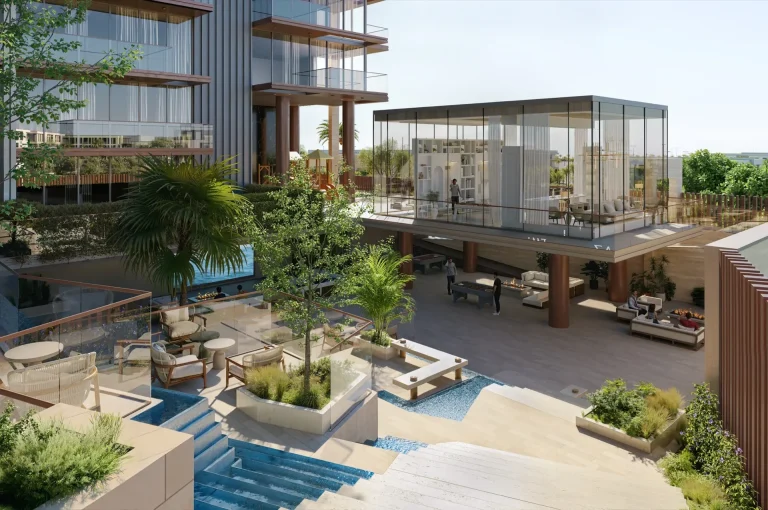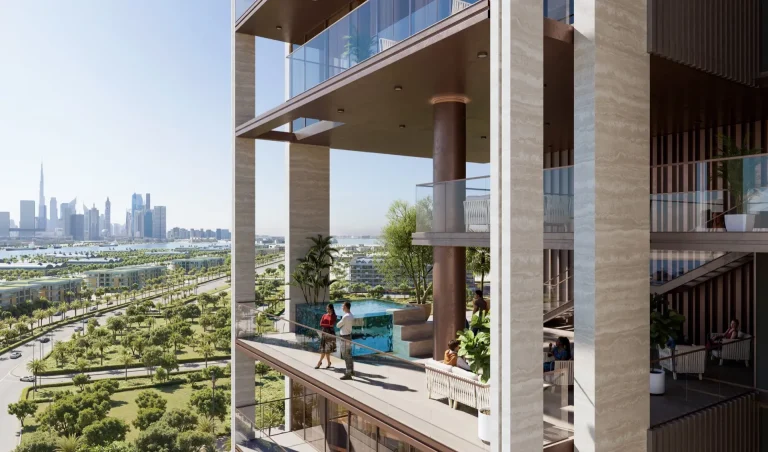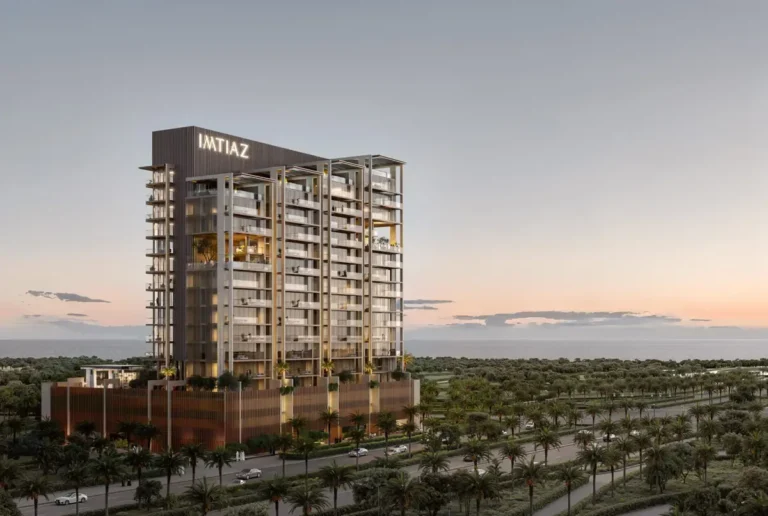
Not every launch in March 2026 was met with silence. While the broader market absorbed the shock of conflict headlines with caution — enquiries pulling back, deal timelines extending, site visits being deferred — select projects in select corridors kept moving inventory. Dugasta’s Paradise View II in Majan was one of them.
The project’s early sell-through figures, tracking at 40–50% of available units absorbed within weeks of soft-launch activity, are not a market anomaly. They are a proof point — and one that every serious Dubai off-plan investor 2026 needs to understand. When the rest of the market is watching and waiting, certain projects are still closing. The question worth asking is: what do those projects have in common?
Majan in 2026: The Case for an Emerging Corridor
Majan sits in the heart of Dubailand along Sheikh Mohammed Bin Zayed Road (E311). It is not a new name — community development began in 2006 — but it is in the middle of a maturation phase that is compressing the price gap between its current valuations and what comparable established communities command.
Average transacted prices in Majan currently sit around AED 1,157 per square foot, against JVC’s AED 1,650 and Arjan’s AED 1,420. Studios enter from AED 436,000; one-bedroom units from AED 499,000. That pricing architecture puts genuine ownership within reach of the sub-AED 700K off-plan Dubai buyer segment — the same cohort that has consistently driven absorption in every Dubai market cycle when mid-to-upper segments pause.
The area’s gross rental yields range between 6% and 8%, in line with or ahead of JVC and Arjan on a risk-adjusted basis, given Majan’s lower acquisition cost base. Return on investment in the community has been documented as reaching 6.34% on a net basis — competitive against Dubai’s citywide average of 5.7% for apartment investors as of early 2026.
For a full breakdown of how Majan’s location fundamentals compare across Dubai’s growth corridors, the Majan Dubai location guide and ROI analysis provides the community-level investment thesis in detail.
Table 1: Dugasta Paradise View II — Project at a Glance
| Detail | Paradise View II — Majan, Wadi Al Safa 3 |
| Developer | Dugasta Properties |
| Location | Majan, Wadi Al Safa 3, Dubailand |
| Configuration | Studios, 1BR, 2BR, 3BR + commercial |
| Building Scale | G + 12 residential floors + basement |
| Starting Price | From AED 436,000 |
| Payment Structure | EOI: AED 5,000 | Flexible milestone-based plan |
| Key Amenities | Pool, children’s pool, gym, sauna, steam room, covered parking |
| Ownership | Freehold — all nationalities eligible |
| Delivery Window | 2026–2027 (estimated) |
Table 2: Majan vs. Comparable Mid-Market Zones — 2026 Benchmarks
| Metric | Majan | JVC | Arjan | Dubai Silicon Oasis |
| Avg. Price/sqft (2026) | AED 1,157 | AED 1,650 | AED 1,420 | AED 1,200 |
| Gross Rental Yield | 6–8% | 7–8.5% | 6.5–7.5% | 6–7.5% |
| Off-Plan Entry (Studio) | From AED 436K | From AED 520K | From AED 500K | From AED 450K |
| Supply Pipeline (2026) | Moderate | High | Moderate–High | Moderate |
| Metro Access | Planned (2030+) | Limited | Limited | Existing (RTA) |
| Freehold Status | Yes | Yes | Yes | Yes |
Dugasta’s Absorption Signal: What 40–50% Sell-Through Actually Means
In a normal market environment, 40–50% sell-through in the first month of a project’s soft launch is a healthy absorption reading. In a market where enquiry volumes across Dubai’s leading brokerages had pulled back approximately 45% from typical levels during March 2026, it is a standout signal.
The Majan off-plan sales March 2026 story at Paradise View II is inseparable from Dugasta’s developer profile. The company, led by CEO Azaan Khan and Founder Tauseef Khan, built its reputation on sell-outs, not just launches. Its predecessor projects — both phases of Al Haseen Residences in Dubai Industrial City — sold out within months of launch, anchored by a structure guaranteeing investors an 8% annual return in the first five years alongside a buy-back option and zero service charges.
Paradise View II does not carry a formal guarantee structure, but it carries the developer’s track record — and in a cautious market, track record functions as a trust multiplier. Buyers who are still in active mode, the 55% of pre-conflict interested buyers who have not cancelled plans, are performing deeper due diligence before committing. A developer that has already sold out comparable projects at comparable price points is one of the clearest signals they can find.
Dugasta currently manages a portfolio worth AED 1.5 billion with plans to expand to an additional AED 2 billion, and the company has delivered over 50 residential projects since its founding — a track record that is not invisible to buyers doing research in a risk-aware market.
This is the dynamics described in depth in our analysis of Dubai prelaunch absorption after the war shock: absorption still matters more than headlines, and buyers who study developer quality rather than react to geopolitical noise have historically captured outsized gains.
The Q1 2026 Macro Backdrop: Off-Plan Held the Market Together
Paradise View II’s absorption did not happen in a vacuum. It happened against a market backdrop that, when examined data point by data point, was considerably more resilient than the sentiment environment suggested.
Q1 2026 produced 44,100 total residential transactions worth AED 176.7 billion — a 4.2% volume increase and a 23.4% value increase year-on-year according to Cavendish Maxwell and fäm Properties. The off-plan segment accounted for 73% of all transactions and grew 10.3% year-on-year.
In March 2026, specifically — the month most affected by conflict-driven sentiment — off-plan residential apartment sales reached AED 17.5 billion across 7,983 deals, up 12.9% in value and 2.3% in volume compared to March 2025. The ready segment, by contrast, contracted 9.2% over Q1. This divergence is not coincidental: buyers deferring commitment instinctively shift toward off-plan, where payment plans extend the timeline to full capital deployment while locking in current pricing.
The week of 23–29 March 2026, total DLD transactions reached AED 8.66 billion — a 49% weekly recovery from the prior week — with off-plan generating AED 6.74 billion, or 77.8% of the total. Dubailand, the broader zone containing Majan, was cited by DLD alongside Dubai South and Dubai Creek Harbour as one of the market’s steadier absorption corridors during the conflict period.
For investors weighing how the supply pipeline interacts with this performance data, our analysis of the Dubai 2026 off-plan market — boom, bubble, or maturity provides the structural context that separates sustainable absorption from speculative noise.
Table 3: Q1 2026 Dubai Off-Plan Market Snapshot
| Metric | Q1 2026 Figure | Year-on-Year Change |
| Total residential transactions | 44,100 | +4.2% |
| Off-plan share of total volume | 73% | +10.3% YoY (off-plan segment) |
| Off-plan apartment sales (March) | 7,983 deals / AED 17.5B | +2.3% volume / +12.9% value |
| Dubailand absorption (week of 23–29 Mar) | Dhs 6.74B off-plan weekly value | 77.8% of the total DLD weekly value |
| Ready segment performance | Declined 9.2% | Buyers’ preference shifting to off-plan |
| Q1 2026 total sales value | AED 176.7B | +23.4% YoY |
Reading Sell-Through as a Market Diagnostic
The early sell-through rate in Dubai off-plan is one of the most under-discussed metrics in property analysis. Most commentary focuses on total transaction volumes or price per square foot. Sell-through rate — the percentage of available inventory absorbed within the first 30–45 days of launch — is a more granular signal because it reflects real-time investor conviction, not lagged market averages.
A project that moves 40–50% of its units in an environment where the broader market is cautious is communicating something specific: the price point is right, the developer is trusted, the location thesis is accepted, and the payment structure removes barriers to commitment. Remove any one of those four conditions, and the number typically drops below 30%.
In Majan’s case, all four conditions align. Pricing from AED 436,000 to sub-AED 700,000 removes the affordability barrier. Dugasta’s track record removes the developer risk barrier. Majan’s location along E311, proximity to Global Village, IMG Worlds, and the planned retail infrastructure reduces the location uncertainty barrier. And a structured EOI-to-payment-plan flow, with AED 5,000 securing position, removes the capital commitment barrier entirely at the entry stage.
This is the same framework underpinning the broader investor shift from rentals to off-plan in Dubai and Abu Dhabi in 2026: payment plans designed to convert rental expenditure into ownership, at entry prices that make the maths work for the largest addressable buyer segment in the market.
Table 4: What Early Sell-Through Rate Signals to Investors
| Sell-Through Rate at Launch | Market Signal | Investor Implication |
| Below 30% in the first 30 days | Weak absorption — pricing or location concern | Approach with caution; re-price risk is real |
| 30–50% in the first 30–45 days | Healthy demand — qualified buyer confidence | Strong entry point; unit availability narrowing |
| 50–70% in the first 30 days | High conviction — project meets market criteria | Early investors secured best pricing; monitor resale |
| 70%+ in first 14 days | Exceptional demand — often Tier-1 developer + landmark location | Waitlist likely; secondary market premium expected |
Why Conflict Periods Reward Affordable Off-Plan Over Luxury
The consistent historical pattern in Dubai’s property market is that during sentiment-driven pauses, affordable off-plan investment units priced below AED 1 million with milestone-based payment structures absorb faster than the luxury and ultra-luxury segments. This is not because luxury buyers disappear; it is because the decision cycle is shorter and the financial commitment is lower.
A buyer committing AED 5,000 as an EOI on a unit starting at AED 436,000 can exit that decision with a 1.1% capital exposure if they change their mind before the first payment milestone. A buyer committing AED 500,000 on an AED 5 million penthouse cannot. In an environment of elevated uncertainty, the lower-stakes entry point wins the conversion.
Majan’s position as the “downtown of Dubailand” — its original 15.6 million square foot master plan designation — gives it one more characteristic that affordable buyers prize in uncertain times: community self-sufficiency. Residents within the zone have access to Midtown Central Majan and Remal Mall, supermarkets, clinics, and leisure, without dependence on city-wide infrastructure that conflict headlines make them feel vulnerable. That perception of local stability is not a trivial consideration for the end-user buyer making a residency decision rather than a pure investment decision.
The interplay between location stability, developer credibility, and affordable pricing is precisely what our analysis of construction continuing while buyers pause in Dubai’s prelaunch market identifies as the three-factor framework for distinguishing projects that absorb in conflict periods from those that don’t.
What This Means If You Are Still Watching
The 40–50% sell-through figure carries a direct message for the investor currently in passive monitoring mode: the window on Paradise View II’s best unit selection is narrowing. Projects in Majan with strong developer backing and sub-AED 700K entry pricing do not hold their full inventory for long — not even in cautious market environments.
For investors who have been tracking Majan prelaunch property as part of their research, the Dugasta data point is a catalyst, not a reason for further delay. The broader Q1 2026 data — 73% off-plan share, AED 176.7 billion in total Q1 sales value, off-plan apartments rising 12.9% in March — confirms that the structural market remains intact. What is adjusting is timing, not trajectory.
For a complete overview of where the best-positioned opportunities sit across Dubai’s growth corridors in 2026, including Dubailand and Majan, the guide to Dubai’s fastest-growing investment communities provides the community-level data investors need to make a comparative decision.
Secure Your Position Before the Window Closes
The 40–50% sell-through at Paradise View II is a data point with a shelf life. As more units are absorbed and sentiment clarity returns to the broader market, the best inventory in this project — optimal floor levels, preferred unit types, and launch pricing — will be gone. The buyers who acted during the cautious phase will have secured positions that the re-entry wave cannot replicate.
If Majan off-plan property is on your research list, now is the moment to convert that research into a direct conversation. MBR Properties has direct access to available inventory in Paradise View II, and the wider Majan corridor, with payment plan structures matched to a range of investor timelines and capital profiles.
Fill in the enquiry form at prelaunch.ae and a specialist will respond within two hours.
Contact us directly:
Phone: +971 52 341 7272
Email: sales@mbrproperties.ae
Frequently Asked Questions
1. What is the starting price for Dugasta’s Paradise View II in Majan?
Dugasta Paradise View II, located in Majan, Wadi Al Safa 3, starts from AED 436,000 for studios, with one- and two-bedroom apartments available at competitive mid-market price points. The project is registered as freehold, meaning it is open to all nationalities.
2. Why is Majan’s off-plan sales performance in March 2026 significant?
March 2026 was the period most directly affected by regional conflict sentiment, with overall enquiry volumes across Dubai’s leading brokerages down approximately 45% from normal levels. That Dugasta’s Paradise View II achieved 40–50% early sell-through during this period signals that the right price point, developer track record, and location thesis can still drive absorption in a cautious market.
3. What rental yields can investors expect from Majan off-plan properties?
Majan gross rental yields range between 6% and 8%, with documented net ROI reaching 6.34% — ahead of the Dubai citywide apartment average of 5.7% on a net basis as of early 2026. The area’s lower acquisition cost base (AED 1,157/sqft vs. JVC’s AED 1,650/sqft) creates more favourable yield arithmetic for investors entering at current prelaunch pricing.
4. How does Dugasta Properties’ track record affect buyer confidence in a conflict period?
Dugasta has sold out multiple comparable projects — including both phases of Al Haseen Residences — using a value proposition built on guaranteed returns, zero service charges, and buy-back options. In a market where investors are performing deeper due diligence before committing, a developer with verified delivery history functions as a trust signal that directly shortens the decision cycle and accelerates absorption.
5. Is the Q1 2026 off-plan market strong enough to support continued investment?
Q1 2026 data from Cavendish Maxwell, fäm Properties, and DLD shows 44,100 residential transactions worth AED 176.7 billion, with off-plan growing 10.3% year-on-year and accounting for 73% of total volume. March specifically saw 7,983 off-plan apartment deals worth AED 17.5 billion — up 12.9% in value year-on-year. The structural market held firm; the sentiment layer was cautious but did not translate into a contraction of transactional activity in the off-plan segment.
6. What is the investment thesis for Majan compared to JVC or Arjan?
Majan offers 20–35% lower entry costs than JVC and Arjan — with comparable or slightly lower gross rental yields — and a longer appreciation runway as the community matures toward its planned 2030 target of 90% development completion. The planned metro access to the Dubailand corridor adds a future value catalyst not yet priced into current Majan off-plan sales. For investors comparing Majan to adjacent corridors, our Dubai oversupply 2026 risk map and safe investment zones provide the supply-side analysis needed to calibrate risk across each area.