Key Market Figures at a Glance — March 2026
| AED 50.58B | AED 30B | 71.27% | 10.79% |
| Transactions during Ramadan 2026 — up 29.7% year-on-year | Deals recorded in just the first two weeks of March 2026 | Off-plan share of all residential transactions, January 2026 | Year-on-year residential price index growth, early 2026 |
When headlines darken — rockets, sanctions, oil-price spikes — the instinct is to pause. Freeze. Wait for clarity. It is a very human response, and in most industries it is arguably sensible. But in Dubai’s real estate development world, pressing pause is far more dangerous than pressing forward.
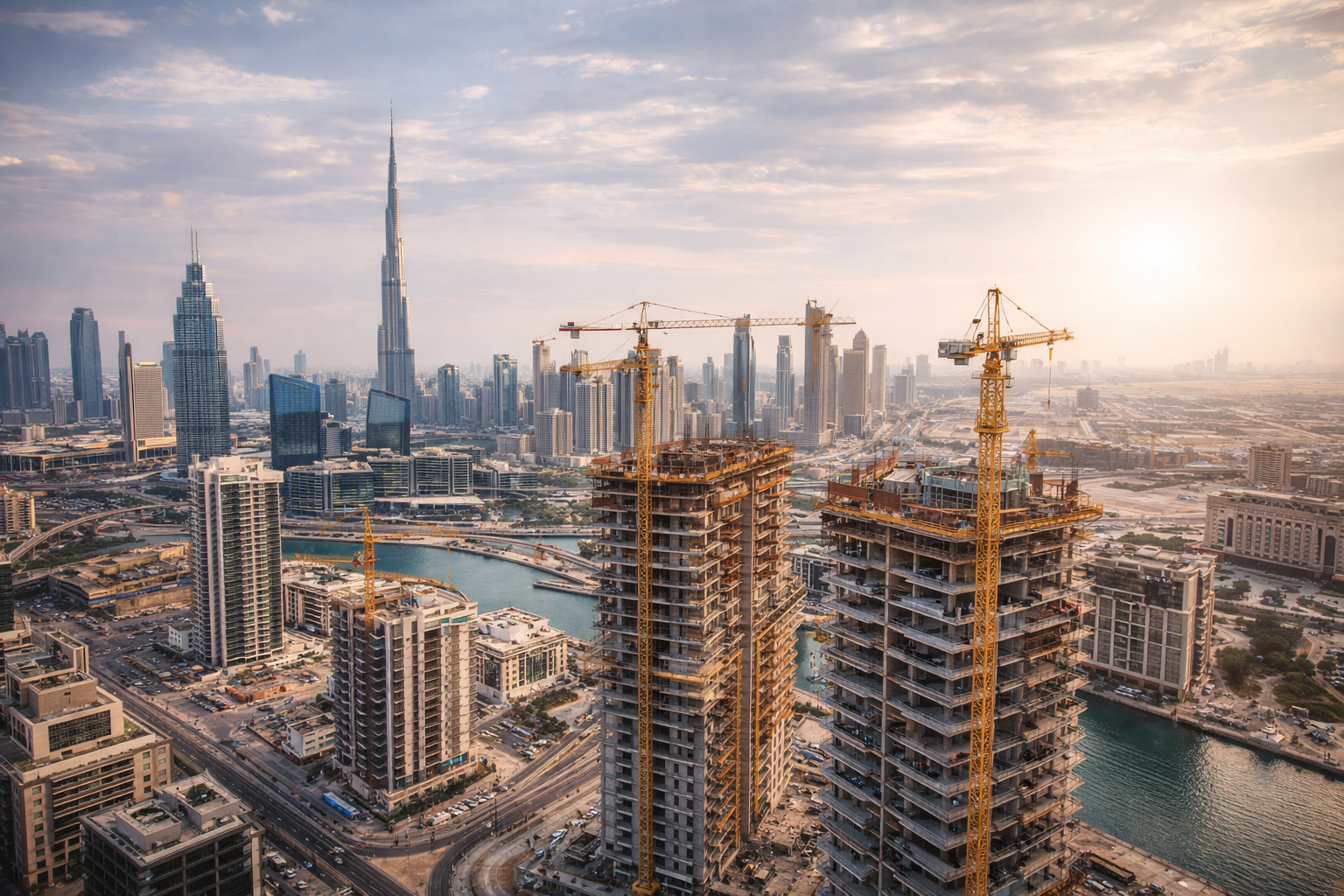
The Dubai project launch of March 2026 has made one thing clear: the city’s most respected developers are not watching the news cycle. They are watching their pipeline. And there is a very deliberate reason for that.
The War Shock That Did Not Stop the Market
Regional tensions involving Iran, the US, and Israel rattled sentiment across asset classes in early 2026. Equity indices wobbled. Speculative capital moved to the sidelines. But Dubai’s physical property market responded with something analysts described as notable resilience — and the data backs that up entirely.
During Ramadan 2026 — traditionally a slower season — the market recorded 15,196 transactions worth AED 50.58 billion, a 5.63% rise in volume and a staggering 29.7% rise in value compared to Ramadan 2025. The first week of March alone generated AED 11.8 billion across 3,437 transactions, including the third most expensive apartment sale in Dubai’s history: a 31,200 sq ft unit at Aman Residences that traded for AED 422 million, while still under construction.
This is what serious capital does under geopolitical pressure. It does not run from real estate. It doubles down on it.
“Unlike equity markets, where sentiment reprices instantly, real estate responds with a lag. The same investors selling shares on Monday are often submitting offers on apartments the same week.” — Market analysts, March 2026
As we detailed in our analysis of why smart buyers are choosing off-plan over rentals in 2026, the structural case for Dubai property has not changed — and short-term headlines are not the right lens through which to evaluate a multi-year investment thesis.
Why Serious Developers Never Stop the Pipeline
Here is something that does not make headlines but shapes everything: stopping a development pipeline is extraordinarily expensive. The moment a developer delays a launch, it triggers a cascade — construction contracts are renegotiated at penalty rates, materials are held at cost, pre-registered clients are lost, and the brand suffers credibility damage that takes years to repair.
But beyond economics, pipeline continuity is the single most powerful signal a developer can send to the market. It says: we have done our risk analysis, we trust our fundamentals, and we are not running. That confidence is contagious — and it is precisely what investors look for when choosing which developers to trust with long-term capital.
In a market where off-plan properties account for over 71% of all residential transactions, buyers are essentially betting on a developer’s conviction. Every launch that goes ahead during uncertain times is, in effect, a very public statement of confidence. Developers who understand this do not pause — they accelerate.
For a deeper look at how this confidence translates into returns, our piece on why prelaunch buyers could see 25% gains in 2026 walks through the price trajectory data in full.
Dubai Real Estate Market Performance — Key Benchmarks, March 2026
| Metric | Figure | YoY Change | Signal |
|---|---|---|---|
| Ramadan 2026 transaction value | AED 50.58 billion | +29.7% | Bullish |
| Off-plan share of residential sales | 71.27% | +~6 pp | Bullish |
| Residential price index growth (YoY) | 10.79% | Moderating from 18–22% | Maturing |
| Median apartment price per sq ft | AED 1,500–1,550 | Stable | Stable |
| Gross rental yields across Dubai | 5–9% | vs London 3%, Paris 2.5% | Superior |
| Total 2025 residential sales (DLD) | 205,100 units | +18.33% volume | Record |
Launch Continuity as a Trust Signal: What It Means for Investors
Imagine two developers in the same city, launching similar projects in the same quarter. One pauses at the first sign of geopolitical noise. The other holds the date, absorbs the pressure, and delivers the launch as planned. Which developer would you trust with a five-year investment?
The answer writes itself. Launch continuity signals institutional discipline — the hallmark of developers with strong balance sheets, regulatory compliance, and long-term market commitment. It tells investors that the developer did not build their pipeline on speculation; they built it on demand analysis.
Dubai’s best developers in off-plan real estate understand that their clients — whether they are European family offices, Asian sovereign wealth managers, or GCC-based end-users — are making a decade-long capital allocation decision. Pausing a launch because of a bad week in the news cycle would undermine exactly the kind of trust that took years to build.
The infrastructure backing these launches is equally resilient. For context on which communities are being built on the strongest foundations, our breakdown of infrastructure mega-projects driving Dubai’s off-plan hotspots provides the geographic and economic context behind each major zone.
Developer Behaviour in Volatile Periods — A Comparative View
| Behaviour | Developers Who Pause | Developers Who Continue |
|---|---|---|
| Pipeline signal to market | Uncertainty, lack of confidence | Stability, institutional discipline |
| Client perception | Risk of brand erosion | Trust reinforcement |
| Financial impact | Penalty costs, delayed revenues | Maintained cash flow and sales |
| Investor confidence | Reduced repeat investment | Increased repeat and referral business |
| Market positioning post-crisis | Recovery takes 12–24 months | Positioned as category leaders |
The Numbers That Geopolitical Fear Keeps Missing
Here is the part that most panicked investors overlook. Dubai’s off-plan market is supply-constrained in practice, even when headline figures suggest abundance. Knight Frank data shows that only 64% of scheduled completions were delivered on time in 2025, down from 50% in 2024. This delivery gap consistently moderates supply pressure — and it is one of the principal reasons prices have remained stable even as new units are announced daily.
The UAE’s GDP is projected to expand at 5.0% in 2026 — the fastest among GCC countries and well above the global average — while Dubai’s population continues to swell past 3.7 million, driven by Golden Visa holders, tech entrepreneurs, and high-net-worth individuals relocating from higher-tax markets.
Cash buyers represent approximately 86% of Dubai’s property transactions, according to Knight Frank. This is a critical context: a market dominated by cash buyers is structurally less exposed to interest-rate shocks or credit-market volatility. When global conditions tighten, Dubai’s buyer profile acts as a natural buffer.
Understanding the full financial toolkit available to buyers is essential for informed decisions. Our guide to zero-down-payment Dubai off-plan strategies explores how developers are lowering entry barriers for qualified investors. And if financing is part of your strategy, our complete guide to Dubai off-plan mortgages for international investors covers lender requirements, approval timelines, and structuring options in full detail.
What This Means If You Are Considering an Off-Plan Investment Right Now
Every significant property market cycle in Dubai’s history — 2009, 2016, 2020 — has one consistent pattern: those who entered during periods of maximum headline fear captured the strongest returns. The best off-plan investment opportunities in Dubai are rarely available during periods of public euphoria. They appear when confidence is shaken but fundamentals remain intact — which is exactly where March 2026 sits.
Dubai project launches in March 2026 are proceeding at scale. Developers with the strongest reputations are not retreating — they are expanding their footprint in areas like Dubai Creek Harbour, Dubai Islands, and Mohammed Bin Rashid City, all of which are supported by confirmed infrastructure investment running into the tens of billions of dirhams.
For investors evaluating whether this is the right moment to act, our 2026 Dubai off-plan market outlook — boom, bubble, or maturity provides a rigorous, data-driven framework for making that assessment. And if you are building a long-term position, the strategies outlined in our guide on navigating Dubai’s market shift as a pre-launch investor remain highly relevant to 2026 conditions.
The developers who keep moving forward are not being reckless. They have already done the analysis you are doing now. Their pipeline is their answer.
Ready to Invest Before the Crowd?
Fill in your details on Prelaunch.ae and get first access to off-plan projects launching in Dubai right now — before the public announcement.
Visit us at prelaunch.ae and fill out the enquiry form to receive a personalised shortlist of Dubai off-plan projects matched to your budget and investment goals.
Contact Us:
- Phone: (+971) 52 341 7272
- Email: sales@mbrproperties.ae
- Website: https://prelaunch.ae
Frequently Asked Questions
| Question | Answer |
|---|---|
| Are Dubai project launches in March 2026 continuing despite geopolitical tensions? | Yes. Dubai recorded AED 30 billion in transactions in the first two weeks of March 2026 alone. Major developers continued planned launches across key communities with off-plan sales exceeding 71% of all residential transactions. |
| Why do top Dubai developers not pause launches when headlines worsen? | Stopping a pipeline incurs financial penalties, erodes client trust, and signals a lack of confidence that takes years to reverse. Leading developers also have access to forward-looking demand data the general market does not, making pipeline continuity both an economic and strategic imperative. |
| Is now a good time to invest in off-plan properties in Dubai? | Prices remain stable at AED 1,500–1,550 per sq ft, rental yields sit at 5–9%, and the UAE economy is projected to grow at 5.0% in 2026. For investors with a 3–5 year horizon, the structural case for entry is strong. |
| How do I identify which Dubai off-plan projects are worth investing in? | Key filters include the developer’s track record for on-time delivery, the location’s infrastructure backing, the payment plan structure, and RERA-registered escrow compliance. Prelaunch.ae provides curated, pre-vetted access to projects across all major Dubai zones. |
| What percentage of Dubai property transactions are off-plan? | As of January 2026, off-plan properties accounted for 71.27% of all residential transactions in Dubai — AED 39.33 billion across 11,229 deals in that month alone. |