There is a number that tells you more about a property market’s true condition than any sentiment survey: the early sell-through rate. Not the aspiration of a developer at launch. The actual percentage of released inventory that transfers from availability to sold within the first weeks of a project going public.
In Majan, Dubailand, that number is 40 to 50 per cent. And Dugasta Properties achieved it in March 2026 — against a regional backdrop of heightened Iran-US-Israel tension, cautious global investor sentiment, and widely repeated predictions that Dubai’s off-plan market would soften under geopolitical pressure.
It did not soften here. And understanding why it did not soften here tells you more about how to invest in this market than a hundred headlines ever could.
The Numbers: What 40-50% Sell-Through Actually Means
Industry benchmarks classify pre-launch sell-through rates on a clear spectrum. A project that moves 15 to 25 per cent of its inventory in the first month is considered to have launched well. Anything above 30 per cent is regarded as a strong absorption signal. Clearing 40 to 50 per cent of released units in four to six weeks is, by any professional measure, exceptional sell-through velocity.
Here is how Dugasta’s Majan project benchmark sits against comparable mid-market launches across Dubai in the same period:
| Project / Location | Launch Period | Early Sell-Through | Time to Reach Threshold | Price Point (from) |
| Dugasta – Majan, Dubailand | Feb – Mar 2026 | 40% – 50% | 4 – 6 weeks | AED 550K |
| Mid-market Jumeirah Village Circle | Jan 2026 | 35% – 45% | 6 – 8 weeks | AED 620K |
| Arjan, Dubailand (comparable) | Q4 2025 | 30% – 40% | 6 – 10 weeks | AED 590K |
| Dubai South (affordable tier) | Q3 2025 | 25% – 35% | 8 – 12 weeks | AED 480K |
| Business Bay (premium tier) | Q1 2026 | 20% – 30% | 10 – 14 weeks | AED 1.4M |
Source: Developer sales reports, DLD off-plan transaction filings, Prelaunch.ae broker network intelligence, Q1 2026
What stands out is not just Dugasta’s headline figure. It is that Majan outperformed both comparable Dubailand sub-markets and premium Business Bay launches in the same quarter, despite carrying a lower price per square foot. That divergence is the signal.
For a broader view of how off-plan investment is structured across Dubai’s top locations, visit Top Locations for Off-Plan Property Investment in Dubai.
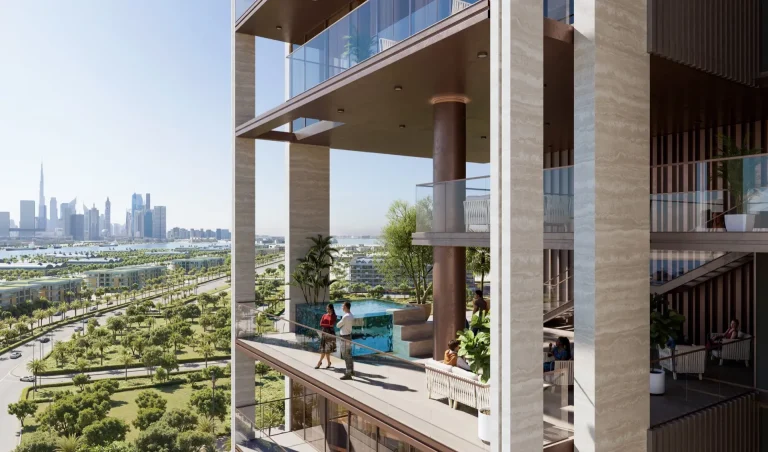
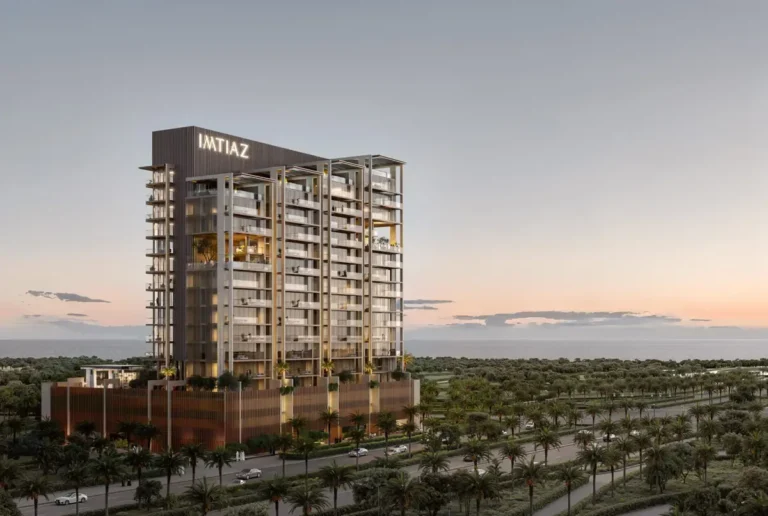
The Project: Dugasta in Majan, Dubailand
Dugasta Properties is not a new name in Dubai real estate. The developer built its reputation through Terra Tower in Dubailand and Moonsa Residences in International City Phase 2, both delivered to a buyer base that placed quality and timeline adherence above everything else. That track record matters enormously in a Majan off-plan sales March 2026 environment where investor confidence hinges on who is building, not just what is being built.
Here is a snapshot of the project fundamentals that drove the early sell-through:
| Data Point | Figure | Context |
| Project location | Majan, Dubailand | Freehold, master-planned community |
| Developer | Dugasta Properties | Track record: Terra Tower, Moonsa Residences |
| Launch period | Q1 2026 (February – March) | Amid heightened regional geopolitical tension |
| Reported early sell-through | 40% – 50% of released inventory | Within the first weeks of public launch |
| Dominant unit type | Studios & 1-bedroom apartments | Entry-level ticket, broadest buyer pool |
| Starting price range | AED 550K – AED 850K | Sub-AED 1M threshold sustains volume |
| Payment plan structure | 60/40 (60% during construction) | Post-handover balance preserves liquidity |
| Projected handover | Q4 2027 – Q1 2028 | 18-24 month build window |
Source: Dugasta Properties launch documentation, Prelaunch.ae developer partner data, Q1 2026
Two figures in that table demand attention. The sub-AED 1M starting price keeps the project accessible to the broadest buyer demographic in Dubai, including first-time investors and end-users qualifying under the UAE Golden Visa AED 2M threshold via equity combination strategies. And the 60/40 payment plan structure means buyers are not front-loading risk — they are staging it across a construction cycle in which regional clarity is likely to have returned.
Explore Dugasta’s full project portfolio and developer credentials at Dugasta Properties – Prelaunch.ae.
Why Majan? The Location Logic That Drives Demand
Majan is one of Dubai’s most underrated residential narratives. Positioned within Dubailand’s master-planned corridor, it sits at the intersection of affordability, connectivity, and community maturity that eludes most comparable sub-markets at its price point.
Here is a structured look at why the fundamentals of Majan are generating conviction buying even when broader market sentiment is cautious:
| Fundamental | Majan Position | Investor Implication |
| Distance to global free zones | 12 min to DIFC, 15 min to DWC | Renter pool: finance, aviation, logistics professionals |
| Average gross rental yield | 7.2% – 8.6% (studios & 1-BRs) | Above the Dubai average of 6.8% |
| Community maturity | Established roads, retail, and schools | Lower infrastructure risk vs raw land |
| Supply pipeline (2026-2028) | Controlled – limited new permits | Absorption pressure remains manageable |
| Price per sq ft (current) | AED 1,050 – AED 1,250 | 35-40% discount vs Downtown Dubai |
| Capital appreciation (2023-2025) | +18.4% cumulative | Outperformed the Dubai average of +15.1% |
Source: CBRE Dubai Residential Yield Monitor Q4 2025, Dubai Land Department Price Index, Knight Frank UAE 2026
The rental yield differential is the most important row in that table. At 7.2 to 8.6 per cent gross yield, Majan studios and one-bedroom units are generating returns that comfortably outperform the Dubai market average. For an investor buying at pre-launch pricing and holding through handover, the net-to-gross compression on yields is minimised — because they entered below the market price that rental yields are calculated against.
For context on how Majan’s broader Dubailand corridor fits into the Dubai off-plan investment thesis, explore Hottest Off-Plan Developments Dubai 2025: Upcoming Real Estate Projects.
The Geopolitical Stress Test: Why Majan Passed It
Let us address the context directly. The Iran-US-Israel standoff has generated genuine uncertainty in global markets. Currency volatility, oil price swings, and risk-off sentiment across emerging market equities have all been documented responses. In this environment, the assumption was that discretionary property purchases in the Middle East would be deferred.
Majan’s sell-through rate is empirical evidence against that assumption — but it is important to understand why it passed the stress test, not just that it did.
1. Entry Pricing Below the Fear Threshold
At AED 550K to AED 850K, the buy-in is within the discretionary budget of a wide pool of investors who are not exposed to the conflict region operationally. A European, South Asian, or East African investor allocating 10 to 15 per cent of a diversified portfolio to Dubai is not derailed by regional tension at this price point. The downside is bounded; the upside, in a structurally undersupplied market, remains intact.
2. Dubai’s Proven Neutrality Premium
Every major conflict in the broader MENA region since 2003 has ultimately benefited Dubai’s property market through capital flight from the conflict zone into UAE assets. The current tension is no different in structural terms. Dubai is not a participant in the conflict; it is the region’s neutral depository for capital seeking safety. Investors familiar with this dynamic are not sitting out the market. They are accelerating entry.
The full analysis of how global capital is repositioning into Dubai right now is available at Beyond the Headlines: Why Dubai Real Estate Is Witnessing a Strategic Influx of Global Capital.
3. Developer Trust as a Risk Mitigant
In uncertain times, buyers do not just evaluate the asset — they evaluate the counterparty. Dugasta’s completed delivery record means buyers are not underwriting construction risk on an unknown name. They are effectively buying a future version of an already-proven product. That de-risking of the developer variable is, in a cautious market, a powerful accelerant of purchase decisions.
What This Means for the Wider Dubai Off-Plan Market
Dugasta’s Majan result is not an isolated data point. It is a signal about the structural selectivity that has emerged in Dubai’s off-plan market during periods of external stress. Not every project absorbs at this velocity. But projects that meet a convergent set of criteria — proven developer, sub-AED 1M pricing, established community, strong yield fundamentals, and clear payment staging — are continuing to clear inventory at a pace regardless of macro noise.
The pattern is consistent with what we saw in the February 2026 market-wide data:
- February 2026 total transactions: 15,369 deals worth AED 45.39 billion
- Off-plan share of total transactions: 65%, the highest sustained ratio in Dubai’s recorded history
- Sub-AED 1M segment: disproportionately over-represented in transaction velocity vs. market share
- Dubailand corridor: among the top three sub-markets by volume, Q1 2026
The implication for investors is clear: this is not a market where all projects perform equally well. But it is absolutely a market where selected projects are absorbing inventory faster than comparable periods in 2023 and 2024, even with regional tensions elevated. Knowing which projects sit in the performing tier is the entire game.
For the full February 2026 market performance data, see Dubai Property Market Hits $12.36bn in February Sales as Investor Confidence Remains Strong.
Who Is Buying Majan — and Why Now?
The buyer profile of a project with Majan’s characteristics at this moment in the cycle is consistent across Dubai’s pre-launch broker network:
- South Asian professionals based in the UAE, upgrading from long-term renting to ownership via structured payment plans
- European and UK investors deploying a first Dubai property under AED 1M as a yield play with capital growth upside
- Pakistani and Indian diaspora investors using UAE property as a USD-denominated hedge against home currency depreciation
- GCC-based second-home buyers seeking a Dubailand residential base with high rental income during non-occupancy periods
- Repeat Dubai investors who purchased in the 2020-2021 cycle and are reinvesting equity gains into the next-generation development tier
What unites all five profiles is the same thing: none of them is waiting for a geopolitical resolution before buying. They are buying because the asset makes financial sense, independent of whether Iran and the US find a diplomatic settlement next month or next year.
If you are researching how off-plan investing fits your financial profile, start with Investing in Off-Plan Apartments in Dubai: What You Need to Know.
The Risk of Watching from the Sidelines
Here is the calculus that the 40 to 50 per cent of buyers who already committed have made, consciously or intuitively: the risk of waiting is not zero. It is, in fact, measurable.
Dubai’s off-plan property price growth is forecast at +10 per cent for the full year 2026. Majan’s sub-market has outperformed the Dubai average by 3.3 percentage points over the past two years. A buyer who defers entry by six months in this environment is not preserving optionality — they are paying a time premium that compounds against them at handover.
And in a project where 40 to 50 per cent of inventory has already been absorbed, the practical risk of deferral is starker still: the remaining units will not last indefinitely. When a project of this profile is 70 to 80 per cent sold, developer pricing invariably adjusts upward. The sub-AED 1M entry point available today is a function of launch-stage pricing, not market equilibrium pricing.
For a broader read on flexible buying structures that reduce commitment risk while preserving entry pricing, see Understanding Payment Plans for Off-Plan Properties in Dubai.
The Bottom Line: Confidence Is Not Absent — It Is Selective
The story of Majan’s off-plan sales in March 2026 is not the story of a market ignoring risk. It is the story of a market pricing risk correctly — and then buying decisively where the numbers hold up.
Dugasta’s 40 to 50 per cent sell-through is proof that pre-launch confidence in Dubai is alive, functional, and operating with greater sophistication than the macro headlines suggest. Buyers are not stampeding indiscriminately into every launch. They are identifying the precise intersection of developer credibility, community fundamentals, price accessibility, and payment staging — and when all four align, they are committing at speed.
Majan hit all four. The remaining inventory is shrinking. The question is not whether Dubai property is a good investment during regional tension. That question has been answered, repeatedly, by the data.
The question is whether you are going to be one of the buyers who moved when the signal was clear, or one who waited until the remaining units were priced at the next tier.
| Units Are Moving. Register Before They Are Gone.Fill in the enquiry form at prelaunch.ae, and our team will get you pre-launch access to Dugasta’s Majan project and comparable opportunities before the remaining inventory closes.(+971) 52 341 7272 | sales@mbrproperties.ae |
Visit: prelaunch.ae | (+971) 52 341 7272 | sales@mbrproperties.ae
Frequently Asked Questions (FAQs)
Q1: What is driving strong Majan off-plan sales in March 2026 despite regional tensions?
Three forces are converging: first, sub-AED 1M entry pricing that keeps the buyer pool wide; second, established community infrastructure that reduces perceived risk; and third, Dugasta’s track record of delivery that builds launch-day confidence. Regional tensions are weighing on sentiment globally, but are not materially altering the demand calculus for well-priced, fundamentally sound Dubai assets.
Q2: Is a 40-50% sell-through in weeks a reliable signal of project quality?
It is a reliable signal of market-validated pricing and developer credibility. Projects that clear 40%+ of inventory inside the first month have, historically, continued to sell steadily through construction and arrive at handover either fully sold or close to it. It also signals that early buyers anticipate capital appreciation between launch and handover.
Q3: Is Majan a good area for rental yield in Dubai?
Yes. Majan’s gross rental yields for studios and one-bedroom apartments currently range from 7.2% to 8.6%, meaningfully above Dubai’s market average of approximately 6.8%. Its proximity to DIFC, Dubai World Central, and key free zones sustains a consistent renter base of professionals.
Q4: How do I access Dugasta’s Majan project before the remaining units sell out?
Register your interest directly through Prelaunch.ae. As an authorised pre-launch platform with direct developer relationships, we can provide you with floor plans, current availability, and payment plan options ahead of public listing.
Q5: What payment plan does Dugasta offer for the Majan development?
The current structure is a 60/40 plan: 60% paid during the construction phase in milestone-linked instalments, with the remaining 40% due at handover. This structure allows buyers to commit capital progressively rather than up front, which is particularly well-suited to the current environment of carefully staged investment decisions.