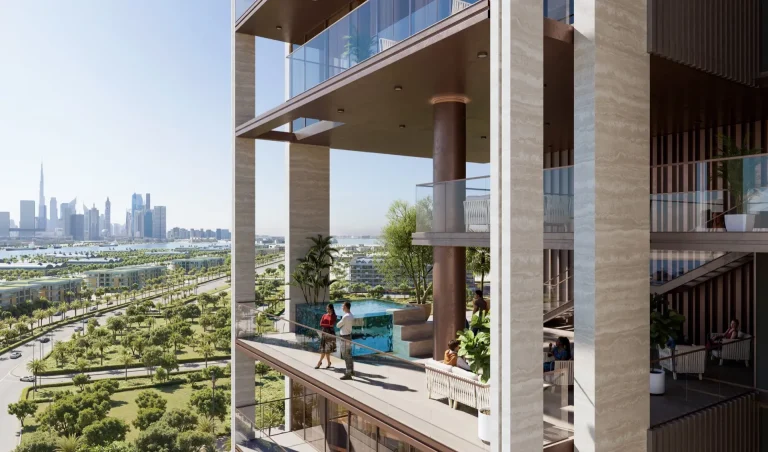
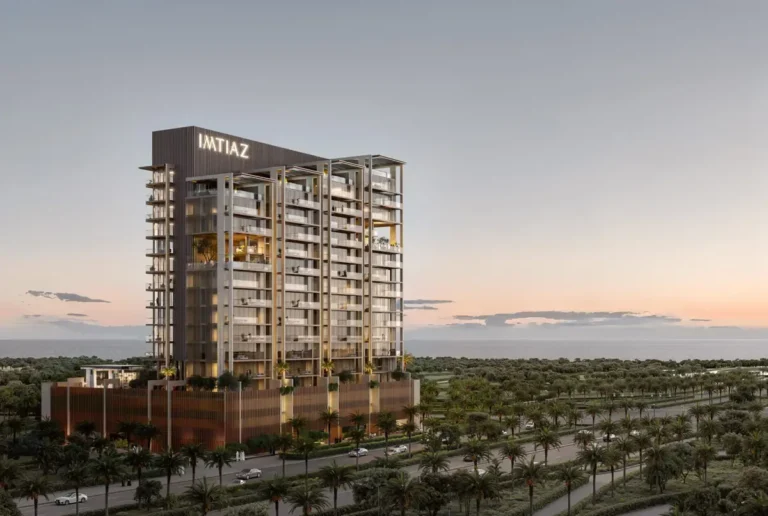
The two Dubai real estate stories running simultaneously right now — Story 1: DFM Real Estate Index down 21%. Emaar stock down 31.71%. Aldar and Emaar both hit the 5% single-day circuit breaker on reopening. UAE bonds the worst performers in emerging markets. Story 2: AED 60.6B in February 2026 property deals. AED 11.93B in March 2–9 transactions. AED 422M apartment sold at Aman Residences during the conflict itself. Viewings up 75% in days 6–9 vs days 1–3. One story is about share certificates. The other is about buildings.
When the Dubai Financial Market exchange closed for two days following Iran’s attacks on February 28, 2026, the market knew exactly what was coming when it reopened on March 4. Emaar Properties and Aldar Properties both hit the 5% daily circuit breaker on the first session — the automated halt designed to prevent single-day losses from spiralling beyond the exchange’s daily limit. The DFM Real Estate Index had already fallen approximately 21% from its near-16,700-point peak to 13,353 by March 9, wiping out every gain made in 2026 in under two weeks. Emaar’s stock price fell from its 52-week high of AED 17.25 to AED 11.20 as of March 16 — a 31.71% collapse in a single month. Deyaar lost 15% in a single week. The numbers are real, they are alarming, and they are dominating the search results for the Dubai property market 2026.
Here is what those numbers are not: they are not a measurement of what a finished apartment in Jumeirah Village Circle is worth today. They are not a measure of whether the AED 30 billion Mercedes-Benz City development by Binghatti is still selling. They are not a measure of whether Dubai’s 6–9% tax-free rental yields have changed. They are not a measure of whether 3.6 million people still live and work in Dubai and need housing. The DFM Real Estate Index measures one thing with laser precision: how much institutional equity traders are willing to pay for shares in listed developer companies this afternoon. Nothing more, nothing less.
Two Scoreboards, One City – Reading Them Correctly
Dubai currently has two completely separate real estate scoreboards running in parallel. Understanding which one you are looking at — and which one matters for your investment decision — is the most important analytical skill in the market right now:
| Metric | Dubai Stock Market (DFM) | Dubai Physical Property Market |
|---|---|---|
| Index / Benchmark | DFM Real Estate Index (DFMREI) | Dubai Land Department — Transaction Registry |
| Movement on Feb 28 – Mar 4 | DFMREI: −21% from ~16,700 → 13,353 by Mar 9 | Feb 2026 (pre-conflict): AED 60.6B / 16,959 deals — all closed |
| Circuit Breaker Event | Emaar + Aldar hit 5% daily limit on Mar 4 reopening | No transaction circuit breaker exists — sales continued |
| Week of Mar 2–9 Performance | DFM General Index: −4.7–4.9% in a single session | 3,570 deals closed / AED 11.93B transacted — values rising by day 7 |
| Trophy Transaction During Period | Emaar stock: −31.71% month change (AED 17.25 → 11.20) | AED 422M apartment at Aman Residences sold — 3rd most expensive in Dubai history |
| Buyer Sentiment Signal | UAE corporate bonds: worst performers in EM (Bloomberg) | Property viewings up 75% in days 6–9 vs days 1–3 of conflict — Allsopp & Allsopp |
| Analyst Long-Term View | Emaar: 12 analysts BUY / 0 SELL; avg target AED 19.154 (+71% from current AED 11.20) | S&P Global: fundamentals intact; 70%+ end-user driven; 90% cash-funded |
Source: DFM / TradingView | Dubai Land Department | Bloomberg | Allsopp & Allsopp | S&P Global | Investing.com — March 2026
Both scoreboards are real. Both contain genuine information. But they measure fundamentally different things on fundamentally different timescales, responding to fundamentally different inputs. The investor who confuses the DFM equity index with a proxy for physical Dubai property values is making the same error as someone who watches Netflix’s stock price drop during a market selloff and concludes that people have stopped watching television. The business and the stock are separate instruments. So are the DFM developer equity and the Dubai physical property asset.
The Circuit Breaker Explained: What 5% Actually Means and Doesn’t Mean
When Emaar and Aldar hit the 5% daily circuit breaker on March 4 — the first trading session after the DFM’s two-day regulatory closure — it meant one specific thing: sell orders outnumbered buy orders so significantly that the exchange’s automated system suspended trading to prevent a cascading, disorderly collapse. The 5% circuit breaker exists precisely because equity markets overshoot — because fear and panic cause selling to go beyond what fundamentals justify. When a circuit breaker fires, the regulatory message is not that the company’s value has changed by 5%. The message is that sentiment has moved faster than the exchange can safely manage.
Reuters’ reporting on the 5% share-price fall for listed developers is accurate. But here is the critical context: Emaar’s stock on March 4 was pricing in uncertainty about a conflict that nobody knew how long would last, how broadly it would escalate, and what damage it would cause. By March 16 — less than two weeks later — the UAE had intercepted over 95% of all incoming projectiles, Dubai International Airport had returned to full operations, no major real estate assets had been damaged, and Emaar’s 12 sell-side analysts maintained an average price target of AED 19.154 against a current price of AED 11.20 — implying 71% upside from the stock’s current sentiment-driven trough. The stock was not reflecting Emaar’s business. It was reflecting the market’s fear of Emaar’s business, which is a very different thing.
Why Stocks Move in Seconds and Property Moves in Months
The structural reason that Dubai stocks and Dubai property cannot be read interchangeably comes down to the mechanism of repricing:
| Dimension | Equity Market (DFM Stocks) | Physical Property Market |
|---|---|---|
| Speed of price change | Milliseconds — algorithmic and sentiment-driven | Months to years — driven by fundamentals, supply and demand |
| What is being priced | Perceived risk of owning developer company shares | Actual value of physical bricks, land, and rental income streams |
| Leverage in the system | Institutional margin calls, leveraged ETF liquidations, and stop-losses triggering chain reactions | ~69% of Dubai resales in Feb 2026 were all-cash — no margin calls possible |
| Who can force a sale | Any market participant — sell order takes 1 click | Only the owner — and only if they choose to. Cash holders have zero compulsion |
| Carrying cost during downturn | Zero — you simply hold the shares (or lose on margin) | Covered by 6–9% tax-free rental yield — property owners are paid to hold |
| Regulatory protection (buyer) | No buyer-protection mechanism in equity markets | RERA escrow accounts legally ring-fence all off-plan buyer deposits by statute |
| Historical DFM drop vs price drop ratio | DFM dropped 70%+ in 2008 crisis; physical prices fell ~30% — nearly half the equity loss | Property consistently lags equity in both downturns AND recoveries — it is structurally more stable |
Sources: fäm Properties / DXB Interact | Dubai Land Department | S&P Global | Historical DFM data, March 2026
The carrying cost dimension is particularly underappreciated. An equity investor who holds Emaar shares through a bear market earns nothing while waiting for recovery. A Dubai property investor holding a fully tenanted unit earns 6–9% annually in tax-free rental income while they wait. The cost of patience is negative — the property actually pays the investor to hold. This structural asymmetry is why cash-rich property buyers do not panic-sell the way equity holders do, and why the physical property market’s price floor is structurally higher than equity markets suggest in any conflict period. As detailed in our comprehensive comparison of Dubai vs Europe: tax benefits, yields, and the investment case for physical property over equity, no major global property market can match Dubai’s combination of zero tax and 6–9% yield — a structural advantage that persists independently of what the DFM prints on any given afternoon.
The Emaar Divergence: When the Stock Price and the Business Go Separate Ways
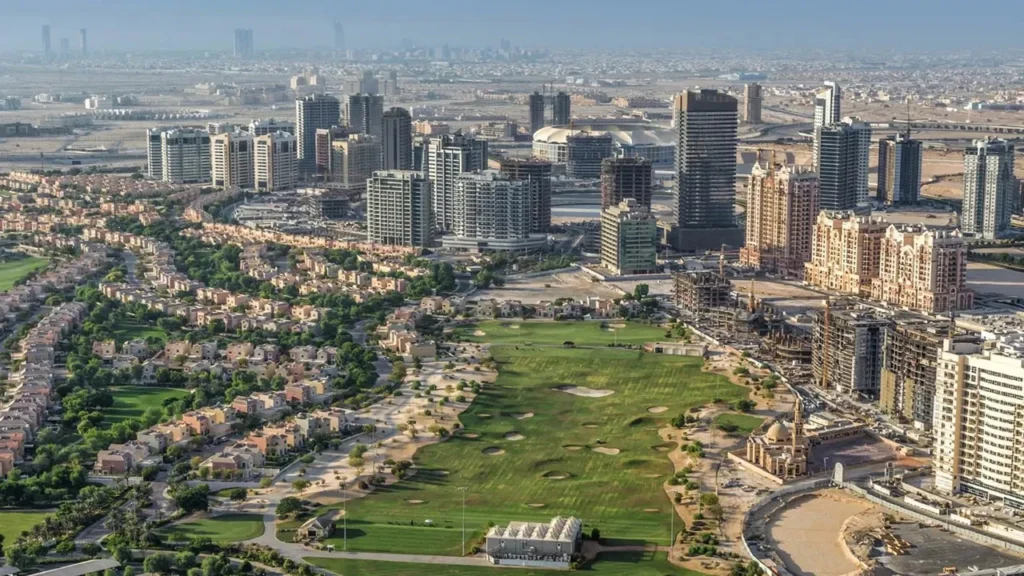
Emaar Properties is the most instructive case study in the current market because the gap between its equity price and its business fundamentals is historically wide. This is not an observation about whether to buy or sell Emaar stock — that is a separate decision. It is an observation about what the stock price tells us about the physical property market, which is: very little:
| Emaar Metric | Current / Recent Data | What It Tells Property Investors |
|---|---|---|
| Stock Price (Mar 16, 2026) | AED 11.20 — down from AED 17.25 (52-wk high) | Equity sentiment at 6-month low; NOT a reflection of property portfolio value |
| Q4 2025 EPS vs Estimate | AED 0.70 actual vs AED 0.51 estimate — 37% beat | The business itself is outperforming expectations by a wide margin — the stock drop is pure sentiment |
| Q4 2025 Revenue vs Estimate | AED 16.45B actual vs AED 12.72B estimate — 29% beat | Revenue running at 29% above what analysts modelled — no structural business deterioration |
| Analyst Price Target | Average: AED 19.154 | High: AED 21.75 | 12 BUY / 0 SELL | Current AED 11.20 price implies 71% upside to average target — stock is pricing fear, not fundamentals |
| Development Backlog | AED 27 billion — committed buyer deposits in escrow | Contracted future revenue from buyers who have already paid — this does not disappear with the stock price |
| Units Under Construction | 51,032 units — largest developer pipeline in Dubai | Physical construction not paused; cranes are still moving; delivery schedules intact |
| Emaar Founder’s Assessment | Mohamed Alabbar: ‘Smart capital will continue to invest’ — CNBC, March 2026 | Founder distinguishes between short-term sentiment and long-term structural conviction |
Sources: Investing.com | TradingView | CNBC | Dubai Land Department | Emaar Investor Relations, March 2026
Emaar’s Q4 2025 earnings beat was not small — 37% above EPS estimates, with revenue running 29% above analyst models. That is a business performing at exceptional levels in the most recent reporting period available. The stock price at AED 11.20 does not reflect that performance — it reflects investor anxiety about a conflict that broke open after those earnings were recorded. Emaar’s founder, Mohamed Alabbar, captured the distinction precisely in his CNBC interview: there “might be some slowdown” — an honest acknowledgement of near-term uncertainty — but the fundamentals are solid and “smart capital will continue to invest.” The word “smart” is load-bearing in that sentence. It distinguishes between capital that reads a stock ticker and concludes the market is broken, and capital that reads a DLD transaction report, a rental yield table, and a population growth curve and concludes the opposite.
The Historical Evidence: What Past DFM Drops Actually Did to Property Prices
The relationship between Dubai stock market falls and physical property price corrections has a clear historical pattern — and that pattern is consistently reassuring for property investors relative to equity investors:
| Year | Crisis | DFM/Developer Stock Drop | Physical Dubai Property Drop | Market Verdict |
|---|---|---|---|---|
| 2008–09 | Global Financial Crisis | DFM fell ~70% | Physical prices: −30% | Stock fell 2.3x more than property; the market recovered fully by 2013 |
| 2014–16 | Oil price collapse | Developer stocks: −40–50% | Physical prices: −20–25% | Stocks again led the decline; property stabilised faster |
| 2020 | COVID-19 pandemic | DFM fell ~35% in 6 weeks | Physical prices: −5 to −10% | Stock markets crashed; physical property barely moved; then biggest boom in history followed |
| 2022 | Russia–Ukraine war | DFM: modest dip then record high | Physical prices: +30%+ in 2022 | Conflict drove capital INTO Dubai; stock and property both rose as safe haven demand surged |
| 2026 | US–Israel–Iran conflict | DFMREI: −21–30%; Emaar: −31.71% | Physical: slowing pace, deals ongoing; AED 11.93B in week 1 | History says stock drop leads; property stabilises within weeks; recovery follows |
Sources: DFM historical data | ValuStrat | Knight Frank | JLL | Dubai Land Department historical records, March 2026
The 2008 pattern is the most instructive because it was the worst-case scenario: a 70% DFM collapse against a 30% property price fall. Even in Dubai’s deepest crisis, physical property lost less than half what developer equities lost — because, as the table confirms, equities reprice in hours while property reprices over quarters. The 2020 COVID comparison is even more striking: a 35% equity collapse against a 5–10% physical property correction, followed by the most powerful bull run in Dubai’s history. The current 21–30% DFMREI decline, mapped against historical ratios, suggests a physical property correction — if it materialises at all — would be measured in the single digits, not in the dramatic double-digit declines that equity price moves imply. For investors navigating which communities offer the strongest resilience against any correction scenario, our analysis of Dubai’s five fastest-growing communities with 7–12% ROI and the strongest structural demand floors provides the community-level filter that separates durable assets from those most exposed.
What Was Actually Happening on the Ground During the Stock Panic
While institutional equity traders were hitting sell on Emaar at the 5% circuit breaker limit, on the other side of the city — at the DLD registry, in developer showrooms, and on broker viewing schedules — a parallel market was operating in an entirely different register:
- AED 11.93 billion in physical property transactions were registered during the March 2–9 conflict week — seven days into active missile exchanges — with daily transaction values rising over the final three days of that period. The trajectory was not down and accelerating. It was down, then recovering.
- An apartment at Aman Residences sold for AED 422 million — the third most expensive transaction in Dubai’s history — during the conflict itself. The buyer who committed AED 422 million in cash to a physical Dubai asset during an active conflict week is not the buyer profile of a panicking market.
- Property viewings increased 75% in days 6–9 of the conflict compared to days 1–3, according to data from Allsopp & Allsopp — one of Dubai’s most active brokerages. The market was not accelerating toward exit. It was accelerating toward re-engagement as the reality of the UAE’s defence capability became apparent.
- The secondary market remained active throughout, with brokers describing “stability, not panic” — a direct contrast to the DFM’s equity market behaviour. Secondary buyers, overwhelmingly cash-funded with no margin exposure, had no financial mechanism to force them to sell.
For investors who want to understand the mechanical relationship between market uncertainty and off-plan buying windows — including which indicators to watch to identify the optimal entry point — our guide on when pre-launch discounts beat move-in-ready units and how to read the cycle correctly maps the exact conditions under which off-plan pricing undercuts ready stock by the widest margin — and why the current environment meets those conditions precisely.
What Smart Property Investors Are Doing While the Stock Market Panics
The divergence between DFM equity prices and physical property fundamentals creates a specific opportunity for investors who can read the two scoreboards independently. Here is the playbook that experienced capital is executing right now:
- Ignoring the DFM as a property market signal. They are tracking the DLD daily transaction feed, broker viewing data, and rental yield movements instead. These instruments measure the physical market, and they are telling a significantly less alarming story than the equity index.
- Watching Emaar’s analyst consensus, not its stock price. With 12 analysts maintaining Buy ratings and an average target of AED 19.154 against a current price of AED 11.20, sophisticated property investors note that the institutions that model Emaar’s development backlog, escrow deposits, construction milestones, and delivery pipeline are not forecasting corporate failure — they are pricing in a 71% recovery when sentiment normalises. This is the equity side of the same confidence in Dubai’s physical property market.
- Positioning in pre-launch during the sentiment trough. Developer launch pricing during uncertainty is not rising — developers understand that buyers need incentivising. This creates the widest spread between pre-launch entry price and projected delivery value available in the current cycle. As our deep-dive analysis of how Dubai’s off-plan market survived every global crisis from 2008 to present confirms, every prior stock-led panic created a subsequent property buying window that rewarded investors who acted during the noise.
- Stress-testing developer quality, not developer stock price. The investors who should be concerned about equity prices are shareholders in under-capitalised developers without escrow-backed project structures. Tier 1 developers with RERA escrow compliance, strong delivery records, and self-financed or bond-backed projects are operationally unchanged by DFM price action. For a full developer quality framework, our comparative guide to choosing the right Dubai off-plan project in 2024, with developer credibility and returns analysis,s provides the specific criteria that separate resilient off-plan investments from exposed ones.
The UBS Bubble Index, S&P, and What Third-Party Risk Assessors Are Actually Saying
Amid the noise, three independent analytical frameworks provide a structural context for Dubai’s physical property risk profile in 2026 that investors should anchor on:
UBS Global Real Estate Bubble Index 2025 rates Dubai as “moderate risk” — the same category as Stockholm and Sydney, and significantly below Miami and Tokyo, which are rated at elevated bubble risk. For a city that has generated AED 539.9 billion in annual transactions, a “moderate risk” designation from one of the world’s most rigorous property risk frameworks is a structural statement about the market’s underlying fundamentals.
S&P Global Ratings confirmed post-conflict that Dubai’s real estate market has long-term fundamentals intact, citing more than 70% of transactions driven by end-users and approximately 90% of transactions cash-funded. S&P specifically noted that smaller, less established developers face the most pronounced near-term pressure — reinforcing the Tier 1 developer filter as the critical differentiator for off-plan buyers in this environment.
Emaar’s own analyst consensus — 12 buy ratings, zero sell, average target 71% above current price — reflects the institutional real estate finance community’s view of the business value of Dubai’s No. 1 developer. When no sell-side analyst is recommending selling Emaar at its current price, the message is unambiguous: the stock is repricing fear, not fundamental collapse. Our analysis of the structural drivers behind Dubai’s 8–10% annual returns sweet spot for the 2025–2026 investment window maps the same fundamentals that underpin analyst confidence in developer equities — and confirms that those fundamentals are still generating the return profile that attracted global capital to Dubai in the first place.
The Stock Market Is Not the Property Market, Read the Right Scoreboard
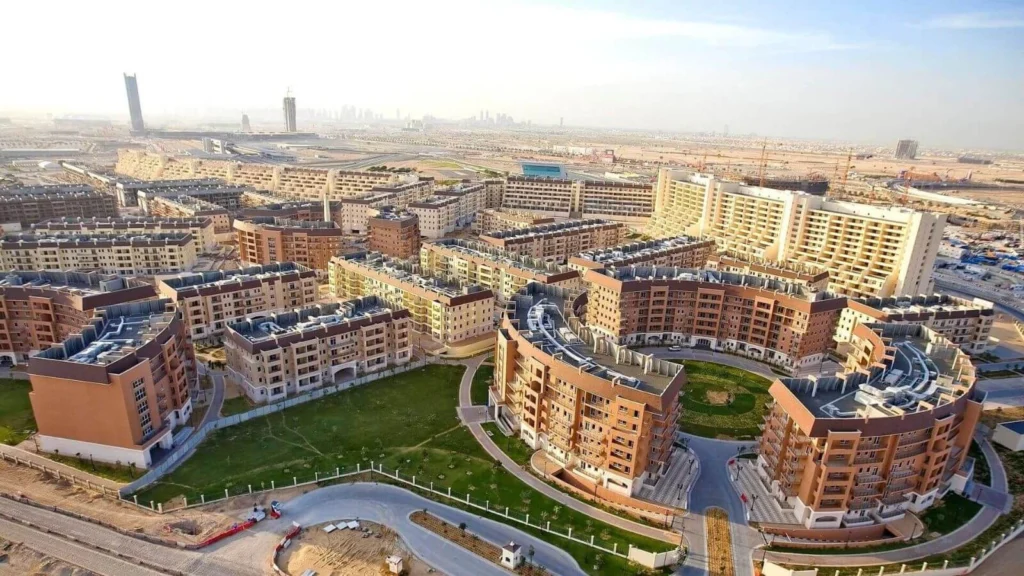
The DFM Real Estate Index has fallen 21–30%. Emaar hit its 5% circuit breaker. Bloomberg called UAE bonds the worst in emerging markets. These are the headlines. Here are the facts running in parallel: AED 133.3 billion in Q1 2026 property deals. AED 11.93 billion in the conflict’s first week alone. AED 422 million for a single apartment sold mid-crisis. Property viewings up 75% by day nine. And every single one of 12 analyst teams covering Emaar is saying: Buy. Not sell. Not hold. Buy — at a 71% discount to where they value the business.
There is one Dubai market worth panicking about right now. It is not the physical property market. Investors who read the right scoreboard, position in the right developer assets, and enter during the sentiment trough that equity panic creates are the ones writing the performance stories of 2027 and 2028. The window between current pre-launch pricing and delivery-stage values is measured in months. The window of maximum buying opportunity is measured in weeks.
Fill out the enquiry form on prelaunch.ae today and let our investment specialists connect you with the Tier 1 developer pre-launch opportunities that are built to withstand equity market noise — and to deliver returns for investors who know how to read both scoreboards at once.
 +971 52 341 7272
✉ sales@mbrproperties.ae

Frequently Asked Questions
Q1. Does the DFM Real Estate Index measure Dubai property prices?
No. The DFM Real Estate Index (DFMREI) tracks the stock prices of publicly listed property developer companies such as Emaar, Aldar, and Deyaar on the Dubai Financial Market. It measures investor sentiment about developer equities, not the value of physical apartments, villas, or commercial properties. Physical Dubai property prices are tracked by the Dubai Land Department through registered transactions and by indices like ValuStrat’s price benchmark.
Q2. Why did Emaar’s stock hit a 5% circuit breaker if the company is performing well?
Because equity markets reprice geopolitical risk in seconds, regardless of underlying business performance. When the DFM reopened after a two-day closure, pent-up institutional sell orders drove Emaar and Aldar to the 5% daily limit. This is a sentiment mechanism, not a business assessment. Emaar’s Q4 2025 results beat EPS estimates by 37% and revenue estimates by 29%. The stock price does not reflect those numbers in the current environment.
Q3. Should Dubai property investors be concerned about the DFM’s 21–30% decline?
They should note it, but not conflate it with physical property market performance. Historically, DFM equity declines have exceeded physical property corrections by 2–3x in every comparable crisis — 2008, 2014–16, and 2020. The current equity decline, mapped against those historical ratios, implies a physical property correction — if it occurs at all — in the single-digit range, not the 21–30% that equity prices suggest.
Q4. Is Emaar stock worth buying at current levels?
This article does not provide equity investment advice. What the data shows is that 12 of 12 sell-side analysts rate Emaar as a Buy with an average 12-month target of AED 19.154 against a current price of AED 11.20 — implying 71% upside to the analyst consensus. Investors should conduct their own due diligence and consult a licensed financial adviser before making equity investment decisions.
Q5. How much Dubai property was actually transacted during the conflict week of March 2–9?
According to Dubai Land Department data, 3,570 sales transactions worth AED 11.93 billion were registered in the seven days of March 2–9, 2026 — the first week of active US–Israel–Iran conflict. Daily transaction values rose in the final three days of that period, with brokers noting that hesitant buyers were resuming commitments rather than abandoning them.
Q6. What should off-plan property investors do when developer stocks fall sharply?
Focus on developer quality metrics — RERA escrow compliance, delivery track record, financial self-sufficiency, and construction milestone transparency — rather than DFM stock price. A developer’s stock price falling 30% does not affect their RERA-mandated obligation to ring-fence your deposit in escrow and deliver your unit according to the registered sale and purchase agreement. The legal protections are regulatory, not market-dependent.