Open any financial news platform today and you will find two competing narratives about Dubai. The first is a story of geopolitical risk — regional tensions, conflict headlines, and cautious analysts warning that sentiment could soften. The second, written not in newspaper columns but in the cold data published by the Dubai Statistics Centre, is far more compelling: on 5 September 2025, at midday, Dubai’s population clock ticked past 4,003,643 residents. Five days earlier, the emirate had welcomed 5,161 new people in a single week. That averages out to approximately 500 new residents every single day — a pace that has made 2025 the fastest population growth year in Dubai’s recorded history.
Here is the critical insight that separates informed investors from those reacting to headlines: every one of those new residents needs somewhere to live. They are not speculators. They are not day traders. They are professionals, entrepreneurs, families, and skilled workers who have made a concrete, life-altering decision to relocate. And that relocation — unlike investor sentiment — does not reverse when the news cycle turns negative.
This is the story of why Dubai’s prelaunch property market has a structural demand floor that war headlines cannot erode. Not a story built on optimism, but one built on numbers, demographics, and the basic arithmetic of a city adding 230,000+ new residents in a single year.
The Population That Changed Everything
Dubai’s journey from a modest trading post to a city of four million has taken less than fifty years. In 1975, fewer than 200,000 people called Dubai home. By 2011, that figure had crossed two million. By September 2025, it had doubled again to four million — making Dubai one of the fastest-growing metropolitan centres on the planet. The growth rate of 6.13% in 2025 — representing 231,000 net new residents — is the highest annualised rate ever recorded for the emirate.
To contextualise the scale: Dubai is adding the equivalent of a mid-sized European city’s population every 18 months. Forecasts from Dubai’s Urban Master Plan 2040 and independent demographers project the emirate will reach five million residents by 2030 — requiring over 350,000 to 500,000 additional housing units before the end of the decade. That supply need is structural and non-negotiable.
| Year | Dubai Population | Key Driver |
|---|---|---|
| 1975 | ~183,000 | Oil discovery & trade growth |
| 1995 | ~689,000 | Regional commerce expansion |
| 2005 | ~1.5 million | Infrastructure & real estate boom |
| 2011 | ~1.93 million | Post-crisis recovery |
| 2018 | ~3.15 million | Expo 2020 preparation, FDI inflows |
| 2022 | ~3.33 million | Post-pandemic rebound |
| 2024 | ~3.83 million | Golden Visa surge, global wealth migration |
| Sep 2025 | 4.003 million (+6.13%) | Fastest growth rate on record |
| 2030 (Projected) | ~5 million | Urban Master Plan targets |
Source: Dubai Statistics Centre Population Clock / Dubai Urban Master Plan 2040 / One Investments Research 2025.
Who Are These 500 New Residents a Day?
The character of Dubai’s population growth is what makes it so durable as a demand driver. This is not speculative inflow — it is a genuine, committed relocation. The Dubai Statistics Centre data shows 85–90% of Dubai’s residents are expatriates, drawn by a combination of economic opportunity, lifestyle advantage, and one of the world’s most competitive tax environments. They are arriving from across the globe — yet the diversity of origin is a strength, not a vulnerability.
What drives them? The IMF projected the UAE’s GDP to expand by 4.8% in 2025, with a 5.0% expansion forecast for 2026 — the fastest rate in the GCC and well above the global average. Dubai welcomed 13.95 million international overnight visitors in the first nine months of 2025, up 5% year-on-year. The financial services sector grew 5.9% in H1 2025, accounting for 13.4% of GDP. Jobs are being created. Companies are registering. And the people filling those roles need homes.
| Resident Profile | Estimated Share | Primary Housing Need |
|---|---|---|
| Skilled professionals (finance, tech, healthcare) | ~35% | Mid-to-premium apartments, off-plan |
| Family households relocating with children | ~25% | Villas, townhouses, school-adjacent communities |
| Entrepreneurs/business owners | ~15% | High-value residential + commercial |
| Construction/logistics/hospitality workforce | ~20% | Affordable apartments, studio units |
| High-net-worth individuals (HNWI/UHNWI) | ~5% | Luxury villas, branded residences |
Source: Dubai Statistics Centre / Cavendish Maxwell H1 2025 Market Analysis / Dubai Media Office estimates.
The Renter-to-Owner Pipeline: A Structural Engine
Here is a dynamic that rarely makes headlines but quietly drives tens of thousands of property transactions every year in Dubai: renters become buyers. The Dubai Land Department’s data points to an average residency period of roughly 4–5 years before a long-term resident converts from renting to purchasing. With Dubai’s residential occupancy rates exceeding 90% across key communities in 2025 and average rents rising 10% year-on-year (studios from AED 45,000; three-bedrooms reaching AED 230,000 annually), the financial calculus of buying versus renting is shifting decisively toward ownership.
The result is a self-replenishing buyer pipeline. Every cohort of new arrivals joining the city today will produce its own wave of first-time buyers in 3–5 years. In Q1 2025 alone, Dubai registered 9,300 residential mortgage transactions, a 24% increase year-on-year. The CBRE report confirmed mortgage rates between 3.89% and 4.99% — the most competitive in years — further accelerating the renter-to-buyer shift. For Dubai’s off-plan and prelaunch investors, this pipeline represents guaranteed future absorption of new residential supply.
Why Families Are the Most Durable Demand Signal
Of all the categories of new residents, relocating families send the clearest signal of durable housing demand. A professional who moves to Dubai alone might decide to leave when geopolitical tensions rise. A family with children enrolled in international schools, a spouse with a career, and roots embedded in a community has committed a 5–10 year horizon to the city by default.
The data confirms this. Private school enrolments across Dubai rose 7% year-on-year in 2025, a metric cited by Cushman & Wakefield as one of the clearest leading indicators of long-term residential stability. Villa and townhouse transactions — the preferred format for families — increased 65% in volume and 56% in value in H1 2025 compared to H1 2024. These are not traded assets. They are homes where children go to school, and parents build careers, and they represent committed, real demand that does not evaporate with a week of difficult news.
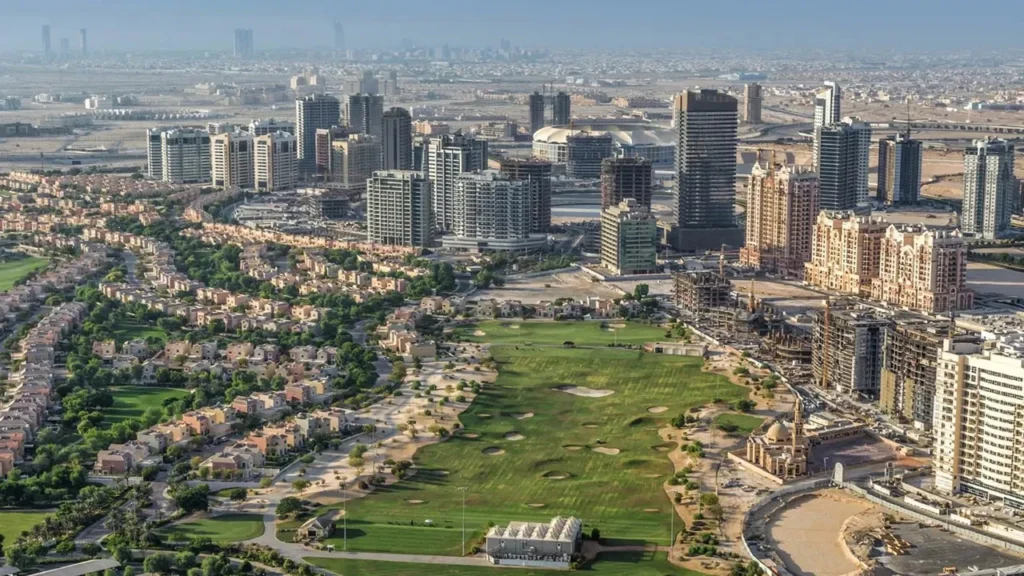
Communities like Dubai Hills Estate, Arabian Ranches, and Jumeirah Village Circle are seeing sustained demand precisely because they offer the school access, green space, and family infrastructure that relocating households need. For investors assessing where to position capital, understanding the hottest off-plan communities attracting families in 2025 is a critical starting point.
What Happens to Prelaunch Activity When Headlines Turn Negative
This is the question investors are asking right now, and the honest answer requires distinguishing between two very different things: sentiment and fundamentals.
Sentiment — the mood of the market, inquiry volumes, investor confidence — does react to headlines. During periods of heightened regional tension, some brokerages have reported inquiry dips of 30–45%. Short-term speculative investors may pause. This is real, and it is worth acknowledging.
But fundamentals — population growth, rental demand, end-user housing need, economic diversification — do not pause. A family that arrived in Dubai three months ago and is searching for a three-bedroom villa near a school they have already enrolled their children in is not waiting for the news cycle to improve. Their housing need is immediate and location-specific. This is the demand segment that prelaunch investors benefit from most: not speculative churn, but genuine occupation demand backed by life decisions.
CBRE’s H1 2025 analysis confirmed that 86% of residential transactions in Dubai were cash purchases — a figure that underscores the absence of leveraged, panic-prone buyer profiles that create crash conditions in other markets. The market’s resilience is structural, not accidental. Learn more about how the oversupply vs demand balance plays out across Dubai’s communities for a balanced view of where absorption remains strongest.
The Numbers That Settle the Debate
The table below summarises the key population and housing demand metrics that provide the real demand foundation beneath Dubai’s prelaunch market:
| Indicator | 2025 Data Point | Implication for Prelaunch Demand |
|---|---|---|
| Population growth rate | 6.13% (fastest on record) | Highest-ever pipeline of future housing buyers |
| Net new residents 2025 | 231,000+ | Immediate rental demand; deferred purchase demand |
| Daily new arrivals (peak) | ~500 per day (17,669 in one month alone) | Continuous organic market replenishment |
| Residential occupancy rate | >90% across key communities | Supply tightness accelerates buyer conversion |
| Average rent increase 2025 | +10% year-on-year | Rising cost of renting accelerates ownership shift |
| Villa transaction volume growth | +65% YoY in H1 2025 | Family relocation demand is intensifying |
| Private school enrolment growth | +7% YoY (2025) | Long-horizon family commitment to Dubai |
| Cash purchases (% of all deals) | 86% (CBRE, 9m 2025) | Low leverage = low crash risk |
| Off-plan share of transactions | ~72% of all 2025 deals | Structural prelaunch demand normalised |
| Mortgage transactions Q1 2025 | 9,300 (+24% YoY) | Renter-to-buyer pipeline accelerating |
| Population target by 2030 | 5 million | 500,000+ additional homes needed before decade end |
Source: Dubai Statistics Centre / CBRE H1 2025 / Cavendish Maxwell / Cushman & Wakefield / PropertyNews.ae / DLD.
The Golden Visa: Turning Residents Into Long-Term Stakeholders
One policy development has been quietly transforming the nature of Dubai’s population from transient to rooted: the UAE Golden Visa. Introduced in 2019 and expanded in 2022 to cover property investments of AED 2 million and above, the Golden Visa grants 10-year renewable residency, independent of an employer sponsor. The implications for housing demand are profound.
A Golden Visa holder is not leaving Dubai at the end of a work contract. They have anchored their life — legally, financially, and practically — to the emirate. Demographers at VISAhq, reporting on Dubai’s population surge, specifically attributed the October-November 2025 record monthly inflow of 17,669 residents to the UAE’s liberalised long-term residency regime. Freelancers, remote workers, retirees, and entrepreneurs are all now eligible for extended status, deepening the resident base across income levels and professional profiles.
For prelaunch investors, the Golden Visa also doubles as an investment validation mechanism: when property ownership confers a decade of residency rights, the pool of motivated, committed buyers at the AED 2 million threshold is permanently enlarged. The UAE off-plan investment landscape spanning Dubai, Abu Dhabi, and Ras Al Khaimah has been fundamentally transformed by this policy dimension.
Population Growth by Area: Where Demand Is Concentrating
Population growth in Dubai is not uniform — it is clustering around infrastructure, employment hubs, and community amenities. Understanding where new residents are settling is the key to identifying which prelaunch communities will absorb demand most efficiently over a 3–5 year horizon.
| District / Community | Growth Driver | Primary Buyer Profile | Avg. Off-Plan Price Range (2025) |
|---|---|---|---|
| Dubai South | Al Maktoum Airport expansion; Expo legacy | Investors, young professionals | AED 700K–1.4M (apts) |
| Jumeirah Village Circle | Affordability + school access | Families, mid-income buyers | AED 500K–1.2M (apts) |
| Dubai Hills Estate | Golf community, King’s College Hospital | Relocating families, HNWI | AED 2M–4.5M (villas) |
| Business Bay | DIFC adjacency, Burj views | Professionals, short-term rental investors | AED 900K–2.5M (apts) |
| Dubai Creek Harbour | Downtown 2.0 master plan | Long-term investors, end-users | AED 1.2M–3M (apts) |
| Mohammed Bin Rashid City | Luxury community, District One Lagoon | Upgrade buyers, HNWI families | AED 2.5M–7M (villas) |
| Dubailand | Suburban scale, value pricing | First-time buyers, growing families | AED 400K–900K (apts) |
Source: Dubai Land Department transaction data 2025 / Knight Frank / Bayut Q3 2025 Market Review. For a comprehensive breakdown of the Business Bay vs Downtown Dubai prelaunch investment debate, the two communities that anchor Dubai’s professional resident base, prelaunch.ae has analysed the pricing, supply, and demand dynamics in detail.
The Honest Counterpoint: What Investors Should Know
A credible article on this topic cannot ignore the pressures. Two points deserve honest acknowledgement.
First, supply is rising. Dubai’s development pipeline for 2026–2027 is significant, with approximately 55,000 new units expected in 2026 and 75,000 in 2027. Fitch Ratings has flagged the possibility of a 10–15% price correction in oversupplied mid-market apartment segments. This is a real and data-supported caution. Not every postcode will perform equally, and investors in high-supply areas like JVC and Dubailand should model their returns conservatively. The prelaunch.ae analysis of how Dubai’s 2026 delivery wave will impact off-plan prices provides an objective, segment-by-segment assessment.
Second, sentiment shifts are real, even if temporary. When regional tensions escalate, some foreign investors pause decisions. Inquiry volumes dip. This creates a window of price and availability advantage for committed, long-horizon investors — but it is not a costless environment. Investors entering prelaunch projects today should be prepared for a 2–4 year hold to let sentiment recover, and construction milestones deliver the unit.
The positive case is not that everything is perfect. The positive case is that when demand is rooted in four million real people who live, work, and raise children in a city, that demand does not simply disappear when a headline frightens a speculator. Population-driven housing need is the most durable demand signal in real estate, and Dubai has it in abundance.
Why Prelaunch Remains the Optimal Entry Point
Given everything above, why does the prelaunch stage specifically represent the best moment to enter?
Price advantage: Prelaunch properties are typically priced 20–30% below anticipated completed-unit values at the time of launch. In a market where prices rose 13% year-on-year in 2025 (22 consecutive quarters of growth per Cushman & Wakefield), buying ahead of that curve matters enormously.
Payment plan flexibility: Dubai’s developers have evolved from rigid 70/30 structures to highly flexible post-handover plans, some extending to 3–5 years beyond completion. This dramatically reduces the capital deployed during the uncertainty window. The evolution of off-plan payment terms from 70/30 to 50/50 and beyond is one of the most important structural changes for investor accessibility in the past five years.
Escrow protection: Under UAE Law No. 8 of 2007, buyer funds in off-plan projects are held in RERA-regulated escrow accounts and released only against verified construction milestones. This legal protection is the foundation of buyer confidence in the prelaunch segment.
Population tailwind: A project launched today with a 2027–2028 handover date will complete into a market that will have absorbed another 400,000–500,000 new residents by then, all requiring homes. The top developers and communities leading Dubai’s off-plan pipeline are positioning their launches exactly at the intersection of this population demand and infrastructure investment.
The Bottom Line: 4 Million Reasons Demand Is Alive
The number that matters most in Dubai’s property story right now is not the price per square foot in Downtown Dubai, nor the quarterly transaction volumes, nor even the Dh916 billion total market value recorded in 2025. The number that matters most is 4,003,643 — the headcount that crossed the population clock at midday on 5 September 2025.
Four million people, the vast majority of them working-age, economically active, and committed enough to their Dubai life to have built it here from scratch. They are renting right now — and as rents rise 10% a year and mortgage rates fall to near-decade lows, more of them will buy. Their children are enrolled in schools. Their spouses have careers. Their companies have addresses. They are not going anywhere because a week of difficult news gave an investor cold feet.
For those exploring Dubai prelaunch properties today, the answer to whether real demand exists is not found in a headlines aggregator. It is found in a population clock ticking forward by 500 people every day, in a city where every one of those people needs a home. That is not a sentiment story. That is arithmetic — and arithmetic does not lie.
Ready to Invest in Dubai’s Population-Driven Prelaunch Market?
Fill out the enquiry form on our website at prelaunch.ae, and our team will connect you with curated prelaunch opportunities matched to your investment profile and timeline.
 Call / WhatsApp: (+971) 52 341 7272 ✉ Email: sales@mbrproperties.ae
Our advisors are on hand to guide you through Dubai’s most compelling prelaunch launches — before they go to the public market.
Frequently Asked Questions
Q: Does Dubai’s population growth slow down during regional conflicts?
Historical data show that while short-term migration inflows can dip briefly during periods of elevated regional tension, the underlying structural drivers — employment, tax advantages, quality of life, and Golden Visa incentives — quickly reassert themselves. Dubai’s 2025 growth rate of 6.13% occurred against a backdrop of ongoing regional instability, confirming the resilience of migration-driven demand.
Q: How many new homes does Dubai need to build by 2030?
Based on the current population trajectory toward five million residents by 2030, and accounting for average household sizes, non-resident investors, vacancy rates, and replacement builds, estimates range from 350,000 to 500,000 new homes before the end of the decade. This structural need underpins the entire off-plan and prelaunch development pipeline.
Q: Is Dubai’s housing demand end-user-led or investor-led in 2025?
CBRE and Cushman & Wakefield both confirmed in their 2025 market reports that demand has increasingly shifted toward end-users and genuine residents, rather than purely speculative investors. Rental registrations rose 7% year-on-year, villa transactions surged 65% in volume, and private school enrolments climbed 7% — all leading indicators of committed, resident-based housing demand.
Q: What is the risk of a housing oversupply despite population growth?
Oversupply risk exists but is segment-specific, not market-wide. Studio and one-bedroom apartments in high-pipeline areas like JVC and Dubailand face the most pressure. Villa communities, premium apartments, and branded residences face far lower risk given constrained supply. Additionally, only 48% of projected 2026 deliveries are expected to be completed on schedule, which historically moderates supply pressure. Selective entry at the prelaunch stage in well-located communities mitigates this risk substantially.
Q: How does the UAE Golden Visa make Dubai’s housing demand more durable?
Golden Visa holders — who receive 10-year renewable residency tied to an AED 2 million property investment — have a direct financial and legal incentive to maintain their property and residency. This policy anchors a significant and growing cohort of the population as long-term stakeholders rather than transient residents, creating permanent, demand-stable ownership. Explore how the ultra-luxury and high-value prelaunch market benefits from Golden Visa-driven demand for a comprehensive breakdown.
Q: Should investors be concerned about headlines regarding regional conflicts?Investors should be informed, not paralysed, by conflict headlines. Short-term sentiment effects are real and worth pricing in. However, the foundational demand drivers — population growth, employment, family relocation, and Golden Visa conversion — operate on a multi-year timescale that short-term news cycles do not reverse. Investors with a 3–5 year prelaunch horizon have historically benefited from sentiment-dip entry points rather than being harmed by them.