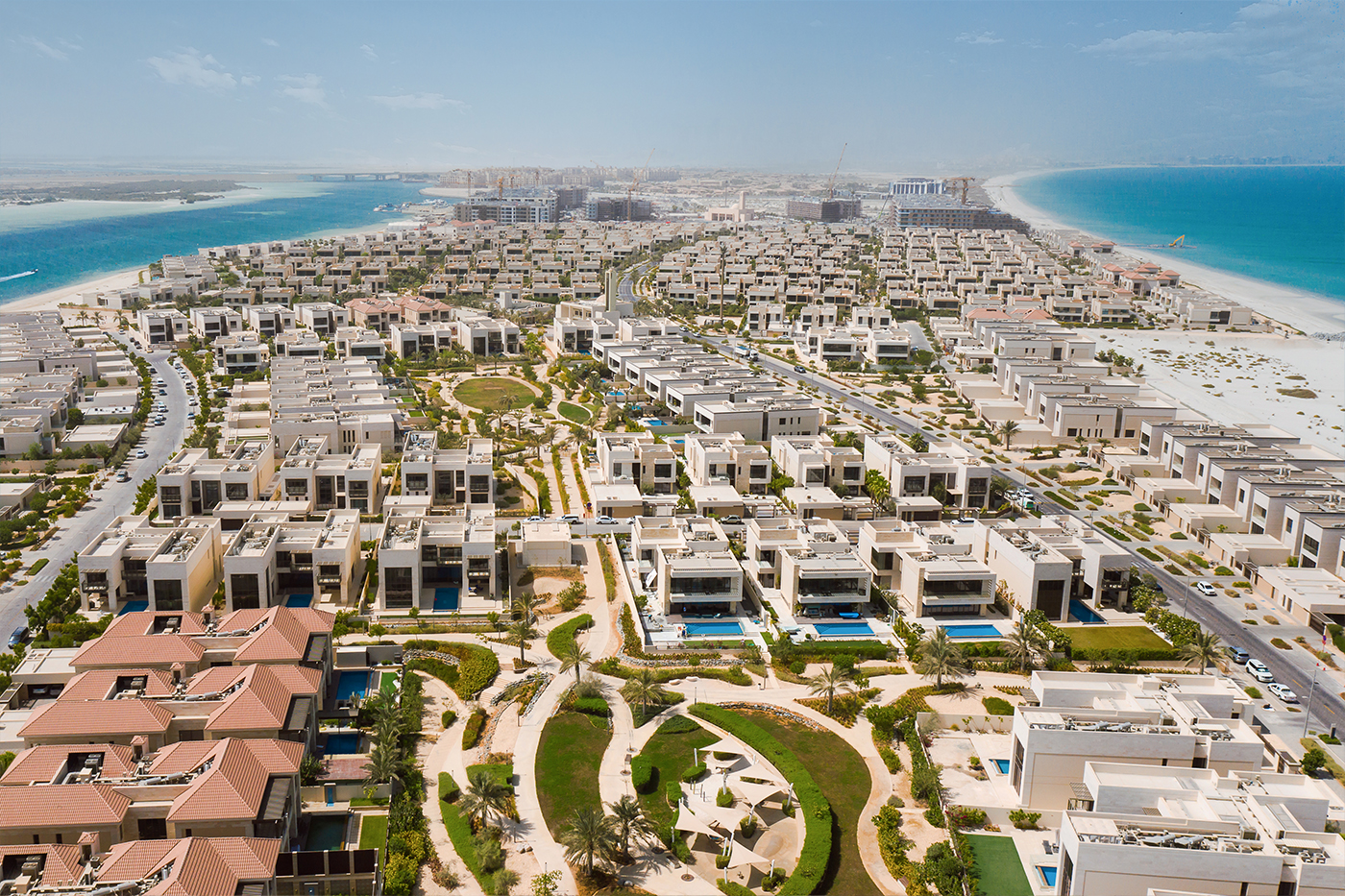
On a week when regional conflict dominated global headlines and stock exchanges across the Gulf briefly suspended trading, something quietly extraordinary happened on Saadiyat Island. A buyer signed a ready property contract for a villa in Hidd Al Saadiyat and transferred Dh88 million — the highest ready property sale recorded during the first week of March 2026 — without hesitation. No discount requests, no deferred closing, no flight of capital. Just a clean, high-value transaction in one of Abu Dhabi’s most prestigious enclaves.
The easy read of this story is that wealthy buyers still love luxury. That is true, but it is also shallow. The deeper and more important read is about jurisdiction. What the Hidd Al Saadiyat sale March 2026 tells us is that sophisticated, large-capital buyers made a deliberate choice to commit tens of millions of dirhams to a specific legal system, a specific governance framework, and a specific sovereign — all during a moment of genuine regional uncertainty. That is not consumer behaviour. That is a calculated institutional vote of confidence.
This article unpacks what really drove that Dh88 million decision, why Abu Dhabi’s jurisdictional architecture is the asset that serious buyers are actually buying, and what it means for investors evaluating the emirate’s property market in 2026 and beyond.
The Dh88 Million Transaction in Context
To understand the weight of this sale, the context must be set carefully. It did not take place in a vacuum of calm. In late February and early March 2026, Iranian missile and drone strikes targeted UAE territory, the Dubai Financial Market and Abu Dhabi Securities Exchange suspended trading for two consecutive days, and some real estate agencies reported that inquiry levels dropped by as much as 45 per cent amid the initial shock. One analysis noted a 51 per cent month-on-month decline in property transaction values across the broader UAE market during the first half of March.
Against this backdrop, the Hidd Al Saadiyat villa sale was not a coincidence or a slow-closing pre-war deal finally clearing the paperwork. It was a ready property transaction — meaning the buyer inspected, valued, negotiated, and completed in real time, during the very week in question. According to Abu Dhabi Real Estate Centre (ADREC) data, it was also accompanied by a Dh68 million off-plan duplex sale at Four Seasons Private Residences at Saadiyat, and Al Reem Island recorded 115 sales worth Dh189 million in the same period. Serious buyers were not freezing. They were transacting.
| “When capital this large moves during conflict, it is not moving toward a property. It is moving toward a jurisdiction.” |
For investors watching Saadiyat Island villa prices surge — already up 21.2 per cent year-on-year through 2025 — this sale confirms that the appreciation is not solely driven by lifestyle demand. It is underpinned by something more durable: a deep-seated trust in Abu Dhabi as a place to store and grow capital under institutional-grade legal protection.
What Is Hidd Al Saadiyat and Why Does It Command Dh88 Million?
Hidd Al Saadiyat is not simply an expensive address. It is a deliberately restricted, freehold community of 464 villas on the northern tip of Saadiyat Island, developed by Saadiyat Development and Investment Company (SDIC) and completed in December 2016. With villas ranging from approximately 4,700 to over 22,000 square feet across 4 to 7 bedrooms, and set directly on Saadiyat’s seven-kilometre private beach, the community represents one of the most genuinely scarce ultra-luxury residential products in the Middle East.
Table 1: Hidd Al Saadiyat — Key Community Profile
| Attribute | Detail |
|---|---|
| Developer | Saadiyat Development and Investment Company (SDIC) |
| Total Villas | 464 units across 4 phases: Qaryat Al Hidd, Al Suhoul, Al Seef, Ras Al Hidd |
| Bedroom Configuration | 4 to 7 bedrooms |
| Size Range | 4,700 sq ft to over 22,000 sq ft |
| Completion | December 2016 (fully delivered, ready community) |
| Ownership Type | Freehold — open to all nationalities |
| Asking Price Range (2026) | AED 11.99M to AED 125M |
| Avg. Asking Price (2026) | Approximately AED 46.9M |
| Highest Recorded Sale (March 2026) | AED 88 million — the highest ready sale that week (ADREC) |
| Community Amenities | Private beach, marina with 117 berths, beach club, schools, retail |
| Key Nearby Institutions | Cranleigh Abu Dhabi, NYU Abu Dhabi, Louvre Abu Dhabi |
The supply constraint at Hidd Al Saadiyat is structural, not cyclical. No additional phases are planned. The entire 1.5 million square metre site is developed, and secondary market listings — there were 154 residential properties listed on Bayut at the time of writing — represent the only route to ownership. When secondary market pricing reaches Dh88 million for a single unit, it reflects a market in which buyers are competing for fundamentally irreplaceable stock. That competition does not pause because of regional headlines. If anything, for buyers seeking permanent capital preservation assets, it intensifies.
Abu Dhabi’s Jurisdictional Architecture: The Real Asset Being Bought
Strip away the beach views, the cultural district neighbours, and the Smart Home systems, and the most valuable thing a buyer acquires at Hidd Al Saadiyat in March 2026 is a position within Abu Dhabi’s legal and governance framework. This is the argument that most property commentary misses — and it is the central argument of this article.
1. Sovereign Fiscal Strength at AA-Rated Scale
S&P affirmed Abu Dhabi’s ‘AA/A-1+’ rating with a stable outlook even as regional conflict intensified. The emirate’s net asset position was estimated at 358 per cent of GDP in 2026 — among the highest fiscal buffer ratios of any rated sovereign globally. Abu Dhabi’s government was projected to run fiscal surpluses averaging 3.8 per cent of GDP through 2029, even under a conservative $65-per-barrel oil price scenario. When a buyer commits Dh88 million to a property in this jurisdiction, they are not betting on a landlord. They are aligning their capital with one of the world’s most fiscally disciplined sovereigns. That is a fundamentally different risk calculation from placing the same capital in a market governed by a sovereign with a weaker balance sheet.
2. Sovereign Wealth Architecture as Market Backstop
Abu Dhabi manages approximately US$1.7 trillion in sovereign wealth fund assets — the largest concentration in the world for a single city. ADIA, Mubadala, ADQ, and the newly launched L’IMAD Holdings collectively represent not just investment vehicles but institutional ballast for the emirate’s entire economic ecosystem. In the property market, this architecture means that the government has both the incentive and the resource base to maintain market stability during external shocks. Buyers placing large capital at Hidd Al Saadiyat are making an implicit bet that this architecture will act, as it historically has, as a market floor when sentiment deteriorates.
3. Rule of Law and Contractual Certainty
Abu Dhabi’s strengthened real estate laws and escrow protections mean that a property transaction is not contingent on goodwill or political continuity in the way it might be in less institutionalised markets. ADREC’s transparent registration system, mandatory escrow for off-plan transactions, and Abu Dhabi Global Market’s (ADGM) world-class dispute resolution framework create a legal ecosystem that high-net-worth investors explicitly cite as a primary reason for choosing the emirate over regional alternatives. A Dh88 million ready property sale is, legally, exactly as secure the day after a missile strike as it was the day before.
4. Dollar Peg and Capital Mobility
The UAE dirham’s hard peg to the US dollar eliminates currency risk for the majority of global investors, who price their wealth in dollars, euros, or sterling. In contrast to jurisdictions where real estate returns can be eroded by currency depreciation, Abu Dhabi’s peg ensures that the value stored in bricks, glass, and land denominated in dirhams moves precisely with the world’s reserve currency. During the regional conflict, when other Gulf equity markets lost several per cent in days, the dirham was the one asset that did not move. That is not luck. That is institutional design.
5. Zero-Tax Capital Preservation
Abu Dhabi levies no property tax, no capital gains tax, and no rental income tax. For a buyer acquiring a Dh88 million villa, the entire appreciation accrues to the owner. In a comparable London property at the same price point, stamp duty land tax alone would absorb approximately 12 per cent of the purchase price, before accounting for annual council tax, capital gains tax on sale, and inheritance tax exposure. The total-return advantage of Abu Dhabi’s tax-free environment compounds meaningfully over a five to ten-year holding period, and this advantage does not diminish during geopolitical turbulence. It is a structural feature of the jurisdiction, not a market condition that reverts to the mean.
Why Dubai and Abu Dhabi Diverged in March 2026
One of the more revealing data points from the first week of March 2026 was the divergence in market sentiment between Dubai and Abu Dhabi — two emirates within the same federation, but with meaningfully different investor perceptions during acute stress events.
Table 2: Dubai vs. Abu Dhabi — Market Response to Regional Conflict, March 2026
| Indicator | Dubai | Abu Dhabi |
|---|---|---|
| Headline transaction impact | ~51% MoM decline cited in some analyses | AED 4.267B first-week volume sustained |
| Inquiry levels | Reported down ~45% in the initial shock period | High-value transactions continued closing |
| Top luxury deal (ready) | Market-wide hesitation reported | Dh88M Hidd Al Saadiyat sale completed |
| Equity market response | DFM index shed over 15% in one week post-conflict | ADX dropped ~3%, outperforming significantly |
| Sovereign credit rating | Not separately rated (federal) | AA/A-1+ (S&P), stable outlook — affirmed during conflict |
| Cash buyer proportion | Estimated 86% of residential transactions | ~80% cash-based (ADREC) — minimal leverage exposure |
| Key narrative shift | Safe-haven status is being ‘tested’ | Jurisdictional confidence maintained by large-capital buyers |
Sources: Khaleej Times, The National, S&P, Goldman Sachs analysis, ADREC, MBR Properties Market Desk
The divergence is not a coincidence. Dubai’s global profile as an entertainment, hospitality, and commerce hub makes it highly sensitive to international sentiment — a feature that drives extraordinary growth in good times but creates sharper vulnerability during external shocks. Abu Dhabi’s more deliberate positioning as a capital-of-capital — anchored in sovereign institutions, hydrocarbon revenues, and a more conservative development cadence — creates a gravitational pull for capital precisely when sentiment is most uncertain. The Dh88 million sale was the most visible single expression of that gravitational pull in action.
The Buyer Profile: Who Places Dh88 Million During a War Week?
Understanding who buys at this level during conflict illuminates the thesis. The buyer profile for a Dh88 million ready villa at Hidd Al Saadiyat in March 2026 is almost certainly one of the following:
| Buyer Archetype | Capital Rationale | Jurisdiction Signal |
|---|---|---|
| UHNW GCC family office | Rotates liquid capital into hard assets during equity market volatility | Trusts Abu Dhabi’s legal title over regional alternatives |
| European / Asian HNW relocating | Acquires primary residence + Golden Visa on accelerated timeline | Choosing permanent domicile inan AA-rated sovereign jurisdiction |
| Institutional co-investment vehicle | Diversifies into illiquid ultra-prime as an inflation hedge | Abu Dhabi’s dollar peg eliminates currency risk on deployment |
| Regional business owner | Moves personal wealth from operating-business risk into a stable real asset | Recognises Abu Dhabi’s insulation from commercial disruption |
Source: MBR Properties Market Desk Analysis, March 2026
Critically, all four archetypes share one behaviour pattern: they do not buy in Abu Dhabi despite the conflict environment; they buy because of it. Uncertainty in global and regional equity markets, combined with a temporary softening in inquiry levels among retail buyers, creates precisely the closing window that sophisticated capital acts on. This dynamic — institutional buyers accelerating while retail buyers pause — has been observed in Abu Dhabi during every prior regional stress event, and it drives a market structure that is unusually resilient at the top of the price curve.
For those considering waterfront luxury investment in Abu Dhabi, this institutional behaviour pattern is one of the most compelling arguments for why Saadiyat’s price floor holds firm even when global headlines are at their most alarming.
What the Dh88 Million Sale Means for Broader Saadiyat Pricing
In real estate valuation, a comparables-based approach means that every transaction at the top of the price curve influences the perceived floor for properties below it. The Hidd Al Saadiyat Dh88 million transaction in March 2026 is a reference data point that re-anchors the valuation expectations for the entire Saadiyat Island ecosystem. It sends three specific pricing signals to the market:
First, floor validation. A buyer willing to pay Dh88 million for a ready asset at a moment of regional conflict effectively confirms that no distressed pricing is available at any level of Hidd Al Saadiyat. Sellers of similar assets now have a data-backed reason not to discount — the market cleared at full value even during stress.
Second, off-plan premium justification. Projects such as The Row Saadiyat by Aldar and other upcoming Saadiyat Island launches price themselves relative to the secondary market. A high secondary market transaction reinforces the development-stage pricing of new launches and reduces the developer’s incentive to offer discounts on future inventory.
Third, ecosystem-wide confidence transfer. Investors evaluating off-plan projects across Abu Dhabi’s investment zones use Saadiyat’s top-of-market performance as a proxy for the health of the entire ecosystem. A strong Hidd transaction during conflict inoculates mid-market investor psychology against panic.
The Structural Case: Abu Dhabi After the Conflict Clears
Markets that hold during crises tend to outperform during recoveries. Abu Dhabi entered the March 2026 conflict period from a position that Cavendish Maxwell described as characterised by “disciplined supply, strong investor confidence, robust demand drivers, and a supportive macroeconomic backdrop.” With apartment prices up 15.1 per cent year-on-year and villa prices up 12.2 per cent in 2025, the market is not appreciating on thin air; it is appreciating on a 55 per cent year-on-year increase in total transaction volumes, with 2025 recording approximately 22,400 deals worth Dh73.2 billion in total.
Table 3: Abu Dhabi Real Estate Market Fundamentals — 2025 and Early 2026
| Metric | Data Point | Implication |
|---|---|---|
| 2025 Total Transaction Volume | ~22,400 deals (up 55% YoY) | Broadest participation base in market history |
| 2025 Total Sales Value | Dh73.2 billion | Record annual value — pre-conflict structural strength |
| Apartment Price Growth (2025 YoY) | +15.1% | Strong competition for the limited residential stock |
| Villa Price Growth (2025 YoY) | +12.2% | Sustained demand across the family housing segment |
| Rental Growth — Apartments (2025) | +12.5% YoY | Tenants converting to buyers, deepening demand |
| Abu Dhabi S&P Sovereign Rating | AA / stable (affirmed March 2026) | Jurisdictional credibility maintained under stress |
| Govt Net Asset Position (2026 est.) | 358% of GDP | Fiscal buffer among the strongest of any rated sovereign |
| Cash Buyer Share | ~80% of residential transactions | Market is insulated from interest-rate-driven demand shocks |
Source: Cavendish Maxwell, S&P, ADREC, Khaleej Times, MBR Properties Market Desk
Against this foundation, the recovery trajectory once conflict de-escalates is likely to be sharper in Abu Dhabi than in other Gulf markets, because the pent-up demand from paused buyers will re-enter a market where no distressed stock has accumulated. Unlike a market that falls and creates a recovery opportunity, Abu Dhabi’s luxury segment never offered distress in the first place. Buyers who waited will compete for the same Saadiyat inventory at the same prices — or higher. As one insight puts it, buyers are deferring rather than cancelling, indicating underlying confidence is intact. For those who act during the window of reduced competition, the entry timing may prove to be among the most advantageous of the decade.
Why Foreign Investors Keep Choosing This Jurisdiction
One of the most frequently overlooked dimensions of the Hidd Al Saadiyat transaction is its role in Abu Dhabi’s wealth migration story. The UAE recorded a net inflow of approximately 9,800 millionaires in 2025 — the highest in the world — and Abu Dhabi’s unique value proposition within that trend is its combination of sovereign stability, freehold ownership rights, and Golden Visa access.
For foreign buyers building wealth tax-free in Abu Dhabi, the Hidd Al Saadiyat transaction crystallises the proposition: a ready freehold villa at Dh88 million generates zero property tax liability, zero capital gains tax on appreciation, and zero rental income tax if leased. The entire compounding return on one of the world’s most fundamentally constrained luxury residential products is retained by the buyer. In London, New York, or Singapore at comparable price points, the tax drag over a decade would be measured in millions — often tens of millions. In Abu Dhabi, it is zero. During conflict, that structural advantage does not change by a single dirham.
Conclusion: The Dh88 Million Was Not About the Beach
There will always be buyers who pay premium prices for beachfront views, private pools, and proximity to world-class museums. But the Hidd Al Saadiyat Dh88 million transaction completed in March 2026, against a backdrop of regional missile strikes and suspended stock exchanges, was not primarily about the beach. It was about the confidence that comes from placing capital in a jurisdiction that has spent decades building the institutional architecture to protect it.
Abu Dhabi’s AA sovereign credit rating, its $1.7 trillion sovereign wealth ecosystem, its hard dollar peg, its zero-tax framework, and its rule-of-law property registration system are not marketing claims. They are demonstrated features of a political and economic system that a buyer of a luxury villa is buying into, alongside the marble floors and the sea view. The Dh88 million was a vote. And the vote was unanimous.
For investors exploring the best investment areas in Abu Dhabi — from Saadiyat’s ultra-prime to Al Reem Island’s high-yield apartments — the message from March 2026 is clear: Abu Dhabi’s jurisdictional premium has been tested under stress and has held. That is the most valuable data point any prospective investor could ask for.
| Ready to Invest in Abu Dhabi’s Safest Asset Class?Fill out the enquiry form at prelaunch.ae — Our advisers will contact you with exclusive, off-market opportunities across Saadiyat Island and beyond. (+971) 52 341 7272 [email protected] prelaunch.ae |
Frequently Asked Questions (FAQs)
Q1: What makes Hidd Al Saadiyat worth Dh88 million?
Hidd Al Saadiyat is a fully delivered, fully restricted freehold villa community of 464 units on Saadiyat Island’s private beachfront — no additional supply will ever be added. The combination of genuine scarcity, direct beach access, cultural district proximity (Louvre, upcoming Guggenheim), and Abu Dhabi’s zero-tax freehold framework creates a store of value that sophisticated buyers are willing to pay Dh88 million to access. The March 2026 transaction was the highest ready property sale recorded that week across all of Abu Dhabi.
Q2: Why did large buyers transact during the regional conflict in March 2026?
Because their buying decision is fundamentally about jurisdiction, not market mood. Abu Dhabi’s AA credit rating, $1.7 trillion sovereign wealth architecture, zero-tax framework, and hard dollar peg are institutional features that do not change with conflict headlines. UHNW buyers and family offices view periods of retail hesitation as closing windows — they close when others pause, not when others race.
Q3: How does the Hidd Al Saadiyat sale affect pricing for other Saadiyat developments?
It anchors the secondary market ceiling and signals to developers of new launches (such as The Row Saadiyat and upcoming off-plan projects) that their pricing is supported by real transaction evidence. It also reduces the likelihood of any distressed pricing emerging for comparable luxury stock — sellers now hold a March 2026 Dh88 million comparable in their negotiating toolkit.
Q4: Is Hidd Al Saadiyat a Golden Visa-qualifying investment?
Yes. Properties in Hidd Al Saadiyat are priced well above the AED 2 million Golden Visa threshold, and the freehold ownership structure is fully compatible with UAE Golden Visa eligibility. Buyers at this price point are typically seeking the 10-year renewable residency benefit alongside the asset’s intrinsic investment value.
Q5: How does Abu Dhabi compare to Dubai as a safe-haven property jurisdiction?
During the March 2026 conflict period, the data points to a meaningful divergence: Abu Dhabi’s ADX equity index fell approximately 3 per cent versus Dubai’s DFM, shedding over 15 per cent in a single week. Abu Dhabi’s separately rated sovereign credit (AA), its larger sovereign wealth buffer (358% of GDP net assets), and its historically more conservative development supply created a demonstrably more stable environment for large-capital property transactions during acute stress. Dubai recovered and will continue to perform strongly, but Abu Dhabi’s architecture proved more resilient in the moment of peak uncertainty.
Q6: Should I buy a ready or off-plan property on Saadiyat Island right now?
Both strategies have merit. Ready properties like Hidd Al Saadiyat villas offer immediate delivery, established community infrastructure, and no construction risk — premium pricing reflects these benefits. Off-plan projects across Saadiyat Island typically offer entry at 10–30 per cent below expected completion-stage pricing, with flexible payment plans. A specialist adviser can help you determine which structure better fits your capital timeline and return objectives.