Something unusual is happening in the UAE property market. Investors who spent the last five years chasing Dubai’s remarkable returns are quietly repositioning their portfolios — and Abu Dhabi is their new destination. The shift is not driven by sentiment or speculation. It is driven by one undeniable data story: off-plan residential supply is growing far faster than population in Dubai, while Abu Dhabi’s population is outpacing its supply pipeline. Add the ongoing geopolitical pressure from the Iran-US-Israel war, which hit Dubai harder than Abu Dhabi, and the calculation becomes even sharper. This article breaks down the numbers, the risks, and where the most compelling opportunities sit in 2027.
The Supply Problem Dubai Cannot Ignore
Dubai’s off-plan pipeline is extraordinary — and that is both its greatest strength and its most significant risk. The emirate is projected to deliver approximately 70,537 residential units in 2027 — nearly double its five-year average of 35,531 units. Between 2025 and 2028, close to 300,000 new homes are expected to enter the market. Hotspots like Jumeirah Village Circle are set to deliver 16,852 units across 2025-2027, while Business Bay will add a further 10,127 units.
This localized oversupply creates pockets of vulnerability that astute investors are pricing in. Fitch Ratings had forecast price corrections of up to 15% based on the supply-demand imbalance — a warning that predated the recent regional conflict. As detailed in our guide on UAE off-plan property investment strategies, location selection has never mattered more.
Table 1: Dubai vs Abu Dhabi Off-Plan Supply — 2027 Projection
| Metric | Dubai | Abu Dhabi |
| Projected 2027 Deliveries | ~70,537 units | ~12,400 units |
| 5-Year Average Annual Supply | ~35,531 units | ~8,000 units |
| Supply Growth vs 5-Year Average | +98% | +55% |
| Off-Plan Share of Transactions (2025) | 71–78% | 73–77% |
Population Growth – Abu Dhabi Is Winning This Race
While Dubai adds residents at a healthy pace, Abu Dhabi’s population trajectory tells a different story. Dubai’s population reached 3.95 million in mid-2025, growing at roughly 3.0–3.5% annually. Abu Dhabi, by contrast, achieved 7.5% population growth in 2024, reaching 4,135,985 people — a 51% surge over the past decade. Assuming 2.8 people per household, Dubai is delivering 1.26 units per new household while Abu Dhabi delivers just 0.08. That 16-fold difference explains why Abu Dhabi property investment is gaining traction among data-driven investors.
Table 2: Population Growth vs Housing Supply (2027 Projection)
| Metric | Dubai | Abu Dhabi |
| Population (2024/25) | ~3.95 million | ~4.13 million |
| Annual Population Growth Rate | 3.0–3.5% | 7.5% |
| Estimated New Households (2027) | ~55,900 | ~22,000 |
| New Units Delivered 2027 | ~70,537 | ~12,400 |
| Units Per New Household | 1.26 | 0.08 |
This fundamental mismatch is why Abu Dhabi apartment prices rose 16.2% and villa prices climbed 14.3% year-on-year in 2025. Supply is simply not keeping up with demand, and that dynamic is expected to persist well into 2027. For more detail, read how Abu Dhabi real estate shattered records as off-plan sales dominated and prices climbed 16%.
The Iran-US-Israel War: A Geopolitical Accelerant
The conflict between Iran, the US, and Israel that escalated from late February 2026 added an unexpected geopolitical dimension to this investor rotation. Following coordinated US-Israeli strikes on Iranian targets, Iran launched retaliatory attacks across the Gulf, making the UAE one of the most directly targeted nations in the region.
Dubai bore the brunt of the economic consequences. The Dubai Financial Market index fell approximately 16% since the conflict began, compared to Abu Dhabi’s ADX, which declined around 9%. More dramatically, Dubai’s real estate index dropped by approximately 30% in two weeks — erasing all gains accumulated since the start of 2026. Goldman Sachs analysts estimated that property transactions fell 37% year-on-year, while sales volumes plunged over 50% compared to February 2026. Drone debris struck near Dubai International Airport, the Burj Al Arab, and Palm Jumeirah.
Abu Dhabi’s more measured diplomatic posture during the conflict offered comparative stability, and investors began treating the capital as a relatively safe haven within the UAE. Experts widely regard the impact as a temporary setback to sentiment rather than a structural challenge to the UAE’s long-term economic plan. Nevertheless, the divergence in how each emirate weathered the shock is something UAE property investors are factoring into 2027 allocation decisions. Learn how this environment is changing buyer behaviour in our article on why first-time buyers are choosing off-plan over rentals in Dubai and Abu Dhabi.
Abu Dhabi’s Market Numbers Speak for Themselves
Table 3: Abu Dhabi Real Estate Performance (2025)
| Metric | Figure |
| Off-Plan Share of Transactions (Q3 2025) | 73–77% |
| Year-on-Year Transaction Volume Growth | +76% |
| Total Transaction Value (Q3 2025) | AED 25.3 billion |
| Apartment Price Growth (YoY) | +16.2% |
| Villa Price Growth (YoY) | +14.3% |
| Average Price Per Sqm | AED 17,394 |
| International Buyer Share | 42% (up from 35% in 2024) |
With off-plan developments in Abu Dhabi driving 73% of all Q3 2025 transactions and a record AED 53.2 billion in H1 2025, the capital’s fundamentals are undeniably robust. Explore the high-yield investment zones in Abu Dhabi that are attracting the most capital right now.
Where to Look in Abu Dhabi in 2027
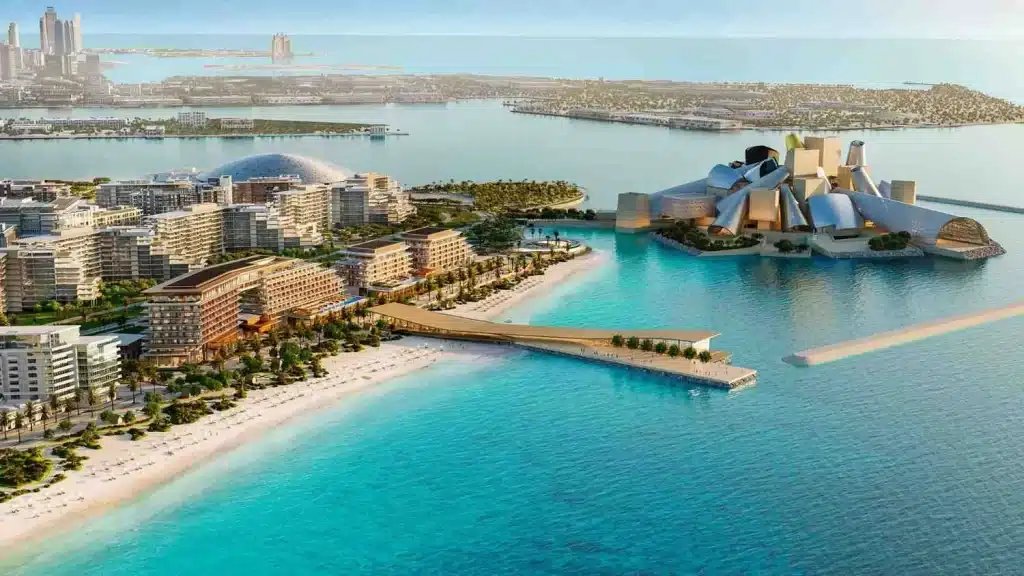
Three communities dominate the smart-money conversation: Yas Island, Saadiyat Island, and Al Reem Island. Yas Island alone hosts 23 new project launches in 2025, offering everything from LEED-certified apartments to entertainment-adjacent residences. Saadiyat Island combines cultural prestige with 15%-plus annual price growth. Al Reem Island offers more accessible entry points with competitive rental yields in Abu Dhabi.
Beyond these, Abu Dhabi’s wider infrastructure story remains compelling. A planned $15 billion corridor development between Abu Dhabi and Dubai, Disneyland Abu Dhabi, and the Abu Dhabi-Dubai Express rail all point to sustained demand well beyond 2027. For a comprehensive breakdown, explore Abu Dhabi’s hottest off-plan developments and pre-launch guide.
Should You Abandon Dubai Completely?
No. For investors with existing Dubai exposure, selling during the current downturn risks crystallising losses. Dubai’s long-term fundamentals — a deep regulatory framework, world-class infrastructure, and 94,000+ residential transactions in H1 2025 — remain intact. For those focused on limited-supply locations like Palm Jumeirah or Emirates Hills, or the ultra-luxury segment, Dubai continues to deliver. The rotation is not about abandoning Dubai. It is about calibrating exposure intelligently. The most successful investors in 2027 will maintain blue-chip Dubai real estate positions while redirecting fresh capital toward Abu Dhabi’s supply-constrained market. Read our ultimate guide to maximising returns with pre-launch properties in the UAE to understand how to build a balanced UAE portfolio.
What Smart Investors Are Doing Right Now
The strategy gaining traction among seasoned investors in 2027: reduce exposure to high-supply Dubai micromarkets (particularly JVC and Business Bay’s mass-market segment), maintain established blue-chip Dubai positions, and redirect incremental off-plan investment capital toward Abu Dhabi pre-launch opportunities where prices are still below where the supply-demand mismatch will eventually push them. The window to act ahead of the wider market is narrowing. Explore how pre-launch off-plan properties in Abu Dhabi represent a smart investment in the emirate’s growth.
Ready to Invest in Abu Dhabi’s Off-Plan Market?
If you want to position your portfolio ahead of the wider market rotation, now is the time to act. Visit prelaunch.ae, fill out the form, and our experts will match you with the right pre-launch properties in Abu Dhabi tailored to your goals and budget. Do not wait for the consensus to catch up.
Contact us:
(+971) 52 341 7272
Frequently Asked Questions
Is Abu Dhabi property better than Dubai for investment in 2027?
For investors focused on supply-demand fundamentals, Abu Dhabi presents a stronger short-to-medium-term case. With just 0.08 new units delivered per new household compared to Dubai’s 1.26, the capital’s pricing power is structurally supported.
How has the Iran-US-Israel war affected UAE real estate?
Dubai’s market was hit harder — its real estate index dropped approximately 30% in two weeks following the conflict’s escalation. Abu Dhabi’s ADX declined around 9% versus Dubai’s 16%. Most analysts regard this as a temporary setback to sentiment rather than a structural collapse.
What are the best areas for off-plan investment in Abu Dhabi in 2027?
Yas Island, Saadiyat Island, and Al Reem Island consistently rank as top-performing communities for off-plan investment due to strong price appreciation, infrastructure investment, and high rental demand.
Why are investors rotating from Dubai to Abu Dhabi?
The primary driver is the imbalance between off-plan supply and population growth. Dubai is on course to deliver nearly twice its historical average of new homes in 2027, while Abu Dhabi’s supply pipeline remains constrained against a population growing at more than twice the pace.