The Reuters headline landed like a cold shower. Dubai’s property market was “beginning to show early signs of weakening,” the agency reported in late March 2026, citing Goldman Sachs data showing real estate transaction volumes had fallen 37% year-on-year and 49% month-on-month in the first twelve days of March. Emaar Properties, the developer behind Burj Khalifa, had shed more than 26% on the Dubai bourse. Some sellers were offering units at discounts of 12–15%, according to messages reviewed by Reuters on real estate WhatsApp groups.
That is a genuinely sobering set of statistics. It would be dishonest to frame them otherwise. But when you sit the Reuters data alongside what actually happened in late March — the launches that went ahead, the deals that closed, the buyer enquiries that rebounded — a more precise story emerges. Dubai’s off-plan market in 2026 is not dead. It is operating under a significantly higher bar of buyer scrutiny. That is not the same thing, and conflating the two will cost investors either opportunity or capital, depending on which error they make.
For a deeper read on how physical property and equity markets diverge during geopolitical shocks, the analysis of war shocks that hit stocks fast but property moves on a different clock is essential context before concluding developer share prices.
What the First Twelve Days of March Actually Measured
Goldman Sachs’ note was published during the most acute phase of the geopolitical shock, following strikes on UAE infrastructure that triggered partial airport shutdowns and a 30% collapse in the Dubai Financial Market Real Estate Index (DFMREI). The 37% volume decline was real. The 49% month-on-month fall was real. But there are two things the early-March data did not capture: the citywide median transacted price per square foot, which fell only 3% year-on-year through mid-March; and the post-shock recovery in buyer activity that began within days.
Betterhomes, which tracks live market data across its brokerage network, reported that by the final week of March 2026, buyer demand had risen 38% week-on-week after the initial soft spell. The firm recorded over 3,900 tenant enquiries and more than 200 new rental listings in March alone — a market that had frozen would not generate those numbers. Its own assessment on March 27: “the market is showing selectivity and more measured pricing, not signs of a significant market-wide drop.”
Separately, Mitchell’s Commercial Realty noted that 60–80% of deals placed “on hold” during the conflict’s peak were expected to close in Q2 2026 once stabilisation occurred. These are delayed decisions, not cancelled ones. The distinction defines the entire investment case.
Table 1: The Two-Signal Split — Early-March Weakness vs. Late-March Correction (March 2026)
| Signal | Bearish Reading (Early March) | Corrective Reading (Late March) |
|---|---|---|
| Transaction volume | Down 37% YoY, 49% MoM (Goldman Sachs, first 12 days Mar) | 4,499 apartment deals in first 15 days; 55% still off-plan |
| Price movement | Distressed listings at 12–15% discounts on WhatsApp groups | Citywide median price per sqft down only 3% YoY — not a crash |
| Developer behaviour | Emaar stock down 26%+ on DFM since the conflict began | Emaar, Danube, Imtiaz, IGO, and Octa all launched new projects in late March |
| Buyer sentiment | 30% drop in site visits and enquiries | Buyer demand rose 38% week-on-week after the soft spell (Betterhomes) |
| Negotiation pressure | Mid-market buyers extracting 3–7% discounts | 60–80% of on-hold deals expected to close in Q2 (Mitchell’s) |
| UHNW activity | Concerns about capital flight from HNW investors | AED 422M apartment sale completed during the active conflict period |
Sources: Goldman Sachs (March 2026 note), Betterhomes (Mar 27 2026 update), Mitchell’s Commercial Realty, DLD data, Reuters.
The Launches That Kept Going
If buyer demand had genuinely evaporated, developers would have pulled projects. That is the clearest behavioural signal available in real estate: a cancelled launch is an admission that the market is not ready. What happened in late March 2026 was the opposite.
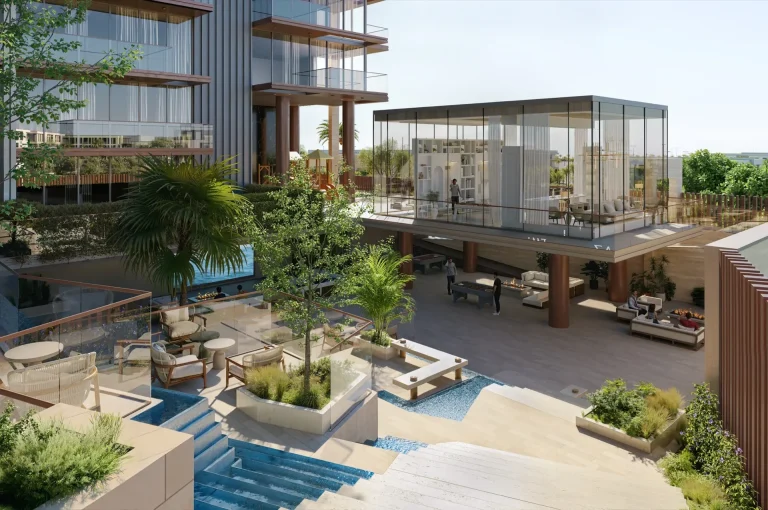
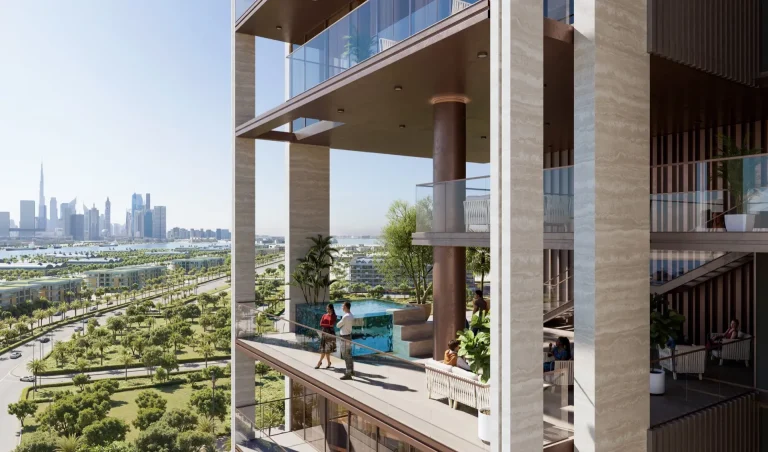
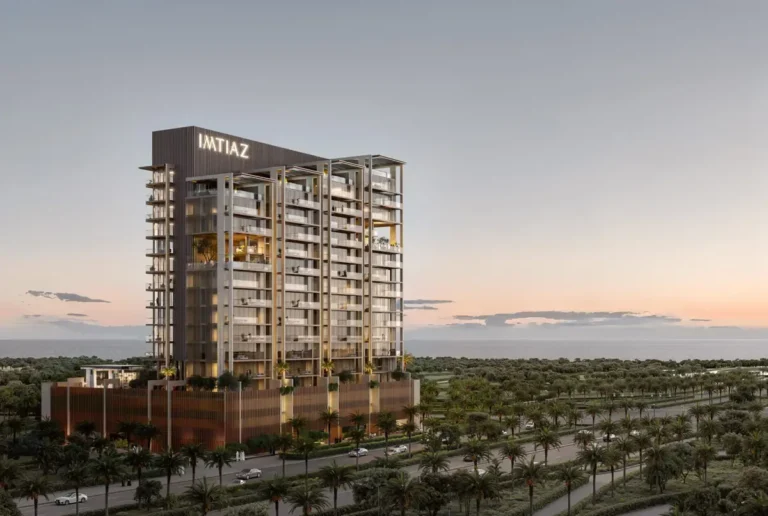
Five residential off-plan projects launched in Dubai during the final two weeks of March, including Emaar’s Golf Vale in Emaar South, Danube’s GreenZ — the developer’s first townhouse-only community in Dubai — and two projects on Dubai Islands: Sea Cliff by Imtiaz and Flora Bay by Octa. IGO launched The Winslow in Meydan with a choice of standard or post-handover payment structures. These are not distressed launches. They are disciplined commercial decisions made by developers with live demand data and escrow obligations.
Table 2: Dubai Off-Plan Launches — Late March 2026
| Project | Developer | Location | Starting Price | Payment Plan |
|---|---|---|---|---|
| Golf Vale | Emaar | Emaar South | AED 1.1M | 80/20; 10% booking |
| The Winslow | IGO | Meydan | AED 1.7M | 60/40 or 60/10/30 post-handover |
| Flora Bay | Octa | Dubai Islands | AED 1.9M | 50/50 staged |
| Sea Cliff | Imtiaz | Dubai Islands | AED 1.99M | 50/50 staged |
| GreenZ | Danube | Academic City | TBA | 1% monthly plan |
Source: opr.ae Dubai off-plan launch tracker, March 18 2026. Pricing correct at date of launch.
Each of these projects targeted a specific gap — affordable golf-adjacent living near Al Maktoum Airport, townhouses in an undersupplied academic district, and low-density coastal inventory on the Dubai Islands. None were chasing speculative buyers. All were structured for end-users and long-horizon investors. That alignment between product design and buyer profile is precisely what the 2026 off-plan market forecast had been pointing toward since late 2025: the easy momentum plays are finished, but the fundamentally sound ones are not.
The Filter, Not the Exit
The headline question for 2026 is not whether buyers have disappeared. It is about which buyers remain and what they are demanding. The evidence points to a segmented market where the filter is running in one direction: away from speculative, outer-ring, price-growth-only plays, and toward projects with genuine liveability credentials, proven developers, and supply-constrained locations.
Table 3: Buyer Behaviour by Segment — Dubai Off-Plan Market, March 2026
| Segment | Buyer Behaviour | Price Pressure | Outlook |
|---|---|---|---|
| Ultra-luxury (AED 10M+) | Active; 990 deals above AED 10M in Jan 2026 alone | Minimal — values intact | Resilient |
| Prime waterfront / branded | Selective but committed; long-term orientation | Marginal negotiation | Stable to positive |
| Mid-market (AED 1.5M–4M) | Pausing to negotiate; on-hold deals likely to close Q2 | 3–7% discount on space | Selective recovery |
| Outer-ring/speculative off-plan | Highest hesitation; weakest demand signal | 10–15% correction possible | Risk zone — avoid |
Sources: Mitchell’s Commercial Realty, DLD, Betterhomes, Goldman Sachs, Excel Properties.
Ultra-high-net-worth demand has remained largely intact throughout the shock. In January 2026 alone, 990 homes priced above AED 10 million changed hands. A single apartment sold for AED 422 million during the conflict period. These buyers operate on a different risk calculus: they own property as a permanent base, a residency anchor, or a multi-decade store of value — none of which a regional military conflict changes. Mid-market buyers have paused to negotiate. Discounts of 3–7% are being extracted in this band, which represents a buyer’s recalibration, not a seller’s crisis. The zone to avoid is speculative outer-ring off-plan, where Dubai’s 2026 oversupply risk is most concentrated — Jumeirah Village Circle’s heavy completion schedule, outer Dubailand clusters, and projects dependent on narrow offshore buyer profiles are all carrying genuine correction risk of 10–15%.
Cash buyers — who represented 87% of Dubai property transactions in 2025 — provide a critical structural buffer here. There are no forced sellers created by mortgage stress. The 2009 scenario, when leveraged markets collapsed and liquidity froze, is structurally impossible to replicate in 2026’s predominantly cash-settled environment. Citi revised Dubai’s 2026 population growth forecast down to 1% from 4%, which is a meaningful demand revision — but it is a moderation, not a reversal, and it will take quarters, not days, to feed into physical property values at scale.
What Buyers Are Now Demanding
The investor profile making decisions in March 2026 is more experienced, more data-literate, and less sentiment-driven than the buyer who was rushing into off-plan units on the back of 2024’s momentum. The questions being asked before committing have changed. Payment plan headline numbers are no longer enough: buyers are stress-testing delivery timelines against developer balance sheets, running rental yield assumptions against real occupancy data rather than brochure projections, and scrutinising infrastructure proximity more seriously than brand appeal.
Firas Al Msaddi of Fam Properties captured it cleanly: “In 2025, momentum drove decisions, but 2026 will be the year when buyers and investors operate with far more logic and discipline.” That shift was already underway before the conflict. The geopolitical shock accelerated a transition the market was already making.
For investors considering entry during this window, the absorption signals in Dubai’s off-plan market post-war shock offer a structured checklist: developer financial stability, project registration with DLD, escrow compliance, secondary market liquidity in the target zone, and realistic population-driven occupancy assumptions. Investors who ran this analysis after Russia invaded Ukraine and stayed the course in Dubai captured 40–60% returns over the following 18 months. The pattern of informed conviction outperforming sentiment-driven exit is consistent across Dubai’s cycle history.
The post-correction opportunity in Dubai’s off-plan market is most visible in mid-market segments where negotiation room exists today, and Q2 demand recovery is already in the data. That is not a guaranteed outcome. But it is a structured risk with identifiable parameters, not a speculative leap. The buyers sitting out entirely are not being cautious. They are missing the distinction between a market where demand has exited and a market where demand has raised its standards.
The Takeaway
Dubai’s launches are not dead. Five projects went to market in the final two weeks of March 2026 under the same geopolitical conditions that produced the Reuters headline. Buyer demand rebounded 38% week-on-week. Median prices held to within 3% of year-earlier levels citywide. The DFM equity crash does not equal a physical property price crash — those are different assets on different timescales.
The complete guide to maximising returns with UAE pre-launch properties remains relevant precisely because the framework for selecting the right launch has not changed — but the cost of getting it wrong is now higher. Developer track record, location infrastructure, supply constraints, and occupancy fundamentals were always the correct variables. In 2026, they are simply non-negotiable.
Ready to Find the Right Dubai Launch for 2026?
Not every launch deserves your capital — but the right ones, correctly filtered, represent one of the most structured entry points in Dubai’s recent cycle history. Fill out the form on prelaunch.ae, and our team will match you with projects that meet the 2026 standard: proven developer, supply-constrained location, occupancy-backed yield assumptions, and a payment structure that works for your horizon.
Contact us directly at (+971) 52 341 7272 or write to sales@mbrproperties.ae. The buyers who perform best in this market are the ones who raised their standards — not the ones who walked away.
Frequently Asked Questions
Q: Did the Reuters report mean Dubai off-plan launches have stopped?
A: No. The Reuters report, based on Goldman Sachs data from the first twelve days of March 2026, captured a volume shock at the peak of geopolitical uncertainty. Five new off-plan projects launched in Dubai in the final two weeks of March, and buyer enquiries rebounded 38% week-on-week by late March. The market paused and filtered — it did not stop.
Q: Which Dubai property segments are most vulnerable in 2026?
A: Speculative outer-ring off-plan projects with heavy completion schedules — particularly in Jumeirah Village Circle, outer Dubailand, and narrow-market developments — face a correction risk of 10–15%. Mid-market units in established communities carry 3–7% negotiation pressure. Ultra-luxury above AED 10 million and prime waterfront assets have shown the highest resilience.
Q: Is the Goldman Sachs 37% transaction decline a sign of a market crash?
A: No. The 37% year-on-year decline in early March transaction volume reflects a geopolitical sentiment shock, not a structural collapse. Citywide median prices fell only 3% year-on-year through mid-March. Eighty-seven per cent of Dubai property transactions are cash-settled, eliminating the forced-selling cascades that caused the 2009 crisis. The current shock is a liquidity pause, not a solvency event.
Q: Why are developers still launching projects during the conflict?
A: Because their live demand data shows buyer interest has not disappeared, only shifted in profile. Developers with projects in genuinely supply-constrained locations, supported by infrastructure and end-user demand, have commercial reasons to proceed. Cancelling launches in this environment would be a signal of structural weakness — and the five March launches from Emaar, Danube, Imtiaz, Octa, and IGO suggest that signal was not being sent.
Q: What should buyers check before committing to a Dubai off-plan project in 2026?
A: Verify developer financial stability and delivery track record. Confirm project registration with the Dubai Land Department (DLD) and escrow compliance. Assess secondary market liquidity in the target zone. Run rental yield assumptions against actual occupancy data, not launch brochures. Prioritise communities with proximity to employment hubs, transport infrastructure, and schools over those dependent on speculative capital appreciation alone.