Not every investor wants the most exciting property market. Some want the most resilient one. They want a market where the floor is deep, and the ceiling is reasonable — where supply is controlled, demand is broad-based, developer quality is concentrated, and the sovereign backstop is genuinely sovereign-grade. In the current regional environment, that description fits Abu Dhabi more precisely than almost any other city on earth.
Cavendish Maxwell — the region’s most respected independent property consultancy, a member of the Royal Institution of Chartered Surveyors — published their 2025 Abu Dhabi Residential Market Performance report in March 2026 and delivered an assessment of striking clarity: “Abu Dhabi’s residential market enters 2026 from a position of strength, supported by disciplined supply, strong investor confidence, robust demand drivers, and a supportive macroeconomic backdrop.”
Andrew Laver, Director of Cavendish Maxwell Abu Dhabi, went further. Addressing geopolitical risk directly — a notable choice for a consultancy not known for political commentary — he said: “While Abu Dhabi’s residential market enters 2026 from a position of strength, geopolitical tension in the wider region could influence investor sentiment and capital flows. However, Abu Dhabi’s strong sovereign buffers and diversified economy are expected to provide meaningful insulation, helping to sustain market confidence and stability.”
That phrase — “meaningful insulation” — is the thesis of this article. This is not a claim that Abu Dhabi is risk-free. No market is. It is a precisely calibrated assessment from an independent RICS-member advisory firm that the combination of supply discipline, sovereign buffers, diversified demand, and structural pricing momentum gives Abu Dhabi a different risk profile from other regional markets — and from Dubai’s higher-volume, more supply-challenged story — that is worth understanding in full.
Supply Discipline: The Structural Advantage Most Investors Underestimate
The single most important structural feature of Abu Dhabi’s off-plan resilience in 2026 is not sentiment, not price growth, and not developer activity. It is supply discipline — the emirate’s consistent pattern of delivering significantly fewer units than its headline pipeline projects, and doing so in a way that prevents sudden oversupply events from eroding pricing.
| Year | Projected Supply | Actual Deliveries | Delivery Rate | Market Impact |
| 2023 | ~10,500 units (industry consensus) | ~5,800 units (est.) | ~55% | Steady absorption; pricing is stable and beginning a trajectory upward |
| 2024 | ~11,200 units (Cavendish Maxwell) | ~6 100 unités (est.) | ~54% | Transaction volumes up; pricing accelerating; vacancy tightening to 4–6% |
| 2025 | ~11,900+ units (Cavendish Maxwell Q1 2025 projection) | 7,400 units confirmed (Cavendish Maxwell 2025 Annual) | ~62% — slightly higher | Record year: 22,400 deals, AED 73.2B total sales; pricing up 15.1% apartments, 12.2% villas |
| 2026 (projected) | 15,900 units (ADREC / Cavendish Maxwell headline figure) | 6,500–9,000 units (Cavendish Maxwell post-conflict estimate) | 41–57% — consistent with historical pattern | Cavendish Maxwell: ‘measured pace of supply expected to support pricing momentum and help prevent near-term market imbalances’ |
| 2027–2028 (pipeline) | 16,800 (2027) / 22,300 (2028) — Cavendish Maxwell projections | Actual likely 55–65% of headline; concentration risk in specific districts | Estimate: 9,000–14,500/year | Rising supply risk in later years; district-level concentration to monitor; Abu Dhabi Vision 2030 infrastructure projects as an absorption cushion |
Sources: Cavendish Maxwell Abu Dhabi Annual Review 2025 (Zawya, Gulf News, Economy Middle East, March 2026), Cavendish Maxwell Q1 and Q3 2025 Residential Market Performance Reports, ADREC, prelaunch.ae analysis
The consistent 41–62% delivery rate against headline projections is not a planning failure — it is a structural feature of Abu Dhabi’s development model. Construction timelines in the emirate are managed conservatively, phased releases are coordinated with community infrastructure completion, and master developer Aldar’s 32% market share gives the emirate’s supply pipeline an unusual degree of top-down coordination. As Cavendish Maxwell’s Q3 2025 report noted: “This staggered pattern of completions, which is typical for the Emirate, allows the market to absorb new supply gradually and prevents sudden increases in available stock.”
The contrast with Dubai is instructive. Dubai’s 2026 pipeline is approximately 100,000–120,000 headline units from 70+ active developers operating with different financial structures, different land bank strategies, and different delivery track records. Abu Dhabi’s pipeline is approximately 15,900 headline units, with Aldar and Modon accounting for the substantial majority of new launches and historically delivering at rates that have been consistently supportive of pricing. This is not just a scale difference. It is a coordination and quality difference that directly affects the risk profile of off-plan investment.
The Cavendish Maxwell Supply Assessment: “While approximately 15,900 units are projected for completion in 2026, recent handover trends suggest actual deliveries are likely to be lower, in the range of 6,500–9,000 units. This measured pace of supply delivery is expected to support pricing momentum and help prevent near-term market imbalances.” — Cavendish Maxwell Abu Dhabi Annual Review 2025, March 2026. This is the most authoritative independent supply forecast available for Abu Dhabi. It is not developer marketing. It is a RICS-member consultancy’s quantitative assessment, published after the conflict escalation.
For investors who want to understand the full spectrum of supply distribution across Abu Dhabi’s specific communities — and which zones are most insulated from the 2027–2028 pipeline rise — our analysis of why 2026 is the year to invest in Abu Dhabi and Ras Al Khaimah’s constrained off-plan markets provides the community-level breakdown.
The Demand Mix: Why Abu Dhabi’s Buyer Base Is More Resilient Than a Single Sentiment Shock Can Disrupt
Supply discipline only produces resilience if it is matched by structurally diverse demand — demand that does not evaporate when one buyer cohort hesitates. Cavendish Maxwell’s central finding about Abu Dhabi’s 2025 performance captures this precisely: “The strength of off-plan and ready transactions in parallel indicates a broad market base. This balance is important as it shows that growth is sustainable across both segments and is not concentrated in one.”
| Demand Driver | Scale in 2025 | Conflict Sensitivity | 2026 Trajectory |
| Aldar-led off-plan launches (end-user + investor) | Aldar: 5,300 sales, 32% market share; off-plan up 68% YoY to 15,900 deals (71% of total) | Low-medium. Aldar’s sovereign backing and brand loyalty insulate it from pure sentiment swings; end-users buying for occupancy are insulated further | Cavendish Maxwell: developers likely to phase launches carefully; Aldar’s backlog and financial position protect delivery continuity |
| Resident rent-to-own conversion | Apartment rents +12.5%, Yas Island +23%; 4–6% citywide vacancy; crossover to mortgage-cheaper-than-rent reached in most mid-tier segments | Very low. Residents whose lease renewal costs more than a mortgage payment are making a financial decision, not a geopolitical one. This demand stream is structurally independent of war headlines | Sustained. Rental growth moderating slightly (Cavendish Maxwell: 8–12% forecast) but remaining above mortgage cost threshold for most segments through 2026 |
| Villa and townhouse end-user demand | 7,600 villa/townhouse units purchased in 2025 — up nearly 50% YoY; off-plan villa sales up 63% to 5,800 deals | Low. Family buyers purchasing for occupancy with 3–5 year horizons are the most durable buyer type; lifestyle infrastructure (schools, hospitals, parks) drives their decision | Strong. Yas Island and Saadiyat lifestyle infrastructure continuing to expand; Cleveland Clinic, NYU Abu Dhabi, Louvre, Guggenheim (opening 2025), all anchoring family demand |
| Overseas and foreign investor demand | Non-UAE nationals buying in designated investment zones; Indian, GCC, European, and Chinese buyer presence confirmed in ADREC data | Medium. This cohort is the most sensitive to conflict news in the short term; however, ADCB economists confirmed foreign demand remains ‘critical’ and will likely return as de-escalation signals build | Recovering. March 2026 weekly volume sustained at Dh4.267B confirms no wholesale withdrawal; quality international buyers still transacting |
| Government-sector and institutional demand | Abu Dhabi government entities and sovereign funds are active buyers of commercial and residential real estate; policy-driven demand for Masdar City, ADGM, and the cultural district residential | Very low. Institutional and government demand is driven by master plan execution, not sentiment cycles | Stable. Abu Dhabi Vision 2030 infrastructure spend is AED 900B (2021–2030 commitment); residential demand from each new infrastructure project is locked in |
Sources: Cavendish Maxwell 2025 Annual Review and Q3 2025 Report, Khaleej Times March 2026, ADCB economists via Reuters, Construction Week Online, prelaunch.ae analysis, March 2026
The five demand drivers in this table have materially different conflict sensitivities. Three of the five — Aldar-led off-plan, resident rent-to-own conversion, and government/institutional demand — are low or very low sensitivity to the conflict cycle. Only overseas investor demand carries medium sensitivity, and even that cohort was sustaining above Dh4 billion weekly volumes in March 2026.
This diversification is what Andrew Laver meant when he said Abu Dhabi’s “broad market base” was important for sustainable growth. The reverse of this statement is also true: a market where only one buyer cohort drives activity is vulnerable to any event that disrupts that cohort’s confidence. Dubai’s historically higher reliance on speculative off-plan investors created exactly this concentration risk in 2008 and — to a lesser degree — in 2022. Abu Dhabi’s demand mix has consistently been more diversified, with end-users and government-linked buyers providing a structural floor under transaction volumes.
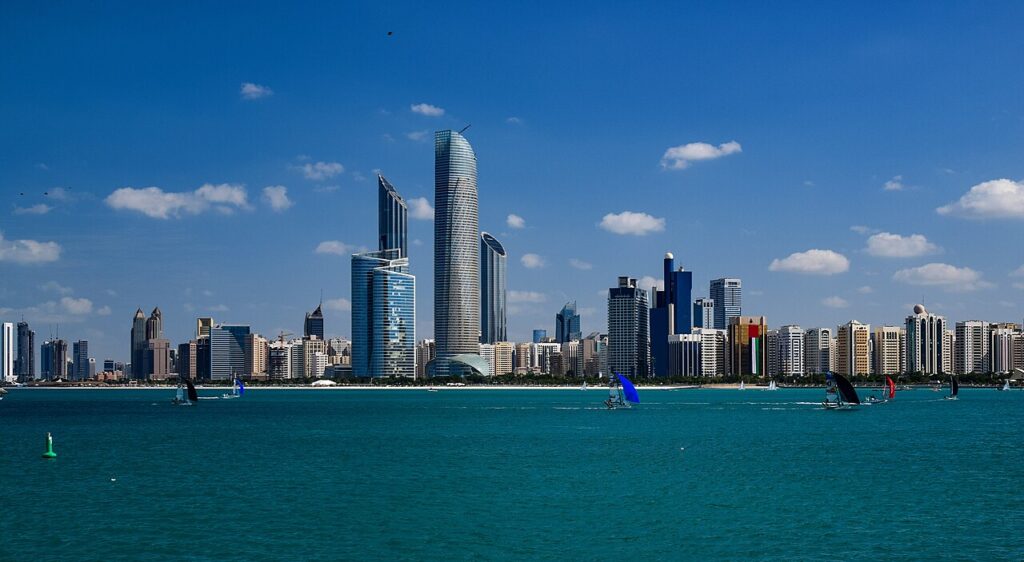
Abu Dhabi vs the Noise: Why Calmer Does Not Mean Smaller Returns
The “calmer market” thesis is sometimes misread as a lower-return thesis. It is not. It is a risk-adjusted return thesis: Abu Dhabi offers a return profile that is built on more defensible foundations, which means it is less susceptible to sharp corrections — and that compounds meaningfully over a 3–5 year hold horizon.
| Return / Risk Factor | Abu Dhabi 2025–2026 | Dubai 2025–2026 | Risk-Adjusted Edge |
| Apartment price growth (2025) | 15.1% YoY; accelerating from 10.9% in 2024 | ~16% YoY in strong segments; some pockets above 20% | Comparable appreciation; Abu Dhabi’s more even distribution reduces downside concentration risk |
| Villa price growth (2025) | 12.2% YoY; Yas Island 17%, Saadiyat 13% | 15–30% in ultra-prime Palm, Dubai Hills; more moderate elsewhere | Dubai ultra-prime higher peak; Abu Dhabi more consistent across tiers |
| Rental yield (apartment, mid-tier) | 6.3–8% gross; Yas Island and Al Reem lead (Sands of Wealth) | 5.5–8% gross; JVC and Business Bay mid-market competitive | Broadly comparable; Abu Dhabi slightly higher in the Al Reem / Yas mid-tier segment |
| Supply pipeline risk 2026 | Actual delivery: 6,500–9,000 units (Cavendish Maxwell); demand outpacing supply | Actual delivery estimated 60,000–80,000+ across a fragmented developer base | Abu Dhabi materially lower supply risk; key advantage in conflict/stress year |
| Developer concentration/quality | Aldar 32% market share; sovereign-linked; Modon second-fastest growing; RICS-quality governance | 70+ active developers; Emaar dominant but market more fragmented; more undercapitalised private names | Abu Dhabi’s concentrated, sovereign-linked developer base is the most important risk difference in a funding-stressed environment |
| Sovereign insulation depth | AA credit rating; ADIA ~$1 trillion SWF; Abu Dhabi Vision 2030 AED 900B infrastructure commitment; non-oil GDP 54.7% of total | Strong, ICD-backed developers; Dubai 2040 Urban Master Plan; more FDI-dependent than Abu Dhabi | Abu Dhabi’s sovereign backstop is deeper and more diversified; oil revenue backstop plus world-class SWF |
| Transaction volume growth (2025) | 55% YoY in transaction count; 71% of deals off-plan; AED 73.2B total residential | ~270,000+ total deals; AED 917B all real estate; larger in absolute terms | Dubai is significantly larger in volume; Abu Dhabi is higher in relative growth rate (55% vs ~20%) |
Sources: Cavendish Maxwell 2025 Annual Review, Construction Week Online, Zawya, Sands of Wealth, Khaleej Times, DLD, prelaunch.ae analysis, March 2026
The table shows that Abu Dhabi does not sacrifice return for resilience — it achieves comparable or superior returns in most categories while carrying lower supply pipeline risk and developer fragility meaningfully. The single largest risk difference is supply: Abu Dhabi’s 6,500–9,000 actual 2026 deliveries versus Dubai’s estimated 60,000–80,000. In a funding-stressed year when overseas buyer sentiment is temporarily soft, lower supply is the most important protective factor a market can have.
IMF projections add the macroeconomic context: Abu Dhabi’s GDP growth is forecast at 5.8% in 2026 — the highest in the region and above the UAE average — driven by increased oil production, non-oil diversification (which has now reached 54.7% of GDP), and the continuation of Abu Dhabi Vision 2030 infrastructure spend. That economic backdrop does not create a property market by itself. But it creates the employment growth, professional talent inflows, and business investment that create the population dynamics that create the housing demand. It is a virtuous cycle — and it is operating in 2026 regardless of what is happening on the regional conflict front pages.
What Gives Hope: The Specific Reasons Informed Investors Are Staying Engaged
Resilience is an abstract quality until it has specific names and addresses. Here are the concrete, verifiable reasons why informed investors are not walking away from Abu Dhabi off-plan in March 2026 — and in several cases are looking at the current conditions as a window rather than a warning:
| Hope Signal | The Evidence | Why It Matters for 2026 Buyers |
| Aldar’s project pipeline continues uninterrupted | Aldar launched Nudra at Saadiyat Island (Dh3.7B, 300 villas), Nikki Beach Residences at Al Marjan, Mamsha Palm, and additional phases across established communities through Q4 2025 and into 2026 | Abu Dhabi’s dominant developer is building, not pausing. Project continuity from a 32% market-share sovereign-linked developer is the strongest single delivery confidence signal in the emirate |
| Q3 2025: the highest residential transaction quarter in Abu Dhabi’s history | 6,400 residential unit sales in Q3 2025 alone (+79.3% YoY); AED 20.5B sales value (+105.9% YoY) — both records for a single quarter | The market entered the conflict from a peak, not from a vulnerable, over-extended position. Shocks that hit markets at their peak tend to produce corrections; shocks that hit structurally sound markets tend to produce pauses that recover |
| Cultural infrastructure is still expanding | Guggenheim Abu Dhabi opened in 2025. The Zayed National Museum is under construction. New theme parks at Yas Island and Sea World Abu Dhabi confirmed. Cleveland Clinic Abu Dhabi is expanding. NYU Abu Dhabi Phase 2 underway | Cultural and lifestyle infrastructure is not optional decoration for a global city — it is the primary anchor for the HNWI population that drives the luxury tier and the professional population that drives the mid-tier. Every new institution adds a permanent demand contributor |
| Non-oil GDP at record 54.7% of total GDP | Abu Dhabi’s non-oil sector grew 6.2% in 2024, outpacing the oil sector; manufacturing, construction, finance, and tourism all grew; the IMF projects 5.8% total GDP growth in 2026 | A diversified economy means the city’s residential demand does not move in lockstep with oil price cycles — the primary vulnerability of Gulf real estate markets in previous decades. Abu Dhabi has reduced this correlation meaningfully |
| Strong off-plan and ready transactions are both growing in 2025 | Off-plan up 68% to 15,900 deals; ready up 31% to ~6,500 deals. Both growing simultaneously is the Cavendish Maxwell ‘broad market base’ signal | Markets where only off-plan is growing are speculative markets — buyers are making future bets but not willing to pay current prices. When both segments grow simultaneously, it confirms that pricing is supported by current value, not just future optimism |
Sources: Cavendish Maxwell Abu Dhabi Q3 2025 and Annual 2025 Reports, Aldar Properties announcements, Construction Week Online, Gulf News, Khaleej Times, IMF 2026 projections, prelaunch.ae analysis, March 2026
The Andrew Laver Assessment: “The UAE capital’s residential real estate market reached historic highs in 2025, reflecting robust buyer demand and increased investor confidence. While Abu Dhabi’s residential market enters 2026 from a position of strength, geopolitical tension in the wider region could influence investor sentiment and capital flows. However, Abu Dhabi’s strong sovereign buffers and diversified economy are expected to provide meaningful insulation, helping to sustain market confidence and stability.” — Andrew Laver, Director, Cavendish Maxwell Abu Dhabi, March 2026. Note: Cavendish Maxwell is an RICS-member advisory firm. This is an independent professional assessment, not developer marketing. Laver is explicitly acknowledging the geopolitical risk and then providing a qualified, evidence-based reassurance about Abu Dhabi’s specific structural position.
There is an important nuance in Laver’s language worth dwelling on: he does not say “Abu Dhabi is unaffected” or “risk is zero.” He says “meaningful insulation.” That precision is itself a confidence signal. An advisor who overstates resilience loses credibility. An advisor who acknowledges risk and then provides specific structural reasons why the impact is expected to be contained — sovereign buffers, diversified economy, disciplined supply — is providing information you can actually use. That is what Cavendish Maxwell has done, and it is the appropriate framing for every buyer evaluating Abu Dhabi off-plan in March 2026.
Buyers wanting to understand the full comparison between Dubai and Abu Dhabi across this cycle, and which market suits their specific investment profile, should read our companion piece on the evidence-based framework for Dubai prelaunch buyers after the war shock, and explore how the 2026 investor shift from renting to off-plan is reshaping demand across both emirates.
Conclusion: Strength, Discipline, Insulation — The Three Words That Define Abu Dhabi in 2026
Cavendish Maxwell chose three words to describe Abu Dhabi’s entry into 2026: strength, disciplined supply, and strong investor confidence. Andrew Laver added a fourth — insulation — when addressing the geopolitical context directly. These are not developer-commissioned optimism. They are an independent RICS-member advisory firm’s measured assessment of a market’s structural position, made with full knowledge of the conflict and with explicit acknowledgement of the risk it represents.
The Abu Dhabi off-plan market in 2026 is not without risk. It never was. But the specific combination of supply discipline, sovereign-linked dominant developer, diversified demand base, record-breaking 2025 foundation, falling borrowing costs, rising rental pressure, and AA sovereign backstop produces a risk profile that is materially different from the market that panic posts and conflict headlines describe — and materially more defensible than most alternative global real estate investments in the same price range.
For investors who found Dubai’s pace too frantic in 2024–2025, or who are now processing the conflict’s impact on the region and want a market with a more measured proposition, Abu Dhabi’s calmer story is not a consolation prize. It is a considered, evidence-backed allocation that delivers comparable returns on a more resilient foundation. Cavendish Maxwell said it. The Dh4.267 billion weekly deal data confirmed it. The rent-to-own structural demand driver sustains it. The IMF’s 5.8% GDP forecast underpins it.
To explore the current selection of Abu Dhabi and wider UAE prelaunch projects on our platform, all vetted for developer quality, escrow compliance, and supply position, visit prelaunch.ae/dubai-developers for our complete off-plan portfolio across all UAE emirates.
Find Abu Dhabi’s Strongest Off-Plan Projects — Vetted Against Cavendish Maxwell’s Standards
Our team is at prelaunch.ae monitors every active Abu Dhabi prelaunch launch for developer quality, supply corridor positioning, escrow compliance, and payment plan flexibility — so you access only what the data supports.
Fill in the form at prelaunch.ae/contact-us — our experts respond within 2 hours.
 (+971) 52 341 7272 | ✉ sales@mbrproperties.ae
Frequently Asked Questions
Q1: What does Cavendish Maxwell mean by ‘disciplined supply’ in Abu Dhabi?
Cavendish Maxwell is specifically referring to Abu Dhabi’s consistent pattern of delivering significantly fewer residential units than its headline pipeline projects — a delivery rate of 41–62% against projections in recent years, producing 6,500–9,000 actual handovers against a 15,900 projected for 2026. This is described as ‘disciplined’ because it is a coordinated outcome rather than a random planning failure: the emirate’s dominant developer Aldar has 32% market share and manages phased releases carefully, community infrastructure and residential delivery are timed together, and construction financing is managed conservatively. The result is that supply enters the market gradually, preventing sudden oversupply events that would compress pricing and hurt off-plan investors at handover.
Q2: Is Abu Dhabi’s property market genuinely calmer than Dubai’s — or is it just smaller?
It is both smaller and structurally calmer, and those two facts are related but distinct. Dubai’s market is approximately 12 times larger in total transaction value — AED 917 billion versus AED 73.2 billion in 2025. But size creates its own risks: Dubai has 70+ active developers with very different financial structures and delivery track records, a 2026 supply pipeline roughly 10 times Abu Dhabi’s in absolute terms, and a higher historical reliance on speculative off-plan activity from overseas investors. Abu Dhabi’s smaller size is matched by greater developer concentration (Aldar at 32% market share), more consistent supply delivery, a higher proportion of end-user demand, and a sovereign backstop (ADIA, AA rating) that is among the deepest of any city globally. ‘Calmer’ in the context of this article means lower volatility risk-adjusted, not lower absolute returns.
Q3: How does Abu Dhabi’s sovereign backing actually protect off-plan buyers?
In three specific mechanisms. First, Aldar Properties — the emirate’s dominant developer — is majority-owned by ADQ, an Abu Dhabi sovereign entity. When market conditions stress privately-funded developers, sovereign-backed developers can access cheaper capital, extend timelines, and complete projects without the fire-sale asset liquidation that threatens buyer deposits in privately-funded development. Second, Abu Dhabi’s AA credit rating and ADIA’s ~$1 trillion sovereign wealth fund provide the government with fiscal capacity to intervene in housing market stability if conditions deteriorate significantly — the precedent for this kind of intervention exists from the 2008 crisis in Dubai and across the GCC. Third, ADEC’s regulatory framework for off-plan transactions includes escrow protection equivalent to Dubai’s RERA system — buyer payments are legally protected from developer misuse.
Q4: Will Abu Dhabi’s calmer supply picture persist into 2027 and 2028?
Cavendish Maxwell’s projections show a rising pipeline: 16,800 units projected for 2027 and 22,300 for 2028. If actual delivery rates track historical patterns (55–65% of projections), 2027 handovers would be approximately 9,000–11,000 units and 2028 approximately 12,000–14,500 units. These are materially higher than the 6,500–9,000 expected in 2026 and will reduce some of the pricing pressure advantage that 2026 off-plan buyers benefit from. However, Cavendish Maxwell notes that even under these projections, concentrated handovers will be district-specific rather than market-wide — and the IMF’s 5.8% GDP growth forecast for 2026 supports continued population growth that absorbs new supply. The 2026–2027 window represents the most favourable supply condition in Abu Dhabi’s near-term pipeline; buyers entering now capture the best supply-demand position before the later pipeline years arrive.
Q5: Which Abu Dhabi developer offers the strongest off-plan protection for buyers in 2026?
Aldar Properties is the consensus answer among independent analysts for three reasons: sovereign ownership (ADQ is a major shareholder), market scale (32% share, 5,300 sales in 2025, multiple completed master communities), and financial position (publicly listed on Abu Dhabi Securities Exchange with audited accounts and strong revenue backlog). Modon Properties is the fastest-growing credible developer, with 2,700 transactions in 2025 versus 485 in 2024, and sovereign backing from the Abu Dhabi government. For branded luxury specifically, ALAIN (Al Ain Asset Management), with 30+ yearsof UAE experience and the Four Seasons Private Residences partnership, offers the strongest brand-anchored protection at the ultra-prime tier. All three are meaningfully better-positioned than the undercapitalised private developers that dominate the tail of the market.
Q6: Is the ‘calmer’ Abu Dhabi story the right fit for all investor types?
No — and this is worth stating clearly. Abu Dhabi’s profile suits investors who: prioritise capital preservation alongside growth; have a 3–5 year minimum hold horizon; seek a higher end-user demand proportion in their target community; value developer concentration and sovereign backing over maximum return potential; and can accept lower absolute transaction volumes compared with Dubai. Dubai suits investors who: are comfortable with higher developer diversity and corresponding due diligence burden; are targeting the highest-potential premium segments (Palm Jumeirah, Downtown branded, Business Bay luxury); have appetite for a larger absolute market with more active secondary trading; or are seeking the fastest-moving prelaunch opportunities in a momentum environment. Both of these are valid in 2026. The key is matching the market’s risk profile to the investor’s actual risk tolerance.