Abu Dhabi’s real estate market is experiencing unprecedented growth, with developers planning to deliver 12,800 new residential units in 2026 and an additional 21,400 units by 2028. However, the critical question for investors and developers remains: which segment—villas or apartments—demonstrates superior supply absorption capabilities? Understanding these property market cycles is essential for making informed investment decisions in the emirate’s evolving landscape.
Understanding Abu Dhabi’s Current Property Market Dynamics
The Abu Dhabi property market has demonstrated remarkable resilience, with residential prices rising by 30% year-on-year in late 2025. This growth contradicts traditional supply-demand economics, where increased inventory typically moderates prices. The emirate’s unique market characteristics, including Golden Visa programs, tax-free ownership, and strategic government initiatives, have created a robust environment where supply absorption varies significantly between property segments.
According to recent market data, apartment rental rates increased by 14.2% year-on-year in Q3 2025, while villa rents grew at a more modest 5.1% annually. This differential performance provides critical insights into how each segment processes new supply and maintains market equilibrium.
Apartment Segment: Superior Absorption Capacity
High Absorption Rates Drive Market Stability
The apartment segment in Abu Dhabi has consistently demonstrated superior supply absorption capabilities. Despite 2,700 residential units entering the market in the first nine months of 2025, high absorption rates kept vacancy levels below 12%, maintaining upward pressure on both prices and rents.
Key apartment performance metrics include:
| Metric | Apartment Performance | Market Impact |
| Annual Price Growth | 34.77% (2025) | Strongest asset class |
| Rental Yield | 6-8% | Higher than villas |
| Vacancy Rate | 10-12% | Decreasing trend |
| Absorption Rate | 95%+ | Superior demand |
| Rent Growth | 14.2% YoY | Outpacing villas |
Why Apartments Absorb Supply More Efficiently
The off-plan developments in the Abu Dhabi apartment segment benefit from several structural advantages:
1. Expatriate Demand Concentration: Approximately 65% of apartment tenants are expatriates, creating consistent rental demand from professionals in government, energy, and financial sectors. This demographic prefers turnkey living solutions with minimal maintenance responsibilities.
2. Lower Entry Price Points: With average prices at AED 1.2 million for one-bedroom units, apartments attract a broader investor base compared to villas that typically range from AED 2.5 million to AED 10 million.
3. Location Premium: Prime apartment developments in Yas Island, Saadiyat Island, and Al Reem Island command AED 10,979 per square meter, reflecting strong demand for waterfront and lifestyle-oriented properties.
4. Investment Efficiency: Smaller unit sizes enable investors to diversify portfolios more effectively, while rental yields of 6-8% provide superior cash-on-cash returns compared to villa investments.
Villa Segment: Selective Absorption Patterns
Family-Driven Demand Creates Stability
The villa market in Abu Dhabi demonstrates more selective absorption patterns, with demand concentrated in established family communities. Ready villa transactions increased 72.2% year-on-year in H1 2025, indicating strong end-user demand despite limited new villa projects in Abu Dhabi.
Villa market characteristics:
| Factor | Villa Performance | Absorption Impact |
| Annual Price Growth | 17.19% | Lower than apartments |
| Rental Yield | 4-6% | Moderate returns |
| Target Demographic | Families, HNWIs | Narrower demand |
| Average Price | AED 8,407/sqm | Higher capital requirement |
| Rent Growth | 5.1% YoY | Stable but slower |
Absorption Challenges in the Villa Segment
While villas demonstrate consistent demand, several factors limit their supply absorption capacity:
1. Higher Capital Requirements: Villa investments require significantly higher initial capital, restricting the buyer pool primarily to UAE nationals and high-net-worth individuals.
2. Slower Turnover: Villas typically appeal to long-term residents and families, resulting in lower transaction velocity compared to apartments that accommodate both investors and transient professionals.
3. Location Dependency: Villa absorption rates vary dramatically by location. Khalifa City villas experienced 30% annual price growth, while peripheral developments show slower uptake.
4. Maintenance Considerations: Villa ownership involves greater maintenance responsibilities, making it less attractive to expatriates on temporary assignments who comprise a significant portion of Abu Dhabi’s population.
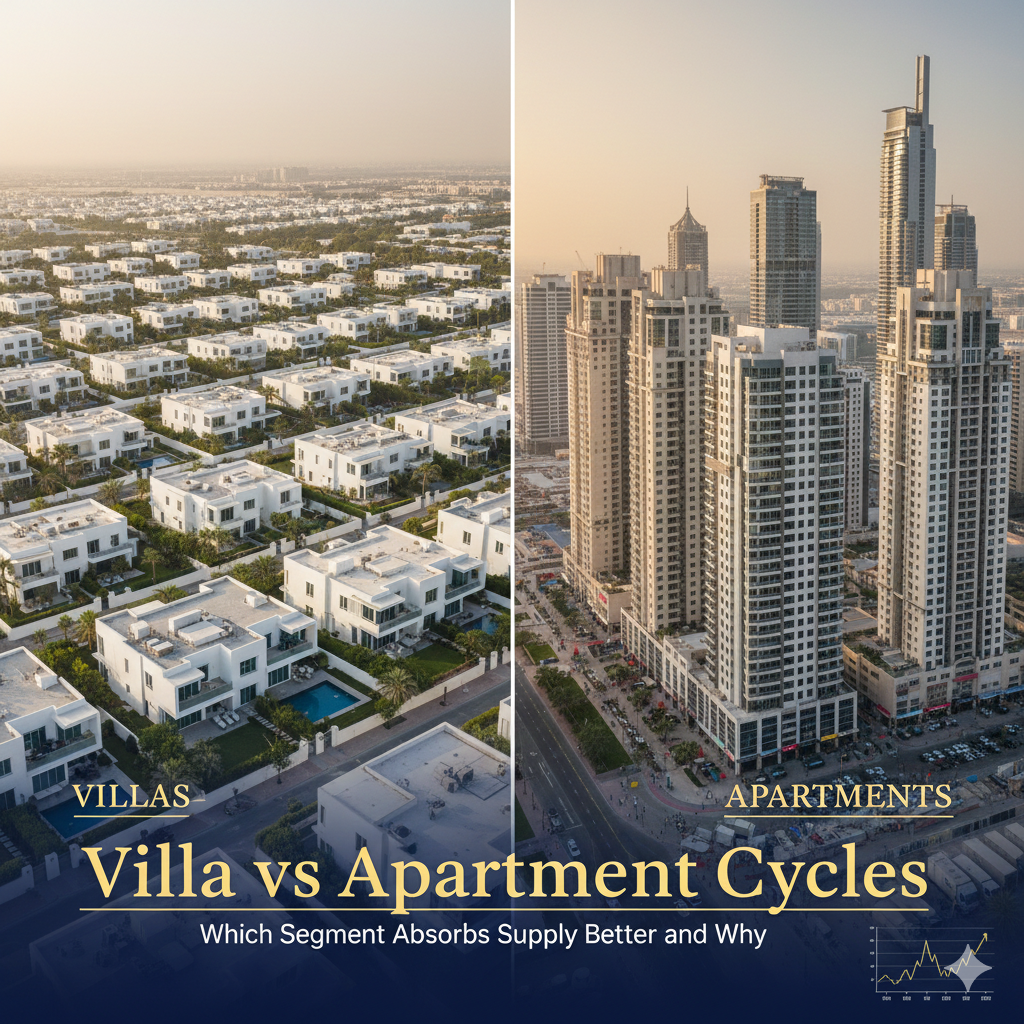
Comparative Analysis: Supply Pipeline and Absorption Capacity
Current Supply Dynamics
Abu Dhabi’s development pipeline reveals strategic planning that favors apartment-heavy projects. Of the approximately 33,000 residential units under construction, apartments constitute the majority, reflecting developer confidence in this segment’s absorption capacity.
Supply Delivery Schedule:
- 2025: 8,000 units (60% apartments, 40% villas/townhouses)
- 2026: 12,800 units (65% apartments, 35% villas/townhouses)
- 2027: 12,400 units (projected distribution)
- 2028: 21,400 units (projected distribution)
The staggered delivery approach, historically typical for Abu Dhabi real estate, allows the market to absorb new supply gradually, preventing sudden inventory spikes that could destabilize pricing.
Absorption Rate Comparison
Based on current market performance, apartments demonstrate approximately 30% faster absorption rates than villas:
Apartment Absorption: With 95%+ occupancy rates and only 10.3% of the projected 2025 pipeline delivered by September, apartments consistently outpace supply projections. The segment’s ability to attract international buyers representing 42% of transactions creates depth in demand that facilitates rapid absorption.
Villa Absorption: While ready villa transactions surged 72.2% year-on-year, the segment’s dependence on end-user demand rather than investor speculation creates more moderate absorption patterns. Villa buyers typically conduct extensive due diligence, resulting in longer sales cycles averaging 45-60 days compared to 30-40 days for apartments.
Investment Implications for 2026 and Beyond
Strategic Considerations for Apartment Investments
For investors targeting pre-launch off-plan properties in the apartment segment:
Advantages:
- Capital Appreciation: Prime waterfront apartments on Saadiyat Island delivered 21.2% annual growth in 2025
- Rental Demand: Sustained expatriate population growth ensures consistent tenant pools
- Liquidity: Faster transaction times and broader buyer pools facilitate easier exits
- Flexible Payment Plans: Developers offer 5-10% down payments with construction-linked plans
Focus Areas:
- Yas Island apartments: Recording 14% annual growth with Disney development effect
- Al Reem Island: Most accessible waterfront community for mid-income buyers
- Saadiyat Island: Cultural district developments offering 8,000+ units with premium positioning
Villa Investment Opportunities
For investors and end-users considering new villa projects in Abu Dhabi:
Advantages:
- Long-term Stability: Family-driven demand creates stable occupancy
- Capital Appreciation: Premium locations like Khalifa City showed 30% villa price growth
- Land Value: Larger plot allocations provide inherent land value appreciation
- Lifestyle Premium: Growing preference for private outdoor space post-pandemic
Focus Areas:
- Established Communities: Khalifa City, Al Raha Gardens, with proven track records
- Lifestyle Developments: Yas Island and Al Hidayriyyat integrated communities
- Premium Segments: Waterfront villas on Saadiyat Island for UHNWI buyers
Market Outlook: Which Segment Wins the Absorption Race?
Short-term Perspective (2026-2027)
The apartment segment decisively outperforms in supply absorption capacity for the immediate term. With 6,500 new residential units projected for 2026, predominantly apartments, the segment benefits from:
- Consistent rental demand from Abu Dhabi’s growing expatriate workforce
- International investor appetite driven by competitive rental yields of 6-8%
- Government initiatives supporting population growth to 4+ million residents
- Infrastructure development in key apartment-heavy zones like Yas Island and Saadiyat Island
Market analysts project apartment absorption rates maintaining 90%+ levels through 2027, supported by limited supply relative to demand growth.
Long-term Perspective (2028 and Beyond)
While apartments maintain absorption advantages, the villa segment’s fundamentals strengthen for long-term investors:
- Demographic Shifts: A growing number of families establishing permanent residency in Abu Dhabi
- Limited Land Supply: Scarcity of freehold land suitable for villa development creates supply constraints
- Lifestyle Preferences: Post-pandemic preference for space and privacy sustains villa demand
- Wealth Migration: Continued influx of 9,800+ millionaires annually expands UHNWI buyer pool
Critical Success Factors for Supply Absorption
Regardless of segment preference, certain factors determine absorption success:
1. Location Quality: Properties in high-yield investment zones with established infrastructure absorb supply 40% faster than peripheral developments
2. Developer Reputation: Projects by Aldar Properties, SOBHA, and Bloom Holding demonstrate superior absorption through brand trust and quality delivery
3. Pricing Strategy: Off-plan units priced 8-12% below ready properties create immediate absorption advantages
4. Amenity Integration: Developments offering comprehensive lifestyle amenities (schools, retail, healthcare) achieve 95%+ absorption within 12 months
5. Payment Flexibility: Flexible payment plans with low down payments of 5-10% and post-handover options accelerate sales velocity
Conclusion: Data-Driven Investment Decisions
The evidence clearly demonstrates that apartments absorb supply more efficiently than villas in Abu Dhabi’s current market cycle. Superior absorption stems from broader demand demographics, lower entry thresholds, higher rental yields, and stronger investor liquidity. However, premium villas in select locations offer compelling long-term value for family-oriented buyers and UHNWI investors.
For investors seeking optimal supply absorption characteristics, focus on apartment developments in Yas Island, Saadiyat Island, and Al Reem Island with established developer credentials and integrated lifestyle amenities. These properties combine strong rental yields, rapid absorption, and capital appreciation potential.
Understanding these property market cycles enables investors to position portfolios strategically, capitalizing on pre-launch opportunities that offer the best combination of value, absorption certainty, and return potential.
Secure Your Investment in Abu Dhabi’s High-Absorption Markets
Ready to invest in Abu Dhabi’s best off-plan projects with proven absorption track records? Our specialized team at MBR Properties provides exclusive access to pre-launch opportunities before public announcements, comprehensive market analysis, and customized investment strategies aligned with your portfolio objectives.
Fill up the form on our website prelaunch.ae to receive:
- Exclusive pre-launch property notifications
- Detailed absorption rate analysis by location
- Comparative investment return projections
- Developer performance track records
- Complimentary portfolio consultation
Contact us today:  Call: (+971) 52 341 7272
  Email: sales@mbrproperties.ae
Don’t miss opportunities in Abu Dhabi’s most dynamic high-yield investment zones—where superior supply absorption meets exceptional returns.
Frequently Asked Questions
Q1: Which property type offers better investment returns in Abu Dhabi?
Apartments currently offer superior risk-adjusted returns with rental yields of 6-8% compared to villas at 4-6%. However, premium villas in locations like Khalifa City delivered an exceptional 30% capital appreciation in 2025. Your choice depends on investment horizon and capital availability.
Q2: How long does it take for the new supply to be absorbed in Abu Dhabi?
Prime apartment developments achieve 90%+ absorption within 6-12 months, while villas in established communities typically reach 80% absorption within 12-18 months. Peripheral developments may require 18-24 months for full absorption.
Q3: Are there oversupply concerns with 12,800 units coming in 2026?
No significant oversupply risk exists due to Abu Dhabi’s conservative development approach and strong demand fundamentals. The population crossed 4 million in 2024 with continued growth, while actual deliveries typically fall 20-30% short of initial projections, allowing gradual market absorption.
Q4: Which locations offer the best absorption rates for off-plan investments?
Yas Island, Saadiyat Island, and Al Reem Island demonstrate the strongest absorption rates, with properties selling within 30-40 days on average. These locations benefit from integrated infrastructure, entertainment options, and waterfront access.
Q5: How do Golden Visa programs impact supply absorption?
Golden Visa eligibility for properties over AED 2 million has accelerated absorption in the premium apartment and villa segments. International buyers now comprise 42% of transactions, creating additional demand that speeds absorption, particularly for qualifying properties.
Q6: What’s the minimum investment for strong absorption potential?Apartments starting from AED 850,000 in locations like Yas Island offer strong absorption potential due to affordability and rental demand. For villas, minimum investments of AED 2.5 million in established communities ensure better absorption prospects.