In Dubai’s expansive real estate market, broad statistics about city-wide price appreciation or average rental yields mask the critical truth that determines investment success: performance varies dramatically between micro-markets. While Dubai’s overall residential market delivered 20% price growth in 2024, specific communities experienced returns ranging from 5% to 45%—a nine-fold difference based solely on location selection.
Understanding micro-market dynamics in Dubai separates exceptional investments from disappointing ones. With over 41,000 new units expected in 2025 and another 42,000 in 2026, knowing which communities will absorb this supply while maintaining strong resale demand and rental performance is the difference between capturing double-digit returns and watching your investment stagnate.
This comprehensive guide reveals how to analyze Dubai communities at the micro-market level, identify locations with sustainable demand drivers, and select properties that deliver both immediate rental income and long-term capital appreciation. Whether you’re targeting luxury waterfront properties, family-oriented communities, or high-yield affordable segments, mastering micro-market selection is your path to exceptional returns.
Why Micro-Market Analysis Matters More Than Ever
Dubai’s real estate market has matured significantly from its boom-bust cycles of the 2000s. Today’s market operates with greater sophistication, where location-specific fundamentals determine performance far more than overall market sentiment.
The Micro-Market Performance Gap
Recent market data reveals staggering performance differences between Dubai micro-markets:
Rental Yield Variance:
- Jumeirah Village Circle (JVC): 7.5-8.5% rental yields
- Downtown Dubai: 5.0-6.0% rental yields
- Palm Jumeirah villas: 4.5-5.5% rental yields
- Dubai South apartments: 8.0-9.0% rental yields
Capital Appreciation Variance (2023-2024):
- Dubai Islands: 25-30% annual appreciation
- Dubai Hills Estate: 15-20% annual appreciation
- Business Bay: 12-18% annual appreciation
- Some oversupplied locations: 2-5% annual appreciation
This variance demonstrates why city-wide averages provide limited investment guidance. A Dubai residential market average of 20% price growth means nothing if your specific community delivered only 5%, while savvy investors in the right micro-markets captured 35%+ returns.
| Performance Metric | City-Wide Average | Top Micro-Markets | Underperforming Areas |
| Price Appreciation 2024 | 20% | 25-45% | 2-8% |
| Rental Yield | 6.7% | 7.5-11% | 4.0-5.5% |
| Occupancy Rate | 88% | 92-97% | 75-85% |
| Days to Rent | 28 days | 10-18 days | 45-75 days |
| Resale Liquidity | Moderate | High (under 90 days) | Low (120+ days) |
These differences compound over time. An investment in a high-performing micro-market delivering 9% rental yields with 25% annual appreciation generates dramatically superior total returns compared to a property in an average location delivering 6% yields with 12% appreciation—even if both properties cost the same initially.
The Five Pillars of Micro-Market Analysis
Successful micro-market selection requires systematic evaluation across five critical dimensions. Investors who master this framework consistently identify communities with lasting resale demand and rental performance.
Pillar 1: Employment Proximity and Accessibility
Employment proximity remains the single strongest predictor of rental demand and occupancy stability in Dubai. Communities within 15-20 minutes of major employment centers consistently outperform distant locations across all market cycles.
Major Dubai Employment Centers:
| Employment Hub | Total Workers | Optimal Communities (15 min) | Rental Premium |
| Downtown Dubai / DIFC | 150,000+ | Business Bay, DIFC, Greens | 15-25% |
| Dubai Media City / Internet City | 85,000+ | Dubai Marina, JLT, Greens | 12-20% |
| DAFZA / Jebel Ali | 65,000+ | Discovery Gardens, JVC | 10-15% |
| Dubai Silicon Oasis | 40,000+ | DSO, Academic City | 8-12% |
| Healthcare City | 35,000+ | Business Bay, Culture Village | 12-18% |
Why Proximity Matters:
Working professionals—particularly expatriates on 2-3 year contracts—prioritize convenience. Communities offering short commutes command rental premiums, experience lower vacancy rates, and maintain demand even during market corrections.
Recent analysis shows Business Bay apartments within walking distance of DIFC lease 40% faster than comparable units requiring driving commutes. Similarly, Dubai Marina properties near Media City and Internet City maintain 95%+ occupancy while more distant communities in the same price bracket struggle with 85% occupancy.
Accessibility Infrastructure:
Beyond proximity, transportation connectivity amplifies location value:
Metro Accessibility: Communities with Dubai Metro access command 10-15% rental premiums. Properties within 800m walking distance of stations like Business Bay Metro, Dubai Marina Metro, and Mall of the Emirates Metro show significantly faster leasing velocity.
Major Highway Access: Direct access to Sheikh Zayed Road, Al Khail Road, or Emirates Road reduces commute friction. Communities like Dubai Hills Estate benefit from strategic positioning between multiple highway connections.
Future Infrastructure: Planned metro expansions and infrastructure projects create pre-appreciation opportunities. Investors identifying communities benefiting from upcoming infrastructure capture value before the market fully prices in improvements.
When evaluating Dubai’s fastest-growing communities, employment proximity should be your first filter. Properties far from employment centers may offer attractive entry pricing, but this “value” often reflects structural demand weakness rather than opportunity.
Pillar 2: Tenant Demographics and Community Positioning
Different Dubai communities attract distinctly different tenant profiles, each with unique demand characteristics, rental behaviors, and economic sensitivities. Understanding which demographic your target community serves is critical for predicting rental stability and long-term demand.
Primary Dubai Tenant Demographics:
Young Professionals (Singles & Couples):
- Age: 25-35 years
- Income: AED 8,000-25,000 monthly
- Preferences: Studios and 1-bedroom units near employment, nightlife, and amenities
- Target Communities: Dubai Marina, Business Bay, JLT, Greens, Downtown Dubai
- Rental Behavior: High turnover (12-24 months), price-sensitive, prioritize location over space
- Investment Implications: Strong yields (6.5-8%), moderate capital appreciation, high liquidity
Families (Local & Expatriate):
- Age: 30-50 years
- Income: AED 30,000-80,000+ monthly
- Preferences: 2-4 bedroom villas/townhouses, schools, parks, community atmosphere
- Target Communities: Dubai Hills Estate, Arabian Ranches, The Springs, Jumeirah Village Circle, Meydan
- Rental Behavior: Long-term tenancy (2-4 years), stability-focused, school calendars drive moves
- Investment Implications: Moderate yields (5.5-7%), strong appreciation (12-18%), lower vacancy
High-Net-Worth Individuals:
- Age: 35-60+ years
- Income: AED 100,000+ monthly
- Preferences: Luxury villas, waterfront properties, privacy, branded residences, premium services
- Target Communities: Palm Jumeirah, Emirates Hills, District One, Jumeirah Bay Island
- Rental Behavior: Very long-term (3-5+ years), often secondary homes, less price-sensitive
- Investment Implications: Lower yields (4-6%), exceptional appreciation (15-25%+), wealth preservation
Budget-Conscious Renters:
- Age: 25-45 years
- Income: AED 5,000-12,000 monthly
- Preferences: Affordable studios and 1-bedrooms, basic amenities, value-for-money
- Target Communities: International City, Discovery Gardens, Dubai South, IMPZ
- Rental Behavior: Cost-driven, moderate turnover, less demanding
- Investment Implications: High yields (8-10%), lower appreciation (6-12%), higher management intensity
Matching Community to Demographics:
The most successful Dubai micro-market investments align community characteristics with appropriate tenant demographics. A luxury waterfront development attracting families in an area without schools will underperform regardless of quality. Conversely, affordable units in employment-proximate areas serving young professionals consistently deliver exceptional yields.
Dubai Hills Estate exemplifies perfect demographic alignment: family-oriented master-planning, proximity to top international schools (GEMS, Nord Anglia, Jumeirah English Speaking School), parks and community spaces, plus quick access to Downtown Dubai employment centers. Result: 15-20% annual appreciation, strong rental demand, and low vacancy.
Conversely, some communities suffer from demographic misalignment—luxury pricing targeting affluent tenants in locations lacking supporting infrastructure, or family-sized units in areas without schools. These mismatches create persistent underperformance regardless of broader market strength.
Pillar 3: Supply Pipeline and Competition Analysis
While Dubai’s overall supply figures dominate headlines, location-specific supply determines individual investment performance. A community receiving 2,000 new units might experience oversupply and price pressure, while another absorbing 3,000 units maintains strong pricing due to superior demand fundamentals.
Effective Supply Analysis Framework:
Step 1: Define Your Competitive Set
Identify properties competing directly with your target investment:
- Similar unit types (studio, 1BR, 2BR, villa)
- Comparable price points (within 15% of your target)
- Similar location benefits (employment proximity, schools, amenities)
- Delivery timing (within 18 months of completion)
Step 2: Quantify Competing Supply
Calculate total units in your competitive set delivering within 18-24 months. This reveals whether your investment faces minimal, moderate, or severe competition.
Step 3: Compare to Historical Absorption
Examine how many similar units the location has historically absorbed annually. If competing supply exceeds 18-24 months of historical absorption, oversupply risk is high.
Step 4: Adjust for Demand Changes
Factor in infrastructure improvements, employment growth, or demographic shifts that might expand market catchment and accelerate absorption.
Supply Analysis Example: JVC vs. Dubai South
Jumeirah Village Circle:
- Existing inventory: ~36,000 units
- Annual absorption (2022-2024): ~3,200 units
- Pipeline (2025-2026): ~6,800 new units
- Months of supply: 21 months (moderate risk)
- Demand factors: Employment proximity to Media City, established community infrastructure
- Assessment: Supply is manageable due to strong location fundamentals
Dubai South:
- Existing inventory: ~8,500 units
- Annual absorption (2022-2024): ~800 units
- Pipeline (2025-2026): ~4,200 new units
- Months of supply: 63 months (high risk in some segments)
- Demand factors: Airport proximity, Expo legacy, affordability
- Assessment: Significant near-term supply pressure requiring careful project selection
This analysis reveals why blanket statements about “Dubai’s oversupply” mislead investors. JVC facing 21 months of supply in a proven, employment-proximate location presents fundamentally different risk than Dubai South managing 63 months of supply in an emerging area still establishing demand patterns.
Investors evaluating Dubai’s off-plan market dynamics must conduct this location-specific analysis rather than relying on city-wide figures.
Pillar 4: Resale Market Liquidity
Resale liquidity—how quickly and efficiently you can sell a property—varies enormously between Dubai micro-markets. High-liquidity communities allow investors to exit positions within 30-90 days at fair market prices, while low-liquidity locations require 120-180+ days and often necessitate price concessions.
Liquidity Indicators:
Transaction Volume: Communities with 500+ annual transactions demonstrate deep, liquid markets. Locations with under 100 transactions annually suggest thin markets where single sales can move prices.
Days on Market: Average time from listing to sale reveals market efficiency. Top communities average 30-60 days; concerning locations, exceed 90-120 days.
Price Discovery: Tight bid-ask spreads (difference between asking and selling prices) indicate efficient markets. Wide spreads suggest pricing uncertainty.
Buyer Diversity: Markets with diverse buyer profiles (end-users, investors, locals, internationals) provide more exit options than those dependent on narrow buyer segments.
Dubai’s Most Liquid Micro-Markets:
| Community | Annual Transactions | Avg. Days on Market | Buyer Diversity | Liquidity Rating |
| Dubai Marina | 4,500+ | 35-50 days | Very High | Excellent |
| Downtown Dubai | 3,200+ | 30-45 days | Very High | Excellent |
| Business Bay | 3,800+ | 40-55 days | High | Excellent |
| JVC | 2,800+ | 45-65 days | High | Very Good |
| Dubai Hills Estate | 1,200+ | 50-70 days | High | Very Good |
| Palm Jumeirah | 800+ | 60-90 days | Moderate-High | Good |
| Arabian Ranches | 600+ | 65-85 days | Moderate | Good |
| Dubai South | 400+ | 90-140 days | Moderate-Low | Moderate |
Why Liquidity Matters:
High liquidity provides strategic flexibility—you can exit quickly to capture opportunities elsewhere, respond to personal circumstances, or rebalance portfolios. Low liquidity creates forced hold situations where market timing dictates your actions rather than your strategy.
During the 2020 market correction, Dubai Marina investors who needed liquidity could exit within 60-75 days at 8-12% below peak pricing. Comparable investors in low-liquidity communities faced 120-180 day marketing periods with 18-25% discounts—more than doubling the cost of exit.
Building Liquidity into Strategy:
Investors can enhance portfolio liquidity by:
- Allocating 60-70% to highly liquid communities (Dubai Marina, Business Bay, Downtown)
- Limiting exposure to emerging locations (15-25% of portfolio)
- Prioritizing standard unit types (1BR, 2BR) over unique configurations
- Selecting properties near major landmarks or amenities that enhance marketability
For investors exploring Dubai’s most searched communities, search volume often correlates with resale liquidity—high search interest indicates broad buyer awareness and facilitates faster exits.
Pillar 5: Infrastructure Quality and Community Maturity
Infrastructure completeness and community maturity profoundly impact both rental appeal and resale value. Established communities with operational infrastructure consistently outperform emerging locations with incomplete facilities, even when the latter offer newer construction.
Infrastructure Assessment Criteria:
Retail and Dining: Operational supermarkets, restaurants, and cafes within 5-10 minutes walking distance significantly enhance rental appeal. Communities lacking these conveniences struggle with tenant retention.
Schools and Nurseries: For family-oriented communities, proximity to quality international schools (GEMS, JESS, Kings, Nord Anglia) is non-negotiable. Dubai Hills Estate commands premiums precisely because multiple top-tier schools operate within the community.
Healthcare Facilities: Accessible clinics, pharmacies, and proximity to hospitals (within 15 minutes) matter especially for family tenants.
Recreation and Leisure: Operational parks, pools, gyms, and community spaces increase tenant satisfaction and renewal rates.
Connectivity Infrastructure: Completed roads, functioning public transportation, and adequate parking all impact livability and desirability.
Maturity Lifecycle:
Communities progress through maturity stages with distinct investment characteristics:
Early Development (Years 0-3):
- Infrastructure incomplete
- Limited operational amenities
- Price volatility (high upside, high risk)
- Requires patient capital
- Example: Parts of Dubai South, emerging areas of MBR City
Maturing (Years 3-7):
- Infrastructure becoming operational
- Community character establishing
- Appreciation accelerating as location proves out
- Rental yields are improving as amenities are completed
- Example: Dubai Islands, parts of Dubai Hills Estate
Established (Years 7-15):
- Complete infrastructure
- Proven track record
- Stable appreciation and yields
- High liquidity
- Lower risk
- Example: Dubai Marina, Downtown Dubai core, JLT
Mature Premium (15+ years):
- Iconic status
- Limited new supply
- Premium pricing vs. newer alternatives
- Wealth preservation focus
- Example: Palm Jumeirah, Emirates Hills, parts of Downtown Dubai
Risk-Return Tradeoff:
Early-stage communities offer higher appreciation potential (25-40%) but carry execution risk—infrastructure delays, demand below projections, longer hold periods. Established communities deliver more predictable returns (12-18% appreciation, 6-8% yields) with significantly lower risk.
Strategic investors allocate across maturity stages:
- 40-50% in established communities (stable income, liquidity, lower risk)
- 30-40% in maturing communities (balance of yield and appreciation)
- 10-20% in early-stage high-potential locations (maximum appreciation, highest risk)
This diversification captures upside from emerging locations while maintaining portfolio stability through established holdings.
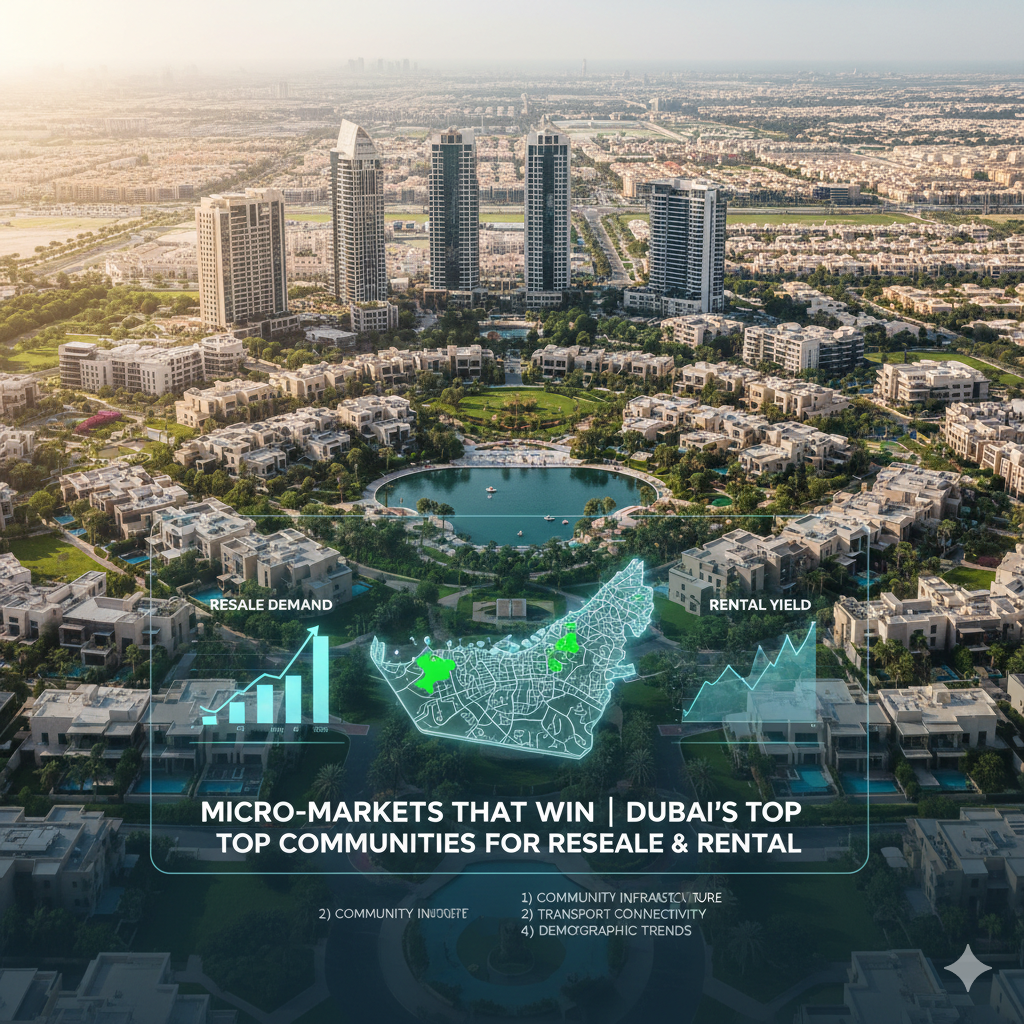
Winning Micro-Markets: Detailed Community Analysis
Applying the five-pillar framework reveals specific Dubai communities offering optimal combinations of resale demand, rental yields, and capital appreciation potential. Here’s a detailed analysis of top-performing micro-markets across different investment objectives:
Tier 1: Premium Yield + Solid Appreciation (Best All-Around Returns)
Jumeirah Village Circle (JVC)
Location Profile: Interior Dubai, Sheikh Mohammed Bin Zayed Road proximity Developer Mix: Multiple developers (Nakheel master-developer, various building developers) Unit Focus: Primarily apartments (studios to 3BR), limited townhouses
Pillar Analysis:
- Employment Proximity: ✓✓✓✓ (15-20 min to Media City, 20 min to Downtown)
- Tenant Demographics: Young professionals, young families, budget-conscious mid-income
- Supply Pipeline: Moderate (21 months inventory) but manageable given strong fundamentals
- Resale Liquidity: ✓✓✓✓ (2,800+ annual transactions, 45-65 day average sale time)
- Infrastructure: ✓✓✓✓ Mature, complete retail (Circle Mall, JVC Walk), schools, clinics
Investment Performance:
- Rental Yield: 7.5-8.5% (among Dubai’s highest for quality apartments)
- Capital Appreciation (2023-2024): 15-22%
- Occupancy Rate: 93-96%
- Average Days to Rent: 15-25 days
Why JVC Wins:
JVC delivers the rare combination of premium rental yields (7.5-8.5%) typically associated with budget locations, while maintaining solid capital appreciation (15-22%) and excellent infrastructure. The community’s strategic positioning near major employment centers creates consistent tenant demand across economic cycles.
Unlike purely budget-focused communities, JVC offers quality construction, complete amenities, and family-friendly infrastructure that attract stable, long-term tenants. This supports both high yields AND capital growth—a combination rare in Dubai’s market.
Optimal Unit Types: 1-bedroom apartments (strongest yields, highest demand), studios (maximum yield but higher turnover)
Investment Strategy: Core portfolio holding for yield-focused investors; excellent cash flow supports leveraged acquisition strategies
Risk Factors: Moderate near-term supply (managed by selectingthe best buildings/locations within JVC), distance from beach/waterfront
Business Bay
Location Profile: Central Dubai, between Downtown and DIFC Developer Mix: Multiple premium developers Unit Focus: Apartments and hotel apartments, commercial integration
Pillar Analysis:
- Employment Proximity: ✓✓✓✓✓ (Walking distance to DIFC, 5 min to Downtown)
- Tenant Demographics: Financial services professionals, young executives, international assignees
- Supply Pipeline: Moderate-high but offset by exceptional location fundamentals
- Resale Liquidity: ✓✓✓✓✓ (3,800+ annual transactions, 40-55 day average sale time)
- Infrastructure: ✓✓✓✓✓ Complete, metro-connected, integrated retail/dining, Canal Walk
Investment Performance:
- Rental Yield: 6.5-7.5% (strong for central location)
- Capital Appreciation (2023-2024): 16-20%
- Occupancy Rate: 92-95%
- Average Days to Rent: 18-28 days
Why Business Bay Wins:
Business Bay’s positioning between Downtown Dubai and DIFC creates permanent location value. Financial services professionals working in DIFC prioritize convenient housing, creating stable demand even during economic uncertainty. The community’s mixed-use character (residential + commercial + hospitality) generates 24/7 activity and diverse amenities.
Recent Dubai Metro access enhancement and Dubai Canal development have amplified location premiums. Properties with canal views or proximity to Metro stations command significant premiums and fastest absorption.
Optimal Unit Types: 1-2 bedroom apartments near Metro or with canal views (balance of yield and appreciation)
Investment Strategy: Core holding for balanced portfolio; strong rental income plus capital growth; excellent liquidity for portfolio rebalancing
Risk Factors: High-rise density creates supply sensitivity; hotel apartment competition in some areas
Dubai Marina
Location Profile: Western Dubai coast, waterfront living Developer Mix: Emaar master-developer, multiple tower developers Unit Focus: Primarily apartments, limited townhouses/villas
Pillar Analysis:
- Employment Proximity: ✓✓✓✓ (5-10 min to Media/Internet City, 20 min to DIFC)
- Tenant Demographics: Young professionals (singles/couples), some families, international residents
- Supply Pipeline: Low (established community with minimal new supply)
- Resale Liquidity: ✓✓✓✓✓ (4,500+ annual transactions, 35-50 day average sale time, Dubai’s most liquid)
- Infrastructure: ✓✓✓✓✓ Exceptional—Marina Walk, The Beach JBR, multiple Metro stations, restaurants, retail
Investment Performance:
- Rental Yield: 6.0-7.0% (moderate but strong for premium waterfront)
- Capital Appreciation (2023-2024): 18-24%
- Occupancy Rate: 94-97%
- Average Days to Rent: 12-20 days
Why Dubai Marina Wins:
Dubai Marina represents Dubai’s most established and liquid micro-market, offering unmatched exit flexibility. The community’s maturity means infrastructure completeness, proven tenant demand, and deep transaction history that facilitates fast resales.
Waterfront positioning, metro connectivity, and proximity to employment centers create diversified demand—young professionals, families, short-term renters (tourism), and lifestyle buyers all target the community. This diversity protects against single-demographic demand shocks.
For investors evaluating high-demand off-plan communities, Dubai Marina exemplifies sustainable micro-market fundamentals that drive long-term performance.
Optimal Unit Types: 1-bedroom apartments with marina views (optimal yield-appreciation balance), studios near Metro (maximum yield)
Investment Strategy: Core portfolio allocation for liquidity and stability; excellent for first-time Dubai investors; strong short-term rental potential
Risk Factors: Minimal new supply limits growth ceiling vs. emerging areas; premium pricing reduces yield vs. budget alternatives
Tier 2: Maximum Capital Appreciation (Growth-Focused)
Dubai Hills Estate
Location Profile: Central Dubai, between Downtown and Al Khail Road Developer Mix: Emaar/Meraas joint venture Unit Focus: Apartments, townhouses, villas; master-planned mixed-use
Pillar Analysis:
- Employment Proximity: ✓✓✓✓ (15 min to Downtown, 18 min to DIFC, central positioning)
- Tenant Demographics: Predominantly families (UAE nationals, affluent expatriates), some young professionals
- Supply Pipeline: Moderate-high but phased delivery supports absorption
- Resale Liquidity: ✓✓✓✓ (1,200+ annual transactions, 50-70 days, improving rapidly)
- Infrastructure: ✓✓✓✓✓ Exceptional—Dubai Hills Mall, golf course, parks, top schools (GEMS, JESS, Nord Anglia)
Investment Performance:
- Rental Yield: 5.5-6.5% (moderate due to premium pricing)
- Capital Appreciation (2023-2024): 18-25%
- Occupancy Rate: 90-94%
- Average Days to Rent: 20-35 days
Why Dubai Hills Estate Wins:
Dubai Hills Estate exemplifies master-planned community excellence. The Emaar/Meraas partnership created comprehensive infrastructure from inception—schools, retail, healthcare, parks, golf course—eliminating the execution risk common in emerging communities.
Family-oriented positioning with top-tier schools attracts affluent, stable tenants who sign long-term leases (3-4 years typical vs. 1-2 years elsewhere). This creates lower vacancy, reduced turnover costs, and more predictable cash flows.
The community’s central location between established Dubai (Downtown, Business Bay) and growth corridors (Dubai South, Expo) provides balanced exposure. Prices reflect quality but remain below ultra-premium locations like Palm Jumeirah, offering an appreciation runway as the community matures.
Optimal Unit Types: 3-4 bedroom townhouses (family sweet spot), 2-bedroom apartments (entry point with solid yields)
Investment Strategy: Long-term appreciation play; stable family tenants support holding strategy; potential for significant value gains as the community reaches full maturity
Risk Factors: Ongoing supply delivery requires monitoring; premium pricing reduces the entry-level buyer pool
Dubai Islands (formerly Deira Islands)
Location Profile: Waterfront, northern Dubai coast Developer Mix: Nakheel master-developer Unit Focus: Apartments, branded residences, resort-style living
Pillar Analysis:
- Employment Proximity: ✓✓✓ (20-25 min to DIFC/Downtown, emerging employment in area)
- Tenant Demographics: Mix of young professionals, lifestyle seekers, short-term rental market
- Supply Pipeline: High but targeting the underserved waterfront segment
- Resale Liquidity: ✓✓✓ (Emerging—1,000+ transactions in 2024, improving)
- Infrastructure: ✓✓✓ Developing—beaches, retail coming, entertainment zones planned
Investment Performance:
- Rental Yield: 6.5-7.5% (strong for waterfront)
- Capital Appreciation (2023-2024): 25-30% (among Dubai’s strongest)
- Occupancy Rate: 88-92% (improving as infrastructure develops)
- Average Days to Rent: 25-40 days
Why Dubai Islands Wins:
Dubai Islands captures the waterfront scarcity premium at more accessible price points than Palm Jumeirah or Emaar Beachfront. The community offers genuine beach access, resort-style amenities, and lifestyle positioning that attract both traditional renters and short-term rental demand (tourism, corporate housing).
The 7% price appreciation in 2024 alone, combined with 1,000+ off-plan transactions, demonstrates strong investor confidence and momentum. As infrastructure is completed over 2025-2027, the location should close its current 25-30% pricing discount to comparable waterfront communities.
For investors exploring emerging high-growth opportunities, the Dubai Islands offer waterfront positioning with a substantial appreciation runway.
Optimal Unit Types: 1-2 bedroom beach-access apartments (balance of yield and appreciation), branded residences (maximum appreciation)
Investment Strategy: Growth-focused allocation; 3-5 year hold to capture infrastructure maturation; consider short-term rental strategy for maximum returns
Risk Factors: Infrastructure completion timing; distance from established employment centers; emerging community execution
MBR City / Meydan
Location Profile: Southern Dubai, between Downtown and Dubai-Al Ain Road Developer Mix: Multiple developers in Meydan One master plan Unit Focus: Luxury villas (District One), apartments, mixed-use
Pillar Analysis:
- Employment Proximity: ✓✓✓ (20 min to Downtown, 15 min to Healthcare City)
- Tenant Demographics: High-net-worth families, executives, affluent expatriates
- Supply Pipeline: Moderate (phased luxury development)
- Resale Liquidity: ✓✓✓ (600+ annual transactions, growing)
- Infrastructure: ✓✓✓✓ Strong—Meydan Racecourse, Meydan Hotel, schools developing, retail improving
Investment Performance:
- Rental Yield: 5.0-6.5% (moderate—luxury segment)
- Capital Appreciation (2023-2024): 20-28% (very strong)
- Occupancy Rate: 88-93%
- Average Days to Rent: 30-50 days
Why MBR City / Meydan Wins:
Meydan positions itself at the intersection of luxury and lifestyle. District One lagoon villas command premium pricing but deliver exceptional appreciation as Dubai’s ultra-high-net-worth population grows. The broader MBR City development offers more accessible luxury apartments with solid fundamentals.
The community’s proximity to Downtown Dubai without downtown density or pricing creates a value proposition for families seeking space and prestige. Upcoming Meydan One mega-development will amplify infrastructure and lifestyle amenities, supporting continued appreciation.
Optimal Unit Types: District One villas (maximum appreciation, wealth preservation), Meydan apartments 2-3BR (more accessible luxury)
Investment Strategy: Premium appreciation play; target high-net-worth tenants for stable, long-term leases; wealth preservation component alongside returns
Risk Factors: Luxury segment is more economically sensitive; lower yields require an appreciation focus; infrastructure delivery timing
Tier 3: Maximum Rental Yield (Income-Focused)
Dubai South
Location Profile: Southern Dubai, Al Maktoum International Airport proximity Developer Mix: Multiple developers, Emaar prominent Unit Focus: Affordable apartments, townhouses, family communities
Pillar Analysis:
- Employment Proximity: ✓✓✓ (Adjacent to airport, Expo City, logistics hubs)
- Tenant Demographics: Airport workers, budget-conscious families, service sector employees
- Supply Pipeline: High (63 months in some segments—requires careful selection)
- Resale Liquidity: ✓✓ (400+ annual transactions, emerging market)
- Infrastructure: ✓✓✓ Improving—Expo legacy, retail development, schools opening
Investment Performance:
- Rental Yield: 8.0-9.5% (exceptional for modern construction)
- Capital Appreciation (2023-2024): 12-18%
- Occupancy Rate: 86-91%
- Average Days to Rent: 30-50 days
Why Dubai South Wins:
Dubai South delivers the highest rental yields among modern, quality communities in Dubai. Prices averaging AED 800-1,200 per sq ft (vs. AED 2,000-3,000+ elsewhere) create exceptional yield math when renting to airport workers, logistics employees, and budget-conscious families.
The Al Maktoum International Airport expansion (projected to be the world’s largest) creates long-term employment demand. Expo City’s legacy infrastructure provides cultural and entertainment amenities unusual for affordable segments.
However, a significant supply pipeline requires selective project choice. Focus on properties near airport gates, completed infrastructure, and established developers like Emaar. Avoid speculative areas with incomplete infrastructure.
For investors comparing affordable vs. luxury opportunities, Dubai South exemplifies maximum income generation with moderate appreciation.
Optimal Unit Types: 1-bedroom apartments (optimal yield-demand balance), studios (maximum yield, higher management)
Investment Strategy: Pure income play; leverage high yields to support debt service; suitable for FIRE (Financial Independence Retire Early) strategies; reinvest cash flow to accelerate portfolio growth
Risk Factors: High supply pipeline (select carefully); distance from established Dubai; infrastructure completion timing; lower appreciation vs. central locations
International City
Location Profile: Eastern Dubai, Academic City proximity Developer Mix: Nakheel master-developer Unit Focus: Budget apartments, ethnic-themed clusters
Pillar Analysis:
- Employment Proximity: ✓✓ (30-40 min to central employment, local job market)
- Tenant Demographics: Budget-conscious workers, service sector, ethnic communities
- Supply Pipeline: Low (established, limited new construction)
- Resale Liquidity: ✓✓ (Moderate transactions, price-sensitive market)
- Infrastructure: ✓✓✓ Mature—Dragon Mart, supermarkets, basic amenities complete
Investment Performance:
- Rental Yield: 8.5-10.0% (among Dubai’s absolute highest)
- Capital Appreciation (2023-2024): 8-12%
- Occupancy Rate: 92-96% (exceptional—budget segment resilience)
- Average Days to Rent: 15-25 days
Why International City Wins:
International City serves Dubai’s essential workforce—the drivers, retail staff, hospitality workers, and service sector employees who keep the city functioning. This demographic prioritizes affordability over location, creating remarkably stable demand even during economic downturns.
While capital appreciation lags premium locations, 8.5-10% rental yields from occupied properties generate exceptional cash-on-cash returns. Low entry prices (studios from AED 250K-350K) enable portfolio scaling and debt leverage strategies difficult in expensive segments.
Optimal Unit Types: Studios (maximum yield, strong demand from single workers)
Investment Strategy: Extreme income focus; build large-unit portfolios leveraging low entry costs; suitable for investors prioritizing cash flow over appreciation; often purchased in bulk (5-10+ units)
Risk Factors: Limited appreciation potential; budget tenant demographic requires active management; lower resale liquidity than premium areas; location peripheral to employment centers
Tier 4: Balanced Lifestyle + Returns
Arabian Ranches
Location Profile: Southern Dubai, Umm Suqeim Road Developer Mix: Emaar master-developer Unit Focus: Villas and townhouses, family-oriented gated community
Pillar Analysis:
- Employment Proximity: ✓✓✓ (25 min to Media City, 30 min to Downtown)
- Tenant Demographics: Established families, UAE nationals, long-term expatriates
- Supply Pipeline: Low (mature community, minimal new development)
- Resale Liquidity: ✓✓✓✓ (600+ annual transactions, established market)
- Infrastructure: ✓✓✓✓✓ Exceptional—golf course, community centers, schools (JESS Ranches, Ranches Primary), retail (Town Center, Souk)
Investment Performance:
- Rental Yield: 5.0-6.0% (moderate—villa segment)
- Capital Appreciation (2023-2024): 14-18%
- Occupancy Rate: 91-95%
- Average Days to Rent: 40-60 days
Why Arabian Ranches Wins:
Arabian Ranches epitomizes Dubai’s established villa communities. Twenty years of proven performance, complete infrastructure, and a prestigious address create wealth preservation alongside moderate returns. The community’s family-first design (parks, pools, golf, schools) attracts long-term tenants who often stay 4-6+ years—dramatically reducing turnover costs.
While yields lag apartment-focused communities, villa appreciation potential, lower management intensity, and a stable tenant base create attractive total returns for investors comfortable with larger capital deployment.
Optimal Unit Types: 3-4 bedroom villas (family sweet spot, best balance), townhouses (entry point, higher yield)
Investment Strategy: Stability-focused allocation; wealth preservation with income; suitable for investors preferring lower management intensity; long-term hold (7-10+ years)
Risk Factors: Lower yields vs. apartments; larger capital requirement; villa market more economically sensitive; longer marketing time when selling
Red Flags: Micro-Markets to Approach with Caution
Not all Dubai communities offer attractive investment fundamentals. Recognizing warning signs prevents capital allocation to underperforming micro-markets:
Warning Sign #1: Extreme Supply-to-Absorption Ratios
Communities facing 36+ months of supply based on historical absorption rates carry high oversupply risk. Even if prices initially appear attractive, excess inventory creates sustained downward pressure on both prices and rents.
Current Concern Areas:
- Parts of Dubai South (some segments exceeding 48 months’ supply)
- Certain DAMAC Hills 2 phases
- Select clusters in the Dubailand region
Mitigation: If investing in high-supply areas, select only properties from top-tier developers, in the best locations within the community, at significant price discounts (25-30% below comparable areas).
Warning Sign #2: Infrastructure Promises Without an Execution Timeline
Many emerging communities market “upcoming infrastructure”—schools, retail, metro connections—without committed timelines or funding. These promises often materialize 3-5+ years later than projected, leaving early investors holding properties in underdeveloped locations.
Due Diligence:
- Verify infrastructure funding approval (not just “planned”)
- Check realistic construction timelines (metro takes 5-7 years minimum)
- Assess property viability, assuming infrastructure delays
- Compared to communities with completed infrastructure
Red Flag Example: Properties marketed on “future metro station” without confirmed government funding and 5+ year minimum delivery timeline. Value depends entirely on an uncertain future event.
Warning Sign #3: Single-Demographic Dependency
Communities relying on a narrow tenant demographic face a higher risk if that demographic shifts. For example, areas dependent solely on specific company employees, single nationality groups, or niche lifestyle segments lack resilience.
Diversification Assessment:
- Does the community appeal to multiple tenant types?
- Can a property attract different demographics if the primary target weakens?
- Is the location defensible if the current demand driver changes?
Concern Example: Communities positioned exclusively for a specific lifestyle (e.g., golf-only appeal) or dependent on a single employer proximity without broader location benefits.
Warning Sign #4: Developer Track Record Issues
Developer quality profoundly impacts both delivery execution and long-term community management. New or unproven developers, or those with histories of delays and quality issues, introduce significant risk.
Developer Due Diligence:
- Verify completion record for previous 3-5 projects
- Check actual delivery dates vs. promised (delays common, but 12+ month delays concern)
- Visit completed projects to assess build quality and community management
- Research buyer satisfaction and post-handover service reputation
Red Flag: Developer with multiple significantly delayed projects, quality complaints, or financial restructuring history.
Timing Your Entry: Market Cycle Considerations
Even excellent micro-markets perform differently depending on market cycle positioning. Understanding where Dubai’s market sits helps optimize entry timing:
Current Market Phase (Q4 2024 – 2025): Maturing Bull Market
Characteristics:
- Prices at or near historical highs
- Strong transaction volumes but moderating pace
- Supply deliveries accelerating (41,000+ units in 2025)
- Rental growth decelerating from 2023 to 2024 peaks
- Buyer profiles shifting from speculators to end-users
Optimal Strategy:
- Focus on established communities with proven fundamentals
- Emphasize rental yield over pure appreciation speculation
- Avoid highly speculative emerging areas dependent on future infrastructure
- Prioritize resale liquidity for exit flexibility
- Consider off-plan selectively (only premium developers, strong locations)
Projected 2026-2027: Market Recalibration
Most analysts project 5-10% price corrections in mid-tier segments as supply deliveries peak, while prime areas (Palm Jumeirah, Downtown Dubai, Emirates Hills) remain resilient with +/-2% movement.
Opportunity Window:
- Corrections create entry points in quality communities at 10-15% below 2024 peaks
- Focus on fundamentally strong micro-markets experiencing temporary oversupply
- Avoid weak locations where corrections may be structural, not cyclical
- Build positions gradually rather than attempting a single perfect timing
Communities Likely to Offer Best Correction Entry:
- Dubai Hills Estate (fundamental strength + moderate oversupply = temporary pricing pressure)
- Business Bay (supply deliveries + fundamental location strength = temporary opportunity)
- JVC (moderate correction in strong-fundamental location)
Communities to Avoid During Correction:
- Emerging areas with incomplete infrastructure
- Locations with structural demand challenges
- Speculative developments dependent on uncertain future events
Practical Investment Framework: Applying Micro-Market Analysis
Armed with micro-market understanding, investors can develop systematic selection processes:
Step-by-Step Selection Process
Stage 1: Define Investment Objectives
Clarify your priorities before analyzing communities:
- Primary goal: Income (yield), growth (appreciation), or balance?
- Hold period: Short-term (2-3 years), medium-term (4-7 years), long-term (8+ years)?
- Risk tolerance: Conservative (established areas), moderate, aggressive (emerging)?
- Capital deployment: Single large property or portfolio of smaller units?
- Management capacity: Self-manage, professional management, hands-off?
Stage 2: Screen Communities Against Pillars
Filter Dubai communities using the five-pillar framework:
| Investment Goal | Pillar Priority | Recommended Communities |
| Maximum Yield | Affordability + Demand | JVC, Dubai South, International City |
| Maximum Appreciation | Infrastructure + Demographics | Dubai Hills, Dubai Islands, MBR City |
| Balanced Returns | Employment Proximity + Liquidity | Business Bay, Dubai Marina, JLT |
| Stability + Preservation | Maturity + Resale Liquidity | Arabian Ranches, The Springs, Palm Jumeirah |
| First-Time Investor | Liquidity + Completeness | Dubai Marina, JVC, Business Bay |
Stage 3: Analyze Supply-Demand Balance
For shortlisted communities, conduct detailed supply analysis:
- Quantify competing supply (18-24 month window)
- Calculate months-of-supply ratio
- Assess demand catalysts and constraints
- Verify infrastructure delivery timelines
Stage 4: Verify Developer Quality
Research developer track record:
- Visit 2-3 completed projects
- Interview current owners about satisfaction
- Check actual delivery dates vs. promises
- Assess community management quality
Stage 5: Financial Modeling
Create comprehensive projections:
- Purchase price + transaction costs (4-5% in fees)
- Mortgage costs if leveraging (typically 25% down, 3.5-5% interest)
- Annual rental income (conservative estimate)
- Operating costs (service charges, maintenance, vacancy allowance)
- Exit scenario (resale price projections, exit costs)
Financial Model Example: 1BR Business Bay Apartment
| Financial Element | Amount (AED) | Notes |
| Purchase Price | 1,500,000 | Market rate |
| Transaction Costs | 63,750 | 4.25% (trustee, registration, agency) |
| Total Investment | 1,563,750 | |
| Annual Rental Income | 105,000 | 7% gross yield |
| Service Charges | (18,000) | AED 15/sq ft on 1,200 sq ft |
| Maintenance Reserve | (3,000) | 0.2% of property value |
| Vacancy Allowance | (8,750) | 1 month / 12 months |
| Net Annual Income | 75,250 | |
| Net Yield | 4.8% | On total investment |
| Capital Appreciation | 15% annually | Conservative estimate |
| 3-Year Value | 2,280,000 | After appreciation |
| 3-Year Total Return | 941,500 | Income + appreciation – costs |
| Annualized ROI | 20.1% | Including leverage potential for higher |
This modeling reveals that even “moderate” 7% gross yields deliver compelling total returns when combined with capital appreciation in strong micro-markets.
Stage 6: Execute with Precision
- Negotiate purchase price (10-15% below asking, often achievable in resale market)
- Secure an optimal payment plan for off-plan (70/30 or 80/20, better than 50/50)
- Verify all documentation before committing
- Conduct professional property inspection (resale purchases)
- Plan the tenant acquisition strategy before the handover
Take Action: Build Your Winning Dubai Portfolio
Understanding Dubai micro-markets provides knowledge. Converting knowledge into profitable investments requires expert guidance, access to the best opportunities, and systematic execution.
Dubai’s market rewards investors who: ✓ Analyze location-specific fundamentals rather than relying on city-wide averages ✓ Match community characteristics to appropriate investment objectives ✓ Time entries strategically based on supply-demand cycles ✓ Select quality developers with proven execution track records ✓ Model comprehensive returns including yield, appreciation, and total ROI
The difference between exceptional returns (20-30% annualized) and mediocre performance (5-8% annualized) comes down to micro-market selection expertise—identifying which specific communities within Dubai’s vast market offer optimal combinations of rental demand, appreciation potential, and resale liquidity.
Fill out the form on our website prelaunch.ae, to receive:
- Comprehensive micro-market analysis for your target investment profile
- Exclusive pre-launch access to projects in Dubai’s highest-performing communities
- Detailed supply-demand reports identifying optimal entry timing
- Curated property selections matching your yield and appreciation objectives
- Portfolio strategy consultation balancing risk and return across micro-markets
Contact our Dubai investment specialists:  (+971) 52 341 7272
  sales@mbrproperties.ae
Our team specializes in micro-market analysis across Dubai, Abu Dhabi, and emerging UAE investment zones. We provide data-driven insights that separate genuinely high-potential communities from marketing hype, helping you allocate capital to locations with sustainable demand, strong fundamentals, and exceptional return potential.
Whether you’re building a yield-focused portfolio in JVC and Business Bay, pursuing appreciation in Dubai Hills Estate and Dubai Islands, or balancing stability with returns in Dubai Marina and Arabian Ranches, expert micro-market guidance ensures your investment capital targets communities with lasting competitive advantages.
Don’t make investment decisions based on city-wide averages or generic advice. Success in Dubai’s complex market requires location-specific expertise that identifies which micro-markets offer genuine opportunity vs. which simply offer marketing promises.
Position yourself in Dubai’s winning communities today.
Frequently Asked Questions (FAQs)
Q1: What’s the difference between a micro-market and a community in Dubai real estate?
A micro-market refers to a specific geographic area with distinct supply-demand dynamics, tenant demographics, and performance characteristics—often a single community like JVC or Dubai Marina, or sometimes a sub-section within larger developments. Community is the common term for master-planned developments. For investment purposes, analyzing at the micro-market level (specific communities or even clusters within communities) provides much more accurate performance predictions than city-wide data.
Q2: Which Dubai communities offer the best rental yields in 2025?
International City (8.5-10%), Dubai South (8-9.5%), and JVC (7.5-8.5%) deliver the highest rental yields. However, yield alone doesn’t determine the best investments—JVC offers superior infrastructure and appreciation potential compared to International City, making it often the better balanced choice despite slightly lower yields.
Q3: How do I identify communities with strong resale demand?
Look for: (1) High transaction volumes (500+ annual sales), (2) Short average days-on-market (under 60 days), (3) Diverse buyer demographics (locals, internationals, end-users, investors), (4) Tight price spreads between asking and selling prices, and (5) Established track record (5+ years of consistent absorption). Dubai Marina, Business Bay, and Downtown Dubai exemplify high resale liquidity.
Q4: Should I invest in established or emerging Dubai communities?
Established communities (Dubai Marina, JVC, Arabian Ranches) offer lower risk, immediate rental demand, and proven performance, but moderate appreciation potential (12-18% annually). Emerging communities (Dubai Islands, parts of MBR City, select Dubai South locations) offer higher appreciation potential (20-30%+) but carry execution risk, longer value realization timelines, and infrastructure uncertainty. Balanced portfolios allocate 60-70% to established areas, 30-40% to selective emerging opportunities.
Q5: How does the supply pipeline affect investment returns?
Excessive supply (36+ months based on historical absorption) creates downward pressure on both prices and rents, reducing returns even in otherwise strong locations. However, location-specific analysis matters—some communities successfully absorb high supply due to strong fundamentals, while others with modest supply struggle due to weak demand drivers. Always analyze supply relative to specific location fundamentals, not just absolute numbers.
Q6: What’s the optimal unit type for Dubai investment?
1-bedroom apartments offer the best balance of rental yield, capital appreciation, tenant demand, and resale liquidity across most communities. They attract the largest tenant pool (young professionals, couples), deliver strong yields (6.5-8%), appreciate well (12-20% annually in good locations), and resell quickly. Studios offer higher yields but greater tenant turnover. 2-3 bedroom units target families, offering stability but lower yields.
Q7: How important is metro access for rental and resale demand?
Metro accessibility adds 10-15% to rental values and significantly improves tenant absorption speed. Properties within 800m walking distance of stations (Business Bay Metro, Dubai Marina Metro, Mall of Emirates Metro) lease 30-40% faster than comparable units requiring car commutes. For resale, metro proximity broadens buyer pool and accelerates sales. However, metro access alone doesn’t guarantee strong performance—overall community fundamentals still dominate.
Q8: Can I achieve both high yields and strong appreciation in Dubai?JVC and Business Bay demonstrate that 7-8% rental yields can coexist with 15-20% annual appreciation in communities with strong fundamentals. However, extreme yields (9-10%+) typically indicate budget positioning with lower appreciation potential, while ultra-premium areas (Palm Jumeirah villas, Emirates Hills) delivering 15-25%+ appreciation offer only 4-6% yields. Most investors optimize by allocating across the spectrum rather than finding single “perfect” communities.